

Activity CZ 174
How to Start a Telecoms Equipment Wholesale Business in Dubai
Telecoms equipment is infrastructure, so the first question is not who will buy it but whether the model may lawfully be supplied here at all. Type approval decides that, and it is granted per model.
ConsultZone licensing desk
- Activity code
- CZ 174
- Category
- Trading
- Reviewed
- Read
- 7 min
Listen instead
42 seconds
An audio summary of this guide.
Topic summary
How to Start a Telecoms Equipment Wholesale Business in Dubai
Equipment on this line is not bought to be used by the person who buys it. A base station, a fibre termination unit, a core switch, an enterprise access point, a microwave link — each of these is installed inside somebody's network so that other people can make calls, open a laptop or load a page. That changes the trade completely. The buyer is an engineer with a design to satisfy, the purchase is part of a project with a commissioning date, and the equipment is expected to be alive and supportable for the better part of a decade.
It also changes which question matters first. In most wholesale lines the founding question is who will buy the goods. Here it is whether the goods may be supplied in this country at all. Anything that transmits over the air, or attaches to a public telecommunications network, meets type approval from the federal telecommunications and digital government regulatory authority before it can lawfully be sold or put into service. That approval is issued against an equipment model, so no trade licence and no supplier appointment can substitute for it — and it is the gate new importers most often discover after the money has been committed.
The money is in the installed base, not the box
The margin on the hardware itself is not where a good operator earns. Three things around it are.
The first order is a decade of orders. Networks grow by extension rather than by replacement. Once a family of equipment is in service, the expansions, the spare units, the line cards, the optics and the power modules all have to match what is already there, because mixing platforms creates a support problem the customer's own engineers will refuse. Winning the first project is expensive and slow; being the incumbent on the sixth is neither.
Parts are a better business than systems. The activity name says "and parts" and that half is easy to under-read. Optical modules, patch panels, antennas, connectors, power supplies, rectifiers, batteries, line cards, filters and cabling accessories are bought constantly, in small quantities, urgently, and by people whose network is down while they are buying. Availability beats price in that conversation more decisively than in almost any other kind of wholesale.
Working capital is the constraint, not demand. Project equipment is often ordered against a long lead time, paid for on order, delivered to a site, installed by somebody else, and invoiced when a commissioning certificate is signed. The gap between paying a factory and being paid by a buyer is measured in months on a project and can be longer with a public-sector customer. This is a trade that fails from cash, not from lack of orders.
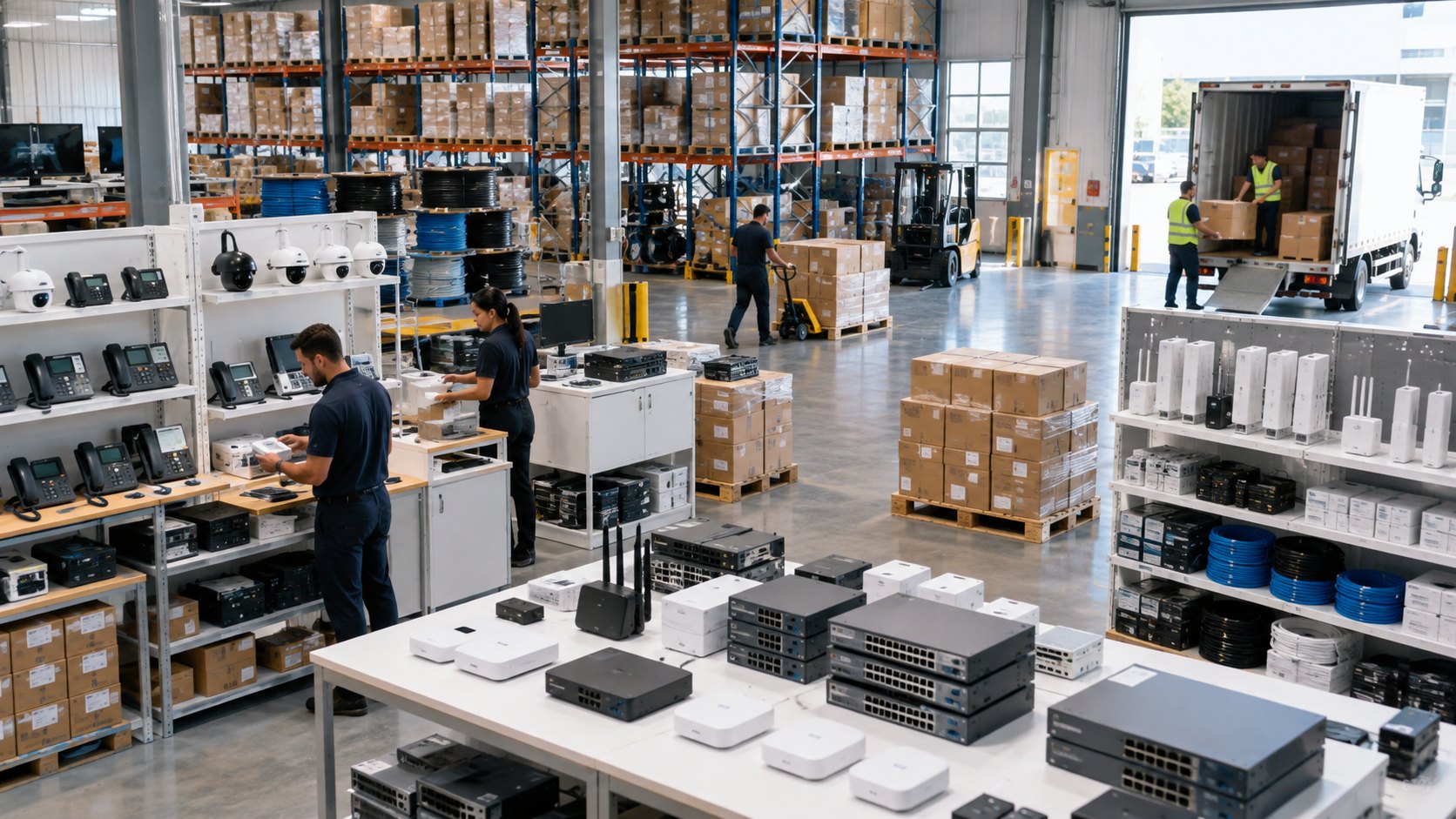
CZ 174 — Electronic and Telecoms Equipment and Parts
The name covers two overlapping families. The telecommunications half is network and transmission equipment: switches, routers, optical line terminals and network units, access points and controllers, radio units and antennas, microwave and satellite equipment, transmission and multiplexing gear, structured cabling systems and the racks, power and cooling that support them. The electronic half reaches industrial and professional electronic assemblies, instruments and control equipment that are not consumer goods.
And then parts, which is the half that pays the bills between projects.
Read the boundary carefully, because two neighbouring lines are held by their own pages and confusing them costs a change to the licence wording later. Consumer electronics — phones, televisions, audio equipment, cameras — is a different activity with a different buyer even though it shares the type-approval question. Telephone and telefax equipment as sold to households and small offices likewise sits on its own line. The distinction that actually works is who installs it: if a technician commissions it into a network, it belongs here; if a customer unboxes it, it probably does not.
three channels, judged on the same seven rows
| Judged on | To a network operator | Through a systems integrator | Direct to an enterprise |
|---|---|---|---|
| The order arrives as a framework or tender | Yes | Sometimes | Rarely |
| Type approval is examined before you are shortlisted | Yes | Yes | Often not, until delivery |
| Stock has to be held to win the order | No | Partly | Yes |
| Installation and commissioning expected from you | Sometimes | No, the integrator does it | Yes |
| Payment terms are set by the buyer | Yes | Yes | Negotiable |
| One win changes the whole year | Yes | No | No |
| Vendor certification of your staff is checked | Yes | Yes | Sometimes |
The middle column is marked because it is the realistic opening for a new company. Operators are the largest prize and the hardest door: they qualify suppliers formally, expect certified staff and audited capacity, and pay on their own terms. Enterprises are reachable immediately but want stock, installation and hand-holding, which is a different company. Integrators sit between the two — they already hold the operator and enterprise relationships, they buy repeatedly, and what they want from a supplier is availability, correct paperwork and equipment that arrives approved and ready to install.
The approval that decides whether you can supply at all
Type approval is the thread through everything on this line, and it is worth being precise about what it is and is not.
It attaches to the equipment, not to the company. Approval is granted for a model, so the correct question is never "are we approved" but "is this model approved, and in what configuration". A supplier can hold every licence in the country and still be unable to supply a particular radio unit.
It is checked where the equipment enters and where it is used. A consignment arriving at the border is cleared by the emirate's customs authority, which treats controlled goods as controlled goods; an operator or a large enterprise will also ask for the paperwork before accepting delivery. There are therefore two independent places a missing approval surfaces, and neither is early.
Not everything in the catalogue is caught by it. A passive patch panel, a rack, a length of copper, a connector or a power rectifier does not transmit and does not attach to a public network. That is why a parts and accessories business is a far shorter route to trading than a radio equipment business, and why many suppliers start there deliberately.
Two further conditions apply to the goods rather than to the radio. Electrical and electronic equipment sold here is subject to national standards and conformity assessment under the federal ministry responsible for industry and standards, which reaches marking, safety and documentation. And a network is not an island: equipment intended to interwork with a public network has to satisfy the operator's own acceptance testing, which is a commercial gate with no government involvement and can be stricter than the regulatory one.
Where this is the wrong purchase: if the plan is to install and maintain networks rather than to supply the equipment, that is a contracting activity and this licence does not describe it. If the plan is to sell handsets or consumer devices, the consumer lines are the right ones. And if the plan is to operate a service over a network rather than to sell the equipment that makes it, that is a licensed telecommunications question of an entirely different kind.
On the structural choice, supplying operators, integrators and enterprises inside the country points at a mainland licence, while using the UAE as a staging base to move equipment onward to other markets is what a free zone arrangement is built for; many suppliers in this sector end up with a view on both. What the licence costs to hold, which emirate suits the plan, and what any specific model needs before it can be imported or supplied all depend on the product list, the premises and the licensing authority — and on this line the product list is the answer, so it is the first thing to bring to the conversation.
References
- Telecommunications and Digital Government Regulatory Authority — type approval for telecommunications and radio equipment, and equipment permitted to connect to public networks. Telecommunications and Digital Government Regulatory Authority
- Ministry of Industry and Advanced Technology — national standards, conformity assessment and marking for electrical and electronic equipment. Ministry of Industry and Advanced Technology
- Dubai Customs — import and export, customs codes, and restricted or controlled goods at the border. Dubai Customs
- Federal Tax Authority — VAT on imported equipment and project supplies, and corporate tax enrolment. Federal Tax Authority
- UAE Government portal — federal law and general government information. UAE Government portal
Elsewhere in Trading
Activities that sit beside this one
Most licences carry more than one activity. Adding a neighbouring line at the application stage costs a fraction of amending the licence afterwards.
Begin with a clear conversation
Tell us what you intend to build.
A consultant will map the structure, jurisdiction, approvals and likely cost against what you actually described — not against a package.
