

Activity CZ 172
How to Start a Computer Hardware Wholesale Business in Dubai
Every machine sold on this line carries a serial number, a warranty tail and a return path, so a hardware wholesaler is holding an obligation as well as an asset.
ConsultZone licensing desk
- Activity code
- CZ 172
- Category
- Trading
- Reviewed
- Read
- 6 min
Listen instead
48 seconds
An audio summary of this guide.
Topic summary
How to Start a Computer Hardware Wholesale Business in Dubai
A serial number is the thing that makes this trade different from selling any other boxed product. Each machine that leaves the store is traceable for the length of its warranty, and for that whole period it can come back — dead on arrival, failed in the first month, or wrong because the buyer ordered the wrong configuration. Cutlery does not return. A laptop does, and the supplier who has not planned for it discovers the cost of that in the second year rather than the first.
This line is hardware only. No software is sold under it, which keeps the business simpler to explain and narrower in what it can invoice. The combined line, CZ 171, adds software to the same shelf and is a different commercial proposition; that page makes its own argument. The case for staying on hardware alone is focus: buying, holding, configuring and supporting physical equipment is a full trade by itself, and doing it well is not a small thing.
CZ 172 — Wholesale of Computers and Computer Peripheral Equipment
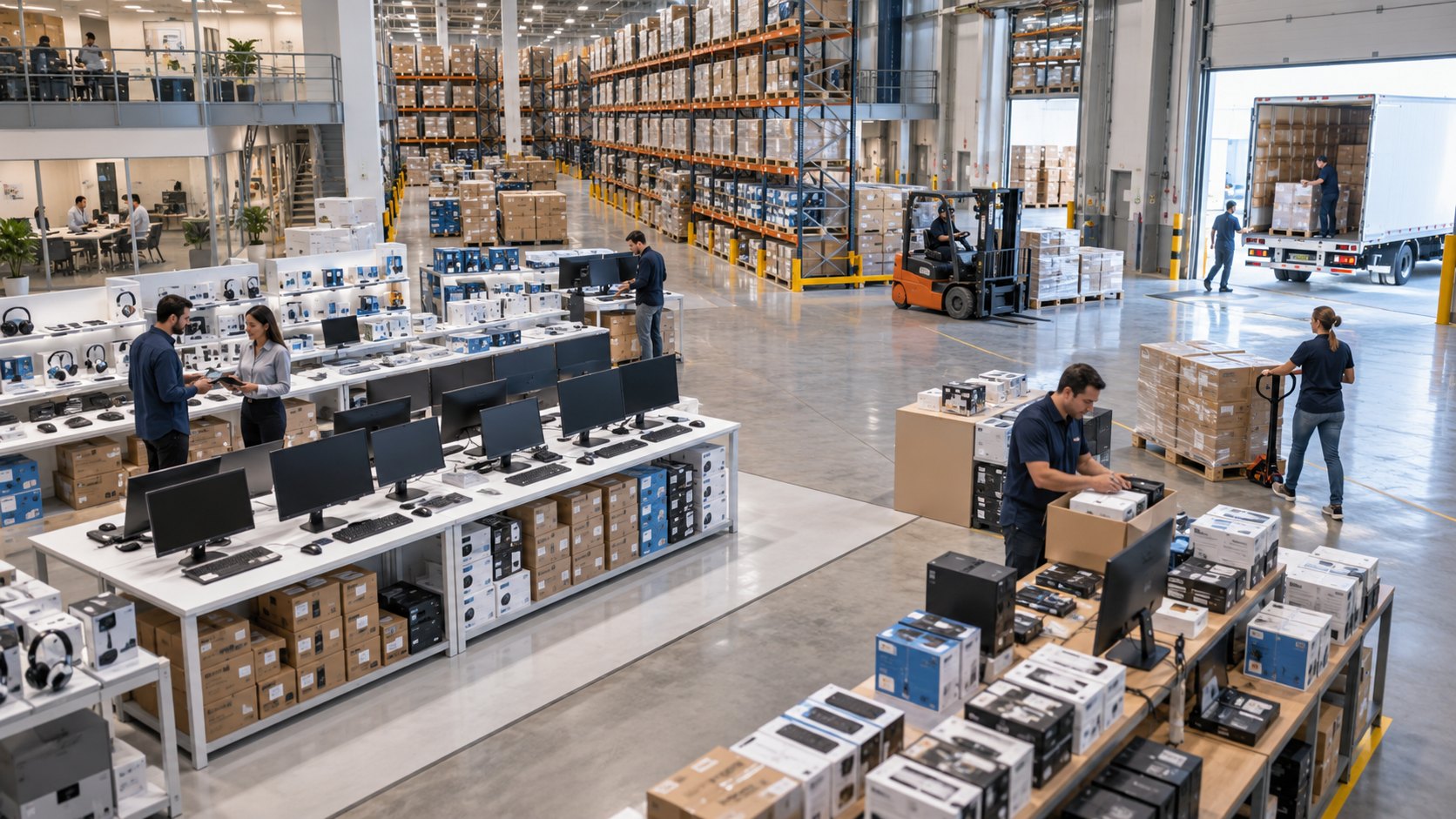
The name reaches two groups. Computers: desktop machines, laptops, workstations, all-in-ones, thin clients and servers. Computer peripheral equipment: monitors, keyboards, mice, printers, scanners, docking stations and port replicators, external and internal storage, uninterruptible power supplies, and the cables, adapters and mounts that make a working desk out of the parts.
Three practical realities govern all of it.
Price erosion runs against you, quietly. A specification does not improve in the store; the price of the newer specification arriving next quarter does. The supplier who buys deep on a good deal and then takes four months to clear it has usually given the discount back without noticing. Depth of buying is the most expensive decision in the business and it is made months before the consequence shows up.
Every unit is a future service event. Dead-on-arrival units, in-warranty failures, mismatched orders and cosmetic damage in transit all arrive back at the same door. Whether the manufacturer reimburses labour, how long a replacement takes, and who carries the freight are commercial terms that vary by brand and matter more to profitability than the headline buy price.
Machines are rarely wanted as they come out of the box. A corporate buyer wants a standard build, the company image, asset tagging, its own name in the setup and often disposal of what the new machine replaces. That work is where a hardware supplier stops competing on price, because a box is comparable between vendors and a delivered, ready-to-use fleet is not.
six kinds of buyer, three ways of serving them
- Small resellers and online sellersThey buy what is available today and will not wait for a container
- Peripherals and consumables — keyboards, mice, cables, cartridgesLow value per line, high frequency, and the buyer expects it the same day
From stock, in small lots
- A corporate fleet refresh of a few hundred machinesThe machines arrive ready to hand to staff, which is most of what is being bought
- Warranty swaps for your own customersA replacement unit has to work on arrival, not merely be in the box
Configured and imaged before delivery
- Schools and government departmentsThe volume is known in advance, so nothing needs to be held speculatively
- Servers and data-centre equipmentSpecified by an engineer, built to order, and never a shelf item
Ordered in against a signed contract
Read the drawing by the middle column. Six buyer types collapse into three ways of working, and the three want different things from the same company: a store that can pick and dispatch today, a bench that can build and image a fleet, and a desk that can read a specification and quote against a tender. Few new entrants do all three at once, and choosing which one to be good at first is the real founding decision.
Four lines that sit next to this one and are not it
CZ 171, computers, peripheral equipment and software. The same physical catalogue with software added. If a single licence is ever going to be sold alongside a machine, that is the line to ask for, because adding it later is a change to the activity wording rather than a change of mind.
CZ 173, software on its own. No machines at all. It appears in the same customer conversation and behaves nothing like this one, having no stock, no freight and no returns.
Consumer electronics. Televisions, phones, audio equipment and cameras belong to their own line and their own page. The overlap is genuine in a shop and clean on paper: a laptop is a computer and a television is not, and the two trades have different buyers, different brands and different sales cycles.
Repair and maintenance of computers. Fixing machines is a service activity. Suppliers who handle their own warranty returns are already doing a version of this work, and the honest time to say so is when the licence is drawn — not during an inspection, and not when a customer asks for a repair invoice that the licence does not support.
Who this line suits
It suits people with a buying temperament. The wins here come from judging quantity, timing and specification correctly, and from terms negotiated with a distributor rather than from persuading a customer to pay more. An operator who enjoys a spreadsheet of stock ageing will do better than a natural closer.
It suits an existing IT services company that has been buying hardware through somebody else. Those firms already hold the customer relationship and the technical staff, so the hardware line captures a margin they were handing away, and the configuration work is already being done in-house.
It suits a supplier with a niche rather than a catalogue: workstations for design and engineering, industrial and rugged machines, point-of-sale equipment, or storage. A narrow range with real depth of knowledge competes on advice, while a broad range with no depth competes on price against everyone in the market.
It suits a business with working capital and patience for tenders if the target is the public sector or a large enterprise, where payment arrives long after delivery and the order is won on evidence of capacity.
Where this is the wrong purchase: if the plan is a shop selling to the public, the retail activity is the one to ask for. If the plan is mainly repair, this licence does not cover it. And if software is part of the offer, take the wider line from the start.
On the structural question, selling to customers inside the UAE market points at a mainland licence, while using the country as a base to move equipment onward to other markets is what a free zone arrangement exists for. What the licence costs, which emirate suits, and what a given consignment needs on entry depend on the product list, the premises and the licensing authority, and are confirmed case by case rather than quoted.
References
- Dubai Customs — import and export, customs codes, and restricted or prohibited goods on entry. Dubai Customs
- Ministry of Industry and Advanced Technology — national standards, conformity assessment and product marking. Ministry of Industry and Advanced Technology
- Telecommunications and Digital Government Regulatory Authority — type approval for radio-bearing equipment, which reaches wireless machines and accessories. Telecommunications and Digital Government Regulatory Authority
- Federal Tax Authority — VAT on imported goods, and corporate tax enrolment and filing. Federal Tax Authority
- UAE Government portal — federal law, consumer protection and general government information. UAE Government portal
Elsewhere in Trading
Activities that sit beside this one
Most licences carry more than one activity. Adding a neighbouring line at the application stage costs a fraction of amending the licence afterwards.
Begin with a clear conversation
Tell us what you intend to build.
A consultant will map the structure, jurisdiction, approvals and likely cost against what you actually described — not against a package.
