

Activity CZ 171
How to Start a Computer and Software Wholesale Business in Dubai
The combined line lets one licence carry the machine and the software that runs on it, which is the difference between a thin hardware margin and wholesale revenue that renews every year.
ConsultZone licensing desk
- Activity code
- CZ 171
- Category
- Trading
- Reviewed
- Read
- 7 min
Listen instead
59 seconds
An audio summary of this guide.
Topic summary
How to Start a Computer and Software Wholesale Business in Dubai
Three lines in this family describe almost the same shelf, and the choice between them decides what a customer can be invoiced for. This is the widest of the three. It reaches the machines, the equipment that hangs off them, and the software that runs on them, all under one licence — and that is not a filing convenience. It is the difference between handing over a box and supplying something that keeps earning after the delivery note is signed.
The arithmetic behind that is blunt. Hardware margin on volume lines is thin and is set by somebody else's price list, not by yours. Software carries a discount structure, an annual renewal and, more and more often, a monthly subscription — and the customer who bought the machine is the same customer who has to renew the licences sitting on it. A supplier holding only one half of that watches the other half invoiced by a competitor, usually to the same buyer, usually on better terms than the box ever gave.
What the line reaches, and why the two halves belong together
Read plainly, the activity name covers three groups of things. Computers: desktops, laptops, workstations, servers, thin clients. Computer peripheral equipment: monitors, keyboards and mice, printers and scanners, docking stations, external storage, and the cables and adapters that join it all up. And software, which is not an object at all but a permission to use something, granted for a period or in perpetuity by whoever owns it.
Two narrower lines sit beside this one. CZ 172 takes computers and peripheral equipment without the software; CZ 173 takes software on its own. Both are sound choices and both are described on their own pages. The argument for the combined line is a document, not a discount: a quotation that prices the machine, the operating system, the productivity suite, the endpoint protection and the backup tool as one delivered outcome is a different proposition from a hardware quotation with a note telling the buyer to sort the rest out for themselves.
The trap is treating the second half like the first
The two halves behave nothing alike in the business. Hardware is bought, held, counted and depreciated; a pallet in the store is capital that is not working and is worth less each quarter. Software is bought against a specific order, often issued electronically on the same day, and there is no store at all. One half rewards accurate forecasting and warehouse discipline. The other rewards accreditation, renewal tracking and the habit of never selling an entitlement you cannot prove you bought.
Operators who come up through hardware tend to run the software side as an afterthought and lose renewals they never diarised. Operators who come up through software tend to underestimate how much working capital a fleet order swallows. Holding both halves is an advantage only if both are actually run.
five choices, weighed on the same two questions
What it givesWhat it costs
- Quoting the machine and its licences as one delivered outcomeA larger order, and a renewal conversation next yearA support obligation that outlives the sale
- Quoting hardware alone to win on priceA short sales cycle and an easy yesSingle-digit margin, and nothing after delivery
- Taking a publisher's reseller appointmentAccess to the licence, and a price the open market cannot reachTargets, accreditation and staff who must stay certified
- Buying hardware on allocation from a distributorStock in hand when a fleet order landsCapital standing in a range that ages from the day it arrives
- Buying only against a confirmed orderNo obsolescence risk at allLost orders, because the buyer who waits is rare
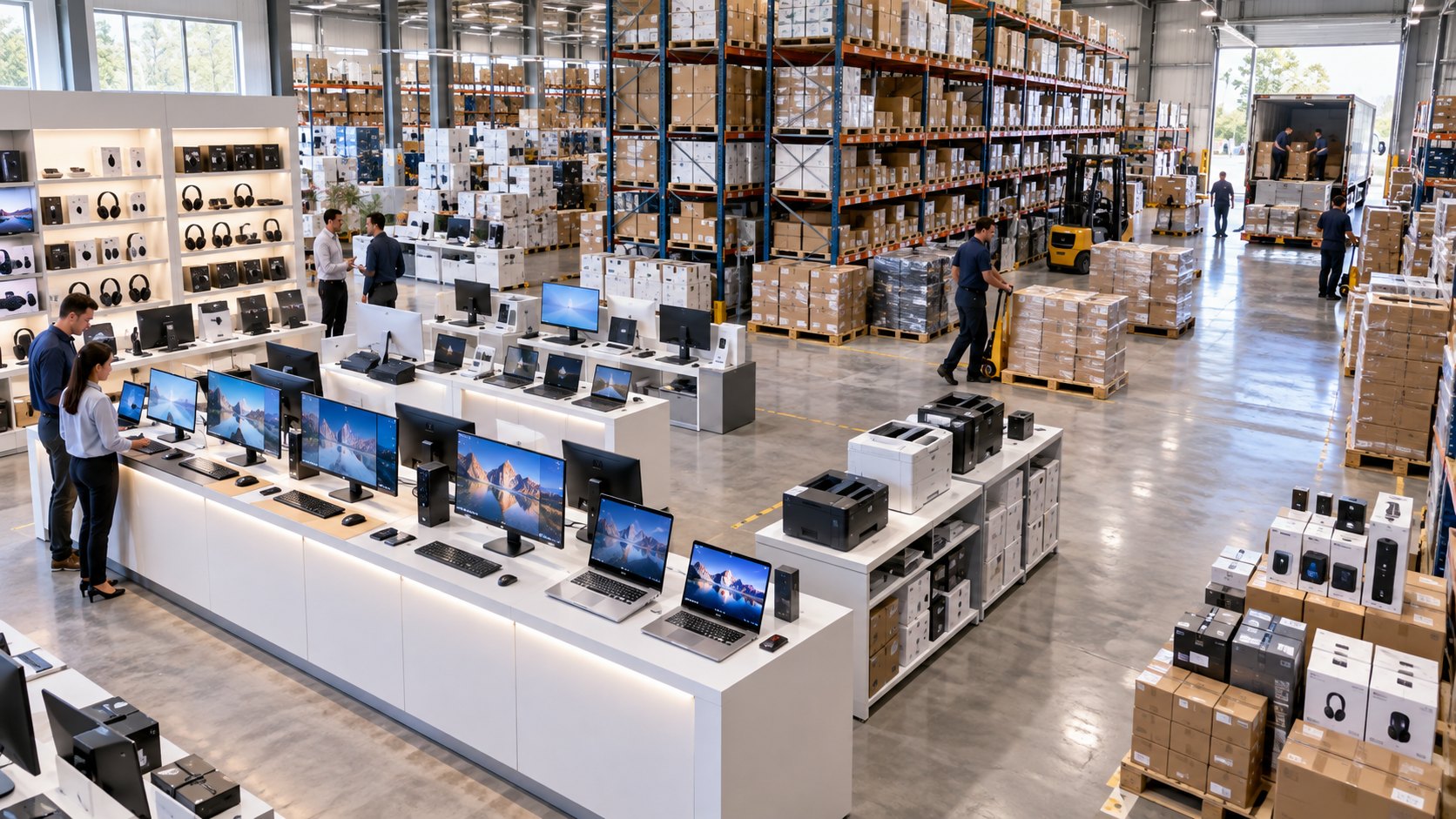
The buyer is an IT department, and it buys differently from a shop
Corporate IT is the centre of this market. It replaces machines in waves rather than one at a time, it wants identical specifications across a fleet so that support stays sane, and it cares more about a model still being available in nine months than about the price this week. It also buys the software in the same conversation, which is the whole reason this line exists.
Schools, universities and clinics behave similarly but on an academic or budget calendar, so the order is predictable and the delivery window is not negotiable. Government and semi-government departments buy against tenders and framework arrangements, where evidence of capacity and after-sales support counts for more than being cheapest. Smaller resellers and system builders buy in small lots, frequently, and expect availability today. Managed service providers are the most valuable buyer of all, because they buy on behalf of dozens of end customers and consolidate both halves of the catalogue into one recurring order.
The structural question about the route to those buyers is the ordinary one. Selling to customers inside the UAE market points at a mainland licence; using the UAE as a base to move goods onward to other markets is what a free zone arrangement is built for. Which suits a particular plan depends on where the buyers actually are, and it is worth settling before the licence is drawn rather than after.
There is a second gate on that route which no government body controls. Publishers decide who may resell their software, and distributors decide who gets hardware allocation. An appointment brings pricing, technical backing and the right to put the product's name in a quotation. Without one, a trader is buying whatever the open market offers that week and cannot honestly promise a customer anything about continuity.
What attaches to the goods, and what attaches to the licences
On the hardware side the obligations are the familiar ones for imported equipment. Consignments clear through the emirate's customs authority under the importer's own code, and consumer-facing goods carry conformity marking and labelling expectations that sit with the federal ministry responsible for industry and standards. Anything in the catalogue with wireless in it — and a modern laptop, a wireless keyboard and a printer with Wi-Fi all qualify — falls into the class of radio-bearing equipment that meets type approval from the federal telecommunications and digital government regulatory authority. Approval is granted against an equipment model, so it is a question about what you have chosen to buy rather than about your trading name.
On the software side there is no border and no consignment, and the exposure moves to intellectual property. A seller is expected to be able to show, for any entitlement sold, where it was bought and that it was bought for this market. A publisher's audit is a routine commercial event for an appointed reseller and an existential one for a trader with no paper trail. Electronic delivery also raises its own tax question, because a licence emailed to a buyer is not a consignment crossing a border, and the treatment follows from what was actually supplied rather than from the product name on the invoice.
Where this is the wrong purchase: if the plan is to sell to the public from a shop, ask for the retail activity. If the plan is to repair machines, that is a service line. And if no software will ever be sold, the narrower hardware line is cleaner and easier to explain to a buyer.
What the licence costs to hold, which emirate suits the plan, and what any particular model needs before it can be imported all depend on the product list, the premises and the licensing authority. Those are confirmed case by case rather than quoted — and on this activity it is the product list that decides most of the answer.
References
- Telecommunications and Digital Government Regulatory Authority — type approval for radio-bearing and telecommunications equipment. Telecommunications and Digital Government Regulatory Authority
- Ministry of Industry and Advanced Technology — national standards, conformity assessment and product marking. Ministry of Industry and Advanced Technology
- Dubai Customs — import and export, customs codes, and restricted or prohibited goods. Dubai Customs
- Federal Tax Authority — VAT treatment of imported goods and of services supplied electronically, and corporate tax enrolment. Federal Tax Authority
- UAE Government portal — federal law on intellectual property and copyright, and general government information. UAE Government portal
Elsewhere in Trading
Activities that sit beside this one
Most licences carry more than one activity. Adding a neighbouring line at the application stage costs a fraction of amending the licence afterwards.
Begin with a clear conversation
Tell us what you intend to build.
A consultant will map the structure, jurisdiction, approvals and likely cost against what you actually described — not against a package.
