
Activity CZ 15
How to Start a Label and Tag Printing Business in Dubai
A label is a component, not a print job — bought by procurement on a schedule, against a specification. Why the process choice is the whole economics, and whose approvals attach to the label.
ConsultZone licensing desk
- Activity code
- CZ 15
- Category
- Manufacturing
- Reviewed
- Read
- 7 min
Listen instead
52 seconds
An audio summary of this guide.
Topic summary
How to Start a Label and Tag Printing Business in Dubai
Nobody buys a label. A brand owner buys a bill of materials, and one line on it is a roll of self-adhesive stock that has to arrive on Tuesday, scan at the till, stay stuck to a chilled bottle and carry every declaration the product is obliged to carry. That is the whole distance between this trade and the rest of printing: the customer is not buying an impression, they are buying a component their own production line stops without.
It follows that the buyer is not in marketing. Artwork may come from marketing, but the purchase order comes from procurement, the specification comes from packaging engineering, and the rejection comes from quality control at goods-in. Those three read a label as a part number with a tolerance, and they behave accordingly: they qualify a supplier slowly, they re-order on a forecast, and they do not switch on price alone, because switching means re-qualifying. For a new entrant that cuts both ways. The accounts are hard to win and, once won, hard to lose.
The money is in tooling, not in ink
Four process families are named in the activity itself, and the choice between them is not a technical preference. It is the entire economics of the business, because each one front-loads a different amount of cost before the first good label comes off the machine.
Lithographic and gravure work carry the heaviest entry cost per design — a set of plates, or a set of engraved cylinders, one for each colour, for each version of each product. Flexographic work carries a lighter plate cost and is what most self-adhesive roll production anywhere is built around. Digital work carries no tooling at all: artwork goes from a file to a printed roll with nothing in between, and pays for that freedom with a higher cost on every label it produces.
So the question that decides a label business is not which process is best. It is where the crossover falls for the work actually in front of you — the run length at which spreading a plate cost across the order becomes cheaper than paying a premium on each label. Long runs of one unchanging design sit a long way on one side of that line. Short runs of many versions sit a long way on the other, and a shop that owns only one kind of machine will quote half the market badly.
Versioning is also the structural feature of this particular market. A product sold in the UAE commonly carries Arabic and English on the same face, a local importer's details, batch and date coding, and artwork revised more often than anybody plans for. Every one of those is another version, and a version is what punishes tooling. That is the honest argument for how a new label business enters: digitally, on the short and versioned work the plate-based shops quote reluctantly, moving a design onto flexographic production once its volume has earned the plates.
judged on the same five rows
| Judged on | Digital | Flexographic | Gravure |
|---|---|---|---|
| Tooling before the first good label | None | A plate per colour | An engraved cylinder per colour |
| Where it earns its keep | Short runs, many versions | Medium to long runs | Very long runs of one design |
| Revising the artwork mid-year | Change the file | New plates | New cylinders |
| Batch and date coding in the same pass | Yes | Usually a second process | A second process |
| Cost carried by each individual label | Highest | Lower | Lowest |
CZ 15 — Printing on labels or tags
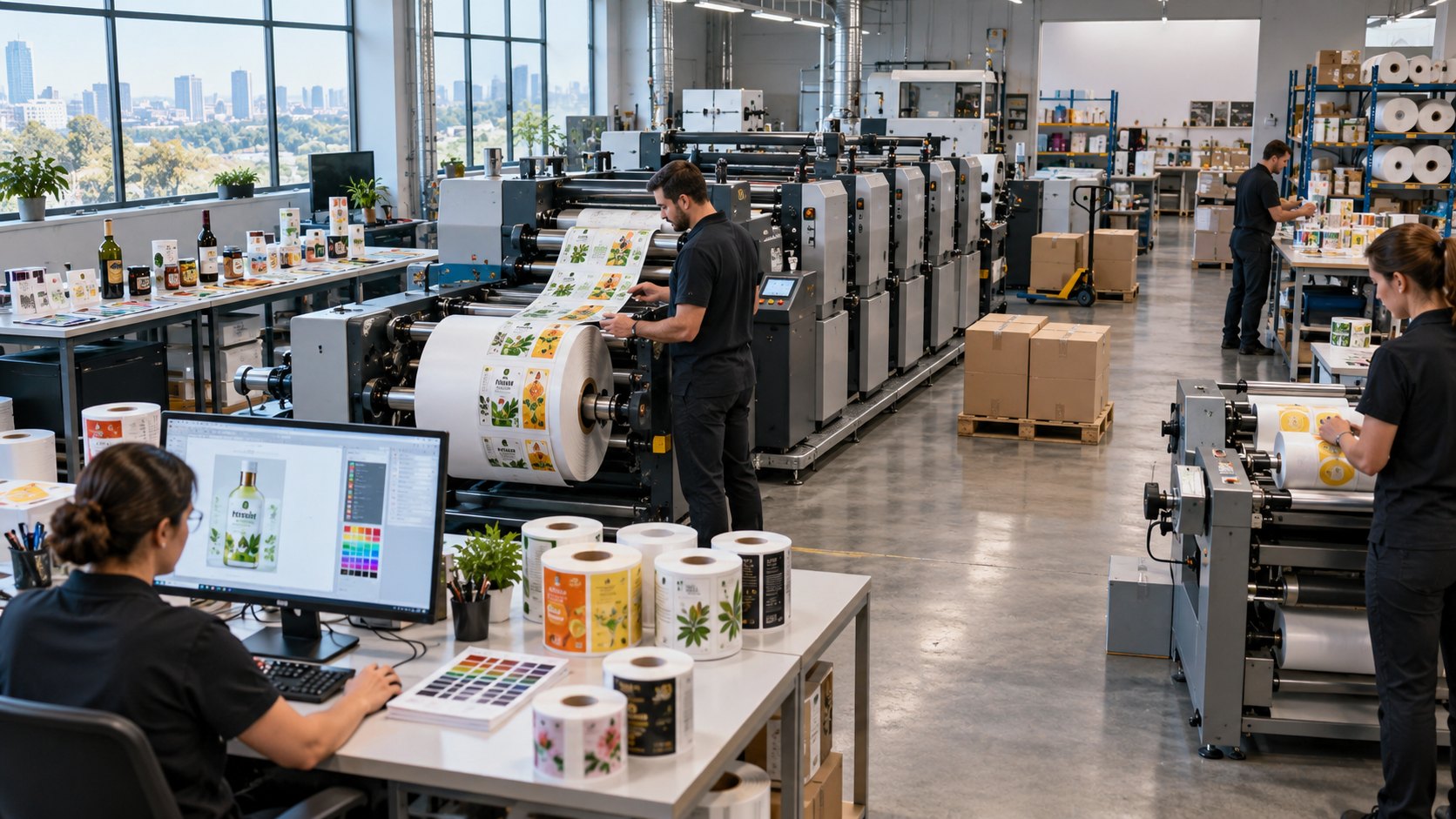
The activity's own name lists processes rather than products, which is a useful reminder that a label shop is defined by the machines standing in it. Read plainly, it covers printing labels and tags by lithographic, gravure and flexographic means, and by anything else that does the job.
Lithographic
Offset printing, usually sheet-fed for label work. It is where fine tonal images, close colour matching and cut-and-stack wet-glue labels are done well — the classic application being a beverage or preserve label applied by a gluing machine rather than peeled off a liner.
Gravure
An image engraved into a cylinder. The cylinder is expensive and effectively permanent, which makes the process wrong for almost everything and very hard to beat at the one thing it is right for: enormous runs of a design that will not change, printed on thin film.
Flexographic
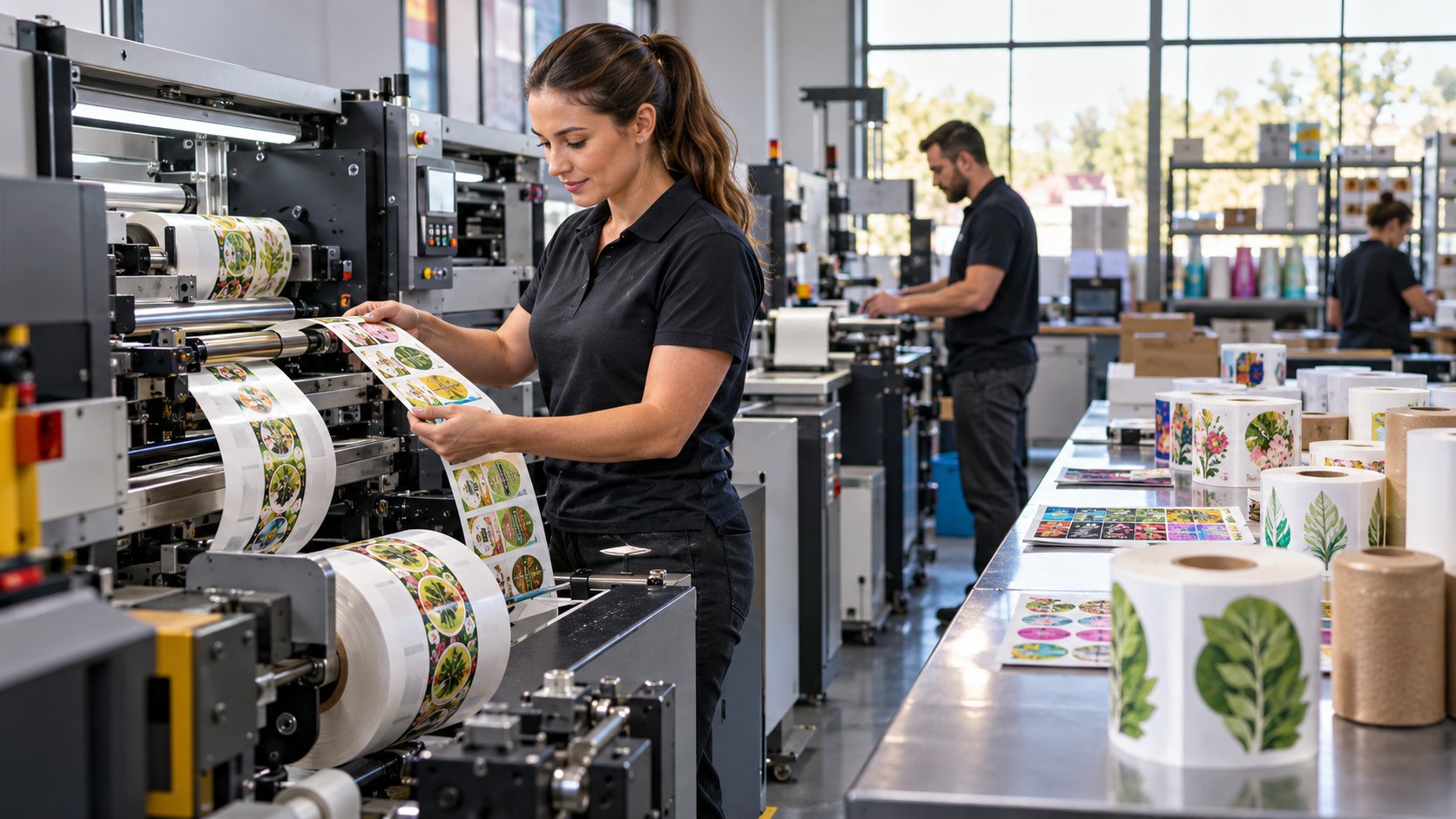
A flexible relief plate on a rotary press running reel to reel, printing and laminating and die-cutting and rewinding in a single pass. This is the workhorse of self-adhesive label production and the shape most converting lines take.
Other
Everything the bracket leaves room for, and the half of the market that has grown: digital toner and inkjet presses, screen printing for heavy opaque deposits and tactile effects, letterpress and hot foil for decorative and security features, and thermal transfer overprinting for the variable data a warehouse adds after the label itself is finished.
Tags are a different product on the same licence
A tag is not a label. It is not stuck to anything — it is strung, pinned, looped or hung, which means it is printed on board rather than on self-adhesive stock and finished by punching, eyeletting and stringing rather than by die-cutting on a liner. Garment tags, price tickets, luggage tags, plant labels and inspection tags all sit here. The finishing equipment differs enough that a shop good at one is often mediocre at the other, and it is worth deciding which of the two the plan is really about before buying a machine.
Most of the approvals attach to the customer's product, not to your press
This is the part of the trade that surprises people, and read the right way it is good news. A label printer is rarely the party a regulator is interested in. The requirements sit on the goods the label goes onto, and they belong to the brand owner. The printer's obligation is to print what has been approved, exactly, and to be able to show which version was printed.
Where the goods are controlled, the artwork is controlled
A food label carries the declarations food control requires of the product, and food control in Dubai sits with the municipality.¹ Medicines, medical devices and health products are labelled under the requirements of the authority that approved the product itself, federally the Ministry of Health and Prevention.² Some goods additionally carry marks required by a federal tax scheme rather than by their owner, and excise is the Federal Tax Authority's remit.³ In none of those cases does the printer apply for anything. In all of them, printing a superseded version of the artwork — or a corrected one before it has been approved — creates a problem for the customer that the customer bills back.
The conditions that do attach to you
Three, and they are practical in origin rather than regulatory. The raw material is almost entirely imported — self-adhesive laminate, films, foils, inks, varnishes and cores — which means a customs code held in the company's own name and an understanding of how each material is treated on arrival.⁴ Solvent-based inks and washes on a flexographic or gravure line are flammable, and how they are stored on the unit is a fire safety approval rather than a licence condition. And the manufacturing side of the licence sits inside the federal framework for industry, national standards and conformity marking held by the Ministry of Industry and Advanced Technology.⁵
The gate nobody calls an approval
A barcode that will not verify is turned away at a customer's goods-in as firmly as a missing declaration, and the cost of that is the whole delivery plus whatever the stopped line behind it is worth. Verification equipment, and the discipline to use it on every job rather than on every complaint, is not a legal requirement anywhere. It is the most common single reason a label supplier loses an account it had already won.
Where this is the wrong purchase. If the intention is to import finished labels and resell them to converters and brand owners, this activity is the wrong shape. It is a manufacturing line with premises and material conditions attached, and a trading activity carries the same business at a fraction of the fixed cost.
References
- Food control and the declarations required of food products sold in Dubai. Dubai Municipality
- Labelling of medicines, medical devices and health products, controlled through the approved product rather than through the printer. Ministry of Health and Prevention
- Excise tax and the marking of excise goods. Federal Tax Authority
- Import of self-adhesive laminate, film, foil and ink, and the customs code an importer holds in its own name. Dubai Customs
- National standards, conformity marking and the federal industrial framework behind a manufacturing licence. Ministry of Industry and Advanced Technology
Elsewhere in Manufacturing
Activities that sit beside this one
Most licences carry more than one activity. Adding a neighbouring line at the application stage costs a fraction of amending the licence afterwards.
Begin with a clear conversation
Tell us what you intend to build.
A consultant will map the structure, jurisdiction, approvals and likely cost against what you actually described — not against a package.
