

Activity CZ 18
How to Start a Fine-Art Printmaking Workshop in Dubai
Printmaking is a workshop-and-reputation trade rather than a scalable one. What the litho stone and woodblock line covers, who buys a hand-pulled edition, and what the chemistry demands.
ConsultZone licensing desk
- Activity code
- CZ 18
- Category
- Manufacturing
- Reviewed
- Read
- 8 min
Listen instead
42 seconds
An audio summary of this guide.
Topic summary
How to Start a Fine-Art Printmaking Workshop in Dubai
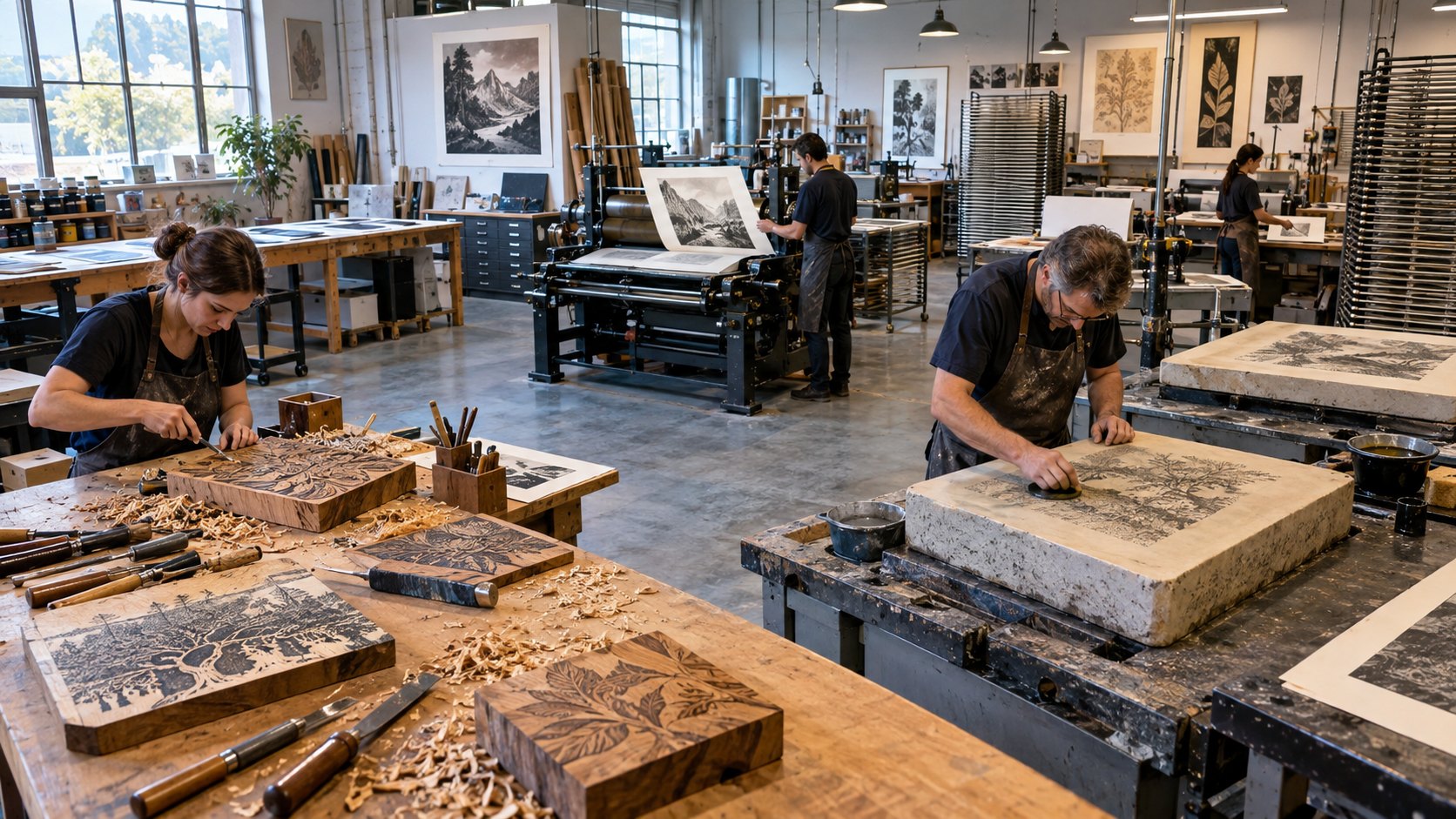
A litho stone is a slab of limestone, and preparing one means grinding its face flat with abrasive and a levigator until it is true, then graining it to the texture the image needs. A woodblock is a plank, seasoned and surfaced, cut away by hand so that what is left holds the ink. Neither is a consumable. A good stone is reground and worked again for decades, and the skill of bringing one back is itself a service somebody will pay for.
That is the whole difference between this line and every other printing activity in the catalogue. Elsewhere the point of the exercise is that the ten-thousandth copy is identical to the first. Here the point is that each impression is slightly not, and the buyer is paying for exactly that. Nobody orders a hand-pulled lithograph because it is the efficient way to make a picture.
Be clear-eyed about what follows. Output is bounded by hands and hours, and no purchase relieves that, because the machine is the thing the collector is paying not to have been used. A workshop of three does not become a workshop of thirty; it becomes a better-known workshop of three, charging more. Revenue per hour rises with reputation and with almost nothing else, and reputation here is built over years in a market that is small, well informed and quick to notice a corner cut. This is a craft business holding a licence, not a manufacturer with an artistic flavour.
What the line actually covers
Two distinct things sit under one activity name, and they sell to different people.
The first is making the work: drawing or cutting an image onto stone, block, plate or screen, etching and gumming it, proofing, and pulling an edition by hand. Lithography, relief printing from wood or linoleum, intaglio, monotype and screen work all belong here. What leaves the studio is a numbered edition and the artist's account of how it was made.
The second is preparing the matrices, and the activity name puts it first for good reason. Grinding, levelling and graining stones to a specified tooth; sourcing, seasoning, surfacing and squaring blocks; recovering a stone that has been worked and is wanted back in a neutral state. Artists and teaching studios across the region buy that work, because doing it properly needs a bench, water, several grades of abrasive and an afternoon nobody making pictures wants to spend. It is unglamorous, it repeats, and it pays more dependably than the editions do.
A third strand sits beside them and is a separate permission rather than part of this one: teaching. Courses, studio access and short workshops are, for many printmakers, the steadier half of the income, and the activity wording has to carry it before a class is charged for. The same is true of selling finished work over the counter from the same premises.
The buyers, and the route to them
This market is small enough to list, which is unusual in this catalogue and worth using as a planning tool rather than reading as a discouragement.
Artists and other printmakers buy prepared stones, blocks and press time. They are the most dependable customers in the trade, because the need recurs and the alternative is to do the grinding themselves.
Collectors buy the editions, and almost never straight from the studio. The route runs through a gallery, a fair or a dealer who already holds the relationship, and the commission that route takes is the price of reaching a buyer at all.
Galleries and cultural foundations commission editions, sometimes for a collection and sometimes as an edition sold to fund a programme. Dubai's gallery quarter and the emirate's fair calendar are the practical way to both, and they run on a season rather than on enquiries.
Specialist and artists' book publishers commission small runs where the printing is the point of the object. Volumes are tiny, the terms are collaborative, and the work travels — a reputation earned on one book reaches an audience the local market never will.
Interior designers, hotels and developers are the one route on this list where volume exists. A hospitality project wanting original work in a hundred rooms is a real commission, and it is also the one most likely to end in an argument about whether an edition of a hundred is still original. Settle that in the brief, in writing, before a stone is grained.
What ties all five together is provenance. An edition's value rests on an account nobody can reconstruct afterwards: how large the edition is, which impression this one is, that the artist signed it, and that the matrix was cancelled or cleaned when the edition closed. That is not paperwork attached to the product. For a collector it is a large part of the product, and a studio that keeps it carelessly has destroyed value it cannot put back.
Conditions attach to the chemistry and the timber, not to the picture
Nothing about an original print is controlled goods. What draws conditions on this activity sits at either end of the bench.
The chemistry comes first. Lithography runs on a dilute acid etch, gum arabic, oil-based inks, litho varnish and solvents for cleaning; intaglio adds mordants; screen work adds emulsions and strippers. Corrosive and flammable material held in a working space is a fire-safety matter judged on the premises themselves, and extraction over a bench where acid is worked is a health condition rather than a comfort. Spent etch, contaminated rags and waste ink leave as controlled waste on a route the municipality accepts, not into a bin in the yard.
The materials come second, and they are heavier and slower than anybody plans for. Limestone slabs and seasoned blocks arrive as freight, under a customs code held in the company's own name. Some hardwoods are restricted at the border under international controls on trade in endangered species, so a block of a particular timber is a clearance question before it is a shopping one. A stone or block old enough to be an antique in its own right can raise a cultural-property question on entry, which is far better answered before a shipment is booked than after it is held.
six gates, and the two bodies that hold four of them
The emirate's economic department
- What the licence says may be sold — editions, prepared matrices, or bothSettled first, because it decides which half earns
- Teaching a class, or selling finished work from the premisesEach is an addition to the wording, never an assumption
The municipality
- A workshop unit with extraction, and where the spent etch goesAnswered with the tenancy
The civil defence authority
- Acid, solvent and oil-based ink held on the premisesAt sign-off, before the first stone is grained
The emirate's customs authority
- Limestone slabs and blocks arriving as freightAfter the licence is cut, and slower than most plans allow
- A hardwood restricted at the borderBefore the block is ordered
Two bodies hold four of those six, and that shape is the useful thing in the drawing. The licensing authority decides what may be sold, so the wording deserves more attention than the premises; and the customs authority decides whether the material arrives at all, which is the gate that most often surprises a workshop that budgeted for stone and not for its clearance. What each condition requires, and what it costs to satisfy, depends on the emirate and on the authority issuing the licence, and those are points we confirm for the specific workshop rather than in general.
Staffing deserves a sentence, because this trade is unusual in it. A printer who can pull a consistent edition is scarce anywhere, and here that person usually has to be brought in, which puts the work permit and the contract through the federal labour ministry and makes the size of the premises a limit on the studio's output as well as on its rent.
Where this is the wrong purchase. If the intention is to produce pictures in quantity — giclée reproduction, poster work, framed prints for retail — this is not the line. That is printing, it wants a press and industrial premises, and a craft licence bought to do it carries the conditions of a workshop without the permission to run a print shop.
References
- Dubai Municipality — premises suitability for a workshop, extraction over an acid bench, and the disposal route for spent etch and contaminated waste. Dubai Municipality
- Dubai Civil Defence — fire-safety conditions on solvents, oil-based inks and corrosive materials kept in a working studio. Dubai Civil Defence
- Dubai Customs — importing limestone slabs and blocks, restricted timber species, and goods of cultural interest. Dubai Customs
- Ministry of Human Resources and Emiratisation — work permits and contracts for a skilled printer brought in from outside the country. Ministry of Human Resources and Emiratisation
- UAE Government portal — how a mainland licence and a free zone licence differ in what may be sold inside the UAE market. UAE Government portal
Elsewhere in Manufacturing
Activities that sit beside this one
Most licences carry more than one activity. Adding a neighbouring line at the application stage costs a fraction of amending the licence afterwards.
Begin with a clear conversation
Tell us what you intend to build.
A consultant will map the structure, jurisdiction, approvals and likely cost against what you actually described — not against a package.
