
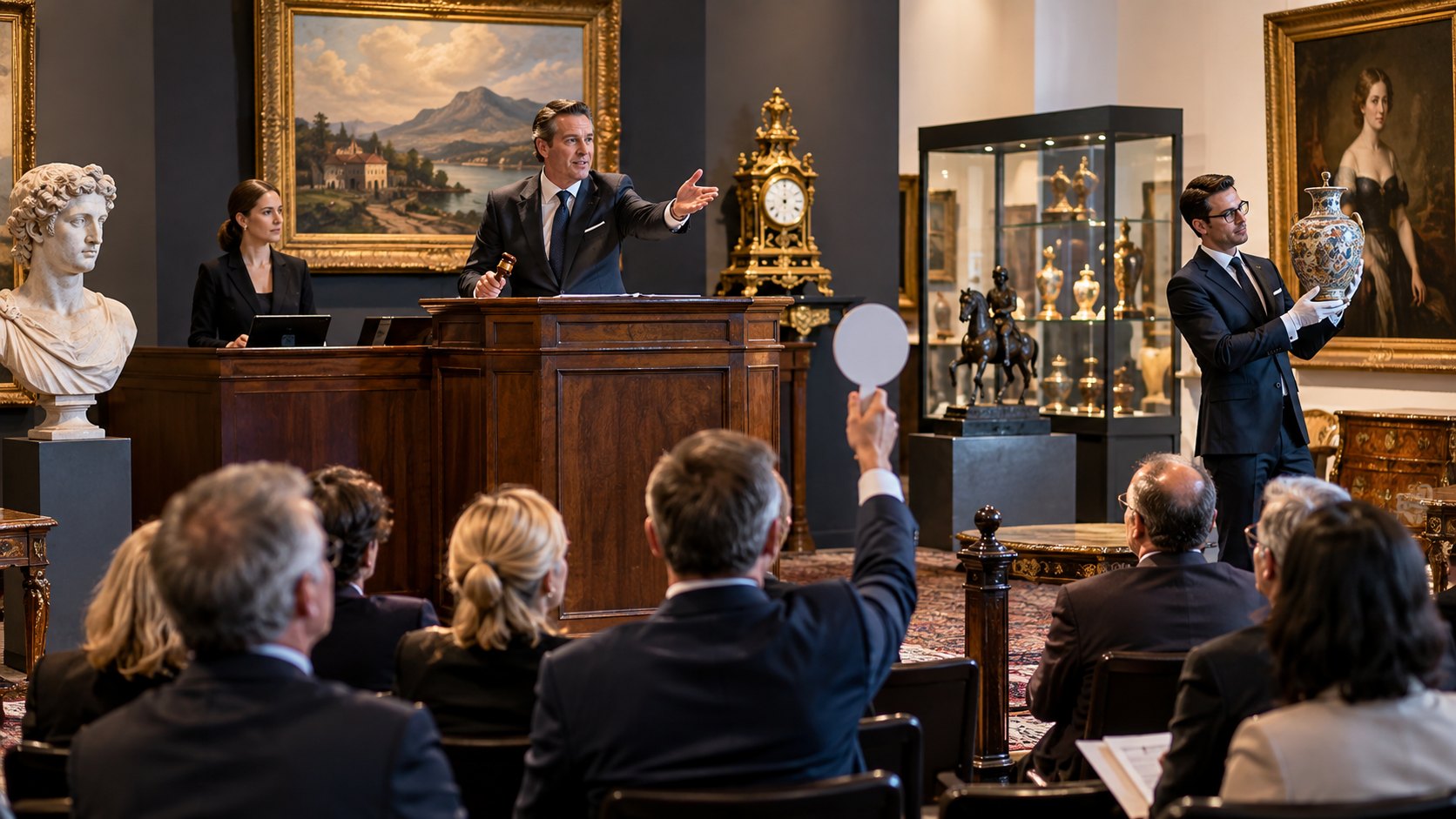
Activity CZ 98
How to Start an Authentic Artifacts & Antiques Auction House Business in Dubai
An antiques auction house lives on the lots it turns away. Authenticity, title and cultural property decide what may be catalogued, and the wording of a description is where the liability sits.
ConsultZone licensing desk
- Activity code
- CZ 98
- Category
- Trading
- Reviewed
- Read
- 8 min
Listen instead
38 seconds
An audio summary of this guide.
Topic summary
How to Start an Authentic Artifacts & Antiques Auction House Business in Dubai
The lots this house refuses are the ones that decide whether it survives. A bronze with no history before last year, a signed painting whose owner cannot say where it was bought, a carved box with an ivory inlay, a manuscript leaf that arrived in a suitcase — every one of them will find a bidder, and each of them can end a company. The specialist antiques house is the only line in this catalogue where saying no to revenue is the core competence rather than a compliance overhead.
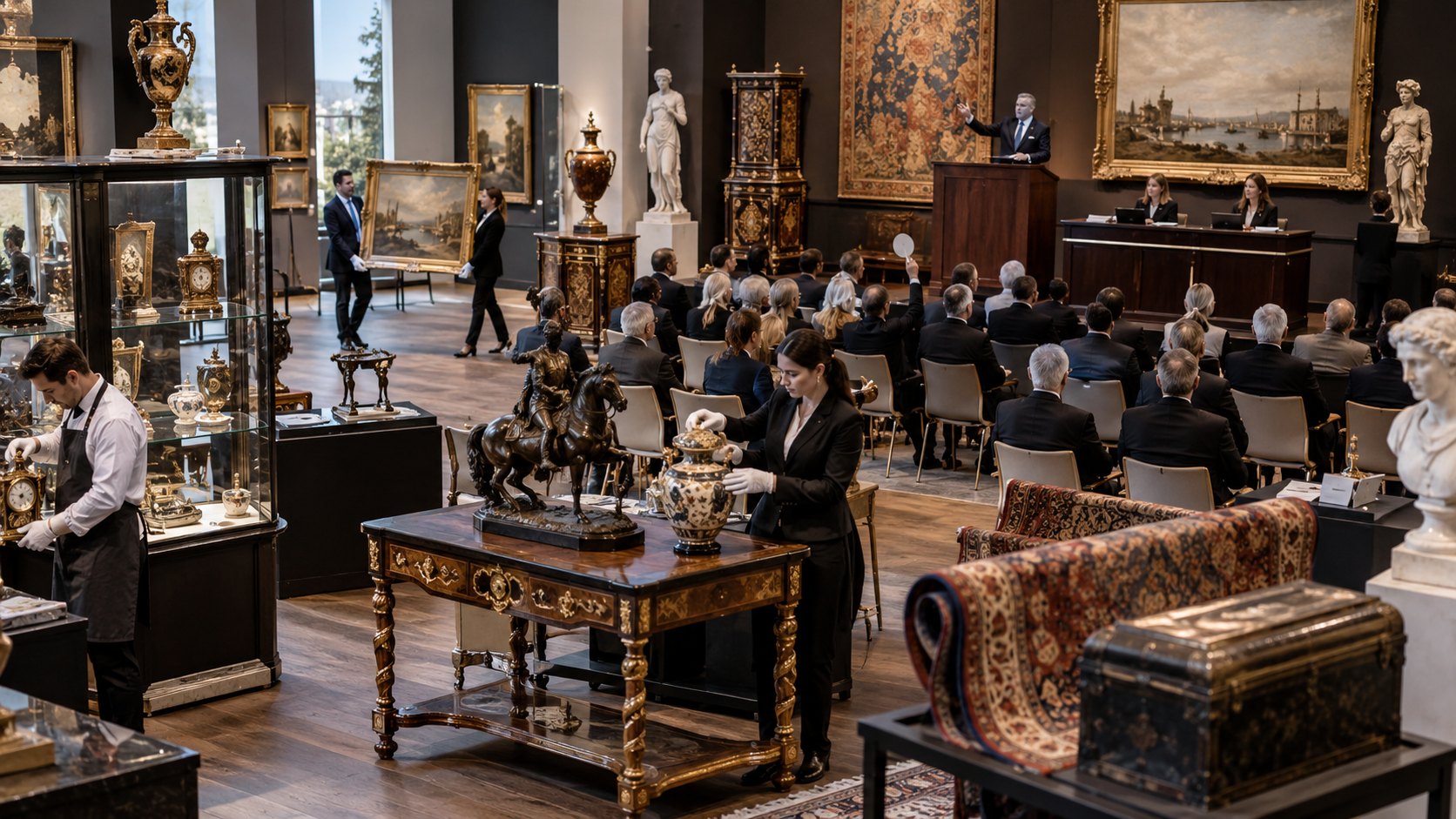
Everything else about it is ordinary saleroom work. The consignment, the catalogue, the hammer, the settlement and the payout run exactly as they do in a general hall, and those mechanics are set out in the auction hall guide in this catalogue rather than repeated here. What follows is the part that applies only to this line, which is the part that takes three years to learn and one lot to get wrong.
CZ 98 — Authentic Artifacts & Antiques Auction House
Three questions have to be answered before an item is photographed, and the order matters because a failure on the third makes the first two irrelevant.
Is it what it is said to be?
Attribution is an opinion, and the catalogue is the place that opinion is stated on the record. This is why the trade's descriptive vocabulary is so precise and so widely misunderstood: a piece described as by a named maker is a different commercial and legal proposition from one described as attributed to them, which is different again from in the manner of, after, school of or bearing the mark of. Those formulas are not hedging. They are the boundary between a warranty the house has given and an opinion it has expressed, and a specialist saleroom that blurs them to lift a price has quietly issued a guarantee it cannot honour.
Reaching the opinion is real work and it is bought in. Condition reports, material and construction analysis, comparison against recorded examples, and a specialist's judgement on a signature, a mark, a glaze or a weave are what the house pays for out of its commission. A house that relies on the consignor's account of what a thing is has no product to sell.
May the consignor sell it?
Ownership history is the second question, and it is the one that most affects the price. An object with documentation — an invoice, an old catalogue entry, an inventory, a photograph in a family house, a probate schedule — commands a premium for reasons that are entirely rational: the buyer is paying for a history they will one day have to produce themselves. An object with no history is not automatically stolen, but it is automatically worth less, because the next seller inherits the same problem.
The house's own protection is a written warranty of title from the consignor, and the absolute refusal to lot anything the consignor will not sign that warranty for. A complaint from a buyer about ownership does not travel to the consignor; it arrives at the counter that took the money.
May it be traded at all?
Some material cannot be sold whatever the paperwork says, and this is where a specialist house is exposed in a way a general hall is not. Archaeological material and antiquities removed from a country of origin, items taken during conflict, and protected cultural property cannot acquire a legitimate history by passing through a saleroom — the catalogue entry is evidence against the house rather than cover for it, and the UAE participates in the international framework against the illicit trade in cultural objects.
Protected animal material is the trap that catches decorative objects rather than antiquities, and it catches them constantly. Ivory, tortoiseshell, rhinoceros horn, certain corals, and skins and feathers from protected species appear in nineteenth and twentieth-century furniture, fans, cutlery, instruments, jewellery and taxidermy. Trade in that material is controlled under the international convention on trade in endangered species, which in the UAE is administered by the federal environment ministry, and age alone does not release an object from the control. The practical rule in a saleroom is that the moment ivory or shell is identified in a lot, the lot stops moving until the position is established in writing.
six kinds of consignment, three destinations
- A piece with unbroken ownership history and documentsNothing is in doubt, so the only question left is the estimate
- A household estate with invoices, photographs and a probate scheduleThe history arrives with the furniture
Straight into the catalogue
- A decorative object containing ivory, tortoiseshell or coralProtected material is controlled whatever the object's age, and that control sits outside the saleroom
Held until the wildlife position is settled
- A signed piece the consignor cannot documentAn attribution is an opinion, and the wording is the liability
Held, and described only as far as the evidence reaches
- An antiquity with no history before last yearCultural property does not acquire a history from a catalogue
- Anything the consignor will not warrant they ownThe buyer's complaint arrives at your counter, not theirs
Declined
Read the destinations rather than the rows. Only two of six go straight to the catalogue, and a specialist house that finds nearly everything landing in the first column is not being efficient — it is not asking. The middle destination is where the business actually lives: most good material is held for weeks while somebody establishes a fact, and the willingness to carry that delay is what a consignor is paying the commission for. The two declines are the cheap ones, and they are cheap only because they happened before the lot was catalogued.
Adjacent lines people confuse with it
The general auction hall. The same room and the same process, applied to plant, vehicles, furniture and stock. A machinery sale needs a clear title and a working engine; it does not need a view on a signature. A house that drifts between the two ends up applying general standards to material that requires specialist ones, and the direction of drift is always the same.
The antiques dealer or gallery. A dealer buys stock, owns it, holds it and sells at a price of their choosing. The house never owns the object and takes a share of somebody else's sale. Different balance sheet, different risk, different licence line — and a house that starts buying lots in has become a dealer wearing a saleroom's name.
Valuation and appraisal services. Selling an opinion rather than a sale: probate, insurance, division of an estate, collateral. Many houses offer both, and the conflict is structural rather than theoretical, because a figure you wrote is a figure you then earn a commission against. Where both are offered, they need separating in writing and in fee structure.
Fine-art logistics and storage. Crating, climate-controlled storage, installation, transport and customs handling. Every serious house uses one; almost none should be one, because the two businesses have nothing in common except the objects.
The replica and reproduction trade. Making and selling decorative pieces in an antique style is entirely lawful and entirely separate. The single thing it must never be is catalogued as the original, and a house that also deals in reproductions has given itself a description problem it did not need.
Lending against objects. Advancing money secured on a painting or a collection is a financial activity, not a saleroom one, and it sits under a different regime altogether.
Who takes this licence, and who should not
The specialist dealer moving to commission. The strongest starting position. The material is already understood and the contacts exist; what changes is the balance sheet, because stock risk is exchanged for the harder problem of persuading owners to consign rather than sell outright.
The international house opening a Gulf saleroom. Brings a process, a bidder list and a brand, and needs consignments. The real commercial question is whether regional collectors will consign locally or keep shipping to established markets, and the answer is usually decided by where the buyers are rather than where the sellers live.
The estate and probate specialist. In every mature market the reliable flow of good material is households, and it arrives with documentation attached. Unglamorous, repeatable, and the most defensible version of this business.
The collector turning a collection into a company. The hardest case. The first catalogue is the founder's own property, which means the house is selling to itself as agent and pricing its own stock, and the conflict has to be resolved in the terms before the first sale rather than explained afterwards.
Where this is the wrong licence. Anyone who wants to own and mark up inventory is describing a dealership. Anyone whose plan depends on material with no documented history is describing a problem. And anyone expecting the licence to lend authority to an attribution has it backwards — the licence permits the sale, and only the evidence supports the description. Which approvals and conditions apply to a particular category, in a particular emirate, and what the licence costs to hold there, depend on the jurisdiction, the premises and the material handled, and ConsultZone confirms them for the specific case.
References
- Ministry of Climate Change and Environment — controls on trade in protected animal material such as ivory, tortoiseshell, horn and coral under the international convention on trade in endangered species. Ministry of Climate Change and Environment
- UAE Government portal — the federal framework on heritage and cultural property, and the UAE's international commitments against the illicit trade in cultural objects. UAE Government portal
- Dubai Customs — import and export of lots, declarations for cross-border consignments, and the restricted and prohibited goods lists. Dubai Customs
- Federal Tax Authority — VAT treatment of commission and buyer's premium on an agency sale, and corporate tax enrolment. Federal Tax Authority
Elsewhere in Trading
Activities that sit beside this one
Most licences carry more than one activity. Adding a neighbouring line at the application stage costs a fraction of amending the licence afterwards.
Begin with a clear conversation
Tell us what you intend to build.
A consultant will map the structure, jurisdiction, approvals and likely cost against what you actually described — not against a package.
