
Sector cluster
SHAMS — Sharjah Media City
Sharjah Media City is the UAE's cheapest credible route to a free zone licence for a service or creative business.
The record
The standing facts behind the cluster.
These are the standing facts we hold, restated against the authority before any application is filed. Where the authority’s own sheet and this page disagree, the authority wins and this page changes.
- Emirate
- Not recorded
- Regulatory framework
- Free zone
- Premises
- Confirmed against the authority for your package.
- Visa allocation
- Confirmed against the authority for your package.
- Our standing
- Authorized channel partner. The authority pays us when a licence is placed here, and our fee is quoted on its own line.
Packages, fees and visa allocations are set by the authority and revised annually. Nothing on this page is a quotation — we confirm the current position in writing before you commit to anything.
In detail
Shams is the zone people choose on price. That is not a criticism — for a certain kind of business it is the right reason. But price is the axis that tells you least about whether the entity will still be fit for purpose in year two.
Here is what Shams licenses well, what the cheap entry costs you later, and when we would send you elsewhere.
What Shams is, and who runs it
Sharjah Media City was created in 2017 by Emiri Decree of H.H. Sheikh Dr. Sultan bin Muhammad Al Qasimi, Ruler of Sharjah. Decree No. 11 of 2017 constituted it as a free zone corporation and made it an affiliate of the Sharjah Media Council, established days earlier under Decree No. 6, with Dr. Khaled Omar Al Midfa appointed chairman under Decree No. 12.
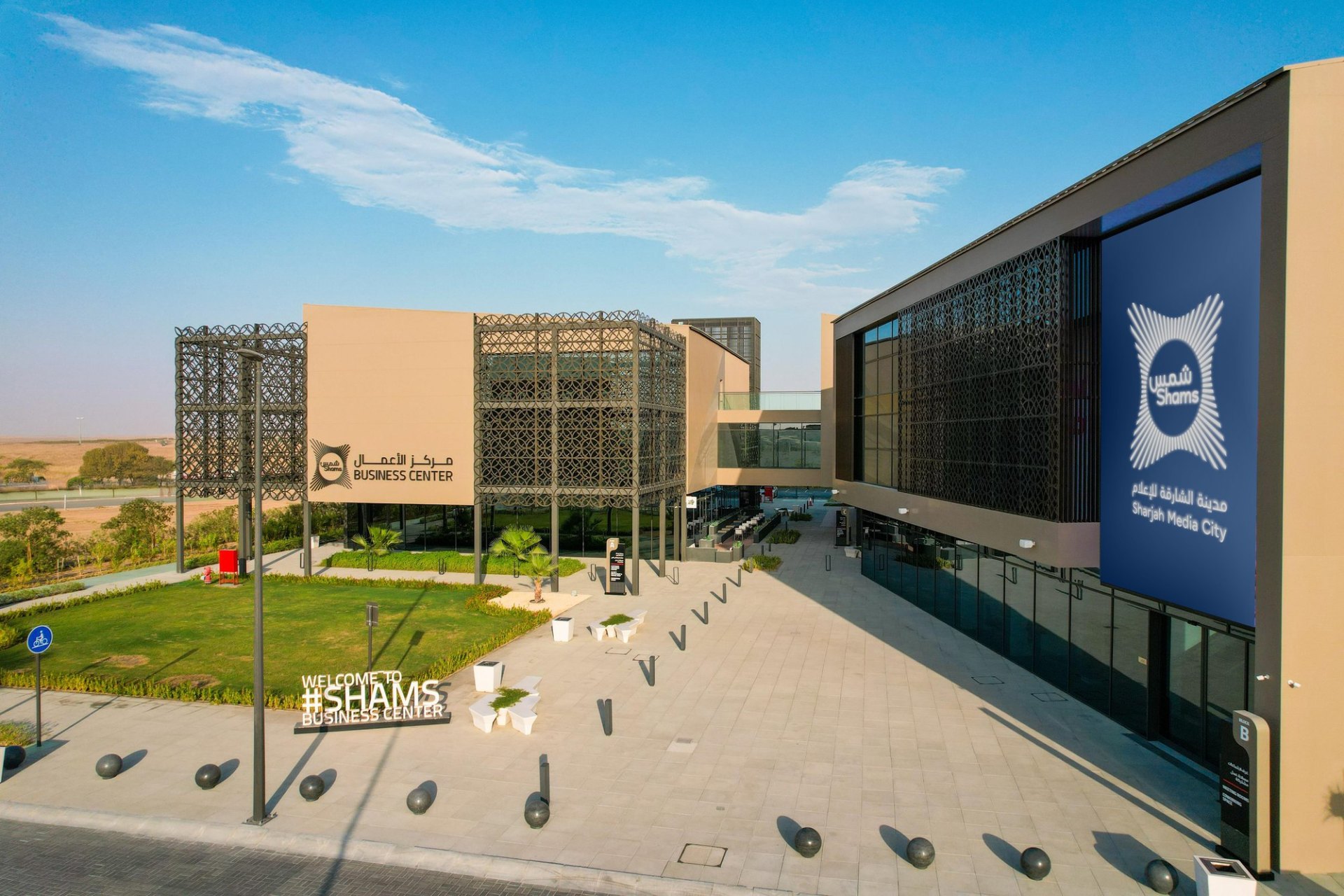
That lineage matters more than it looks: Shams is a media council asset, not a ports or industrial development authority. Its campus — a stated footprint of over two million square metres at Al Messaned, near Sharjah International Airport — was built to draw creative capital to Sharjah, though it long ago outgrew that brief and now licenses a broad spread of consultancy, e-commerce and trading activity.
The incorporating authority is efficient and unusually digital: the application runs entirely online, and Shams markets incorporation in under an hour with the licence issued in a couple of working days. Its website has since moved to a new address — a consultant's PDF still citing the old one has figures as stale as the link.
Who it genuinely suits
- Solo consultants and small professional firms invoicing outside the UAE — marketing, management consultancy, design, IT, training.
- Creators, producers and agencies whose work is genuinely media, where the campus and studio facilities carry value.
- Founders testing an idea who want a compliant entity and a residence visa without committing five figures to a jurisdiction they may not need.
- Holding and IP-owning entities where the operating substance sits elsewhere in the group.
- E-commerce sellers fulfilling from outside the UAE, where nothing crosses a UAE customs line in the company's own name.
The common thread: low physical footprint, revenue from outside the UAE, no regulated activity. Move away from any of the three and the case weakens fast. Test them in that order, before a price list is opened — each one is fatal on its own, and no saving on the licence buys any of them back.
Everything after this — the packages, the desk, the bank, the tax position — assumes all three already hold.
Licence types and what each permits
Shams issues an LLC and allows up to five activities on one licence across different industries — so a consultancy that also sells a digital product needs no second entity. Media activities sit in a separate media package of up to five; what that does not buy you is covered below. Which Sharjah authority a creative business belongs under in the first place is a prior question, and the six licensing homes Sharjah gives a creative founder answers it without repeating the costs and limits set out on this page.
Every share in that LLC can be foreign-held. Shams offers 100% foreign ownership — no Emirati shareholder, no local sponsor, no nominee to find — and the company's name takes a plain LLC suffix with no FZ marker in it. Neither fact changes what the company is. Since the 2020 amendments to the Commercial Companies Law, investors of any nationality can also wholly own a mainland company in every sector bar some activities with a strategic impact, so ownership no longer separates Shams from a mainland licence — and a name that reads like a mainland company's does not let the company operate like one. What does separate them is where your customers sit, which is point seven of the section on where Shams is the wrong choice; the other side of that comparison is on our mainland company page.
The setup sequence, and what differs at Shams
The generic pathway — trade name, initial approval, documents, licence — is in our free zone company formation pillar. Four things differ here:
- Activity first, always. Visa quota, bank appetite and tax position all follow from it, and the five-activity allowance tempts founders into breadth they cannot later justify to a bank.
- No NOC, no travel. Holding a UAE residence visa under another sponsor needs no NOC, and no shareholder need be in the country to incorporate.
- Payment in full, up front — though instalments via partner banks and a buy-now-pay-later facility are offered, unusual among UAE incorporating authorities.
- Immigration runs through Sharjah. Entry permit, medical, Emirates ID and stamping all mean trips to Sharjah, not Dubai. Budget the days.
What the sequence does not include is a capital deposit. Shams' terms set a default declared share capital of AED 100,000 and ask for nothing extra at or below it. Declare more and you must show a bank statement with a balance at least equal to the figure — before the company can hold an account of its own, so settle whose statement Shams will accept before you choose the number. The deposits the terms do take are visa deposits: a refundable one on every dependant's visa sponsored under a shareholder, forfeited if that dependant overstays by even a single day, and another when the last shareholder on a Shams visa cancels it — held against fines if the licence is left running, and set against the cancellation fee if it is closed instead. How a bank or a buyer reads the capital figure later is covered in the share capital figure is a promise, not a payment.
Open the bank conversation alongside the licence application, not after it. Nothing else in the sequence compresses.
What it costs, and what the headline price leaves out
Shams publishes no price list, only a cost calculator — so every figure you read elsewhere is a third-party quote of a moving number. Treat these as indicative only:
Routinely excluded: establishment card, medical, Emirates ID and stamping per person; attestation of foreign corporate documents; activity amendments; external approvals; and the one that catches people — renewal, which is not always priced like year one. Authority fees change without notice, and anyone quoting a fixed all-in figure for a year not yet reached is guessing.
Visas and premises: the quota, and what the desk costs you
Shams advertises up to 50 visas per licence. That is a ceiling, not an entitlement — what you get is set by the package and facility you buy. A shared-desk package carries a small quota, commonly one to six; going past it means taking physical space, at which point the price advantage over IFZA, RAKEZ or Meydan narrows sharply. Founders who buy the cheapest package intending to hire four discover this in month three, when upgrading mid-term costs more than buying correctly would have. Count headcount eighteen months out before choosing.
The flexi-desk that keeps the quota cheap is a real allocation in a real building, not a bare address. It is also the first thing a bank compliance officer sees, and what the Federal Tax Authority would weigh if it tested your substance. A flexi-desk is consistent with a one-person consultancy, not with a trading company projecting eight-figure turnover. If your model implies premises, take premises — the saving is not worth what it costs at the next two gates.
Banking: who says yes, and why applications fail
Shams hosts banks on its own campus: Sharjah Islamic Bank and RAKBANK keep a presence in the Shams office, the most reliable available signal as to who is receptive. Beyond those, digital-first business banks clear a first account fastest, while large conventional banks scrutinise low-cost free zone entities with no trading history far harder.
The refusal reasons common to every UAE application are in our banking advisory. One is specific to Shams: volume risk by association. A zone that incorporates cheaply and fast attracts a share of dormant and shell entities, compliance teams price that in, and your file inherits the average until you distinguish it — with verifiable substance, an activity that matches how you describe the business, and source-of-funds evidence prepared before anyone asks. The workable route is often to open with a digital bank, build six months of real transaction history, then approach a conventional bank from evidence rather than intention.
Tax and compliance after the licence
Being in a free zone is not a tax outcome. Under Federal Decree-Law No. 47 of 2022, taxable income up to AED 375,000 is taxed at 0% and the excess at 9%. Qualifying Free Zone Person status buys 0% on qualifying income, but Cabinet Decision No. 100 of 2023 and Ministerial Decision No. 265 of 2023 require adequate substance — staff, premises, operating expenditure — plus qualifying activities and non-qualifying revenue below a de minimis of the lower of 5% of revenue or AED 5 million. Breach it and status is lost for that period and the four following.
What that means at Shams, plainly: a flexi-desk consultancy is very unlikely to satisfy adequate substance, and mainland income is not qualifying income anyway. The realistic position for most Shams companies is the ordinary 0%/9% scale, with Small Business Relief under Ministerial Decision No. 73 of 2023 where revenue stays at or below AED 3 million — available only for tax periods ending on or before 31 December 2029, and expressly not to Qualifying Free Zone Persons. That date was 31 December 2026 until Ministerial Decision No. 131 of 2026 moved it, so guidance written before 29 July 2026 understates it by three years.
The rest of the calendar:
- Corporate tax — enrol with the FTA whether or not tax is payable, on the timetable in FTA Decision No. 3 of 2024; returns due within nine months of the tax period's end.
- VAT — mandatory above AED 375,000 of taxable supplies, voluntary from AED 187,500.
- UBO — Cabinet Decision No. 109 of 2023 requires commercial free zone companies to keep records of real beneficial owners, shareholders and nominee directors, notifying changes within 15 days. Penalties under Cabinet Decision No. 132 of 2023 reach AED 100,000 and licence suspension.
- ESR — Cabinet Decision No. 98 of 2024 restricted the Economic Substance Regulations to financial years ending on or before 31 December 2022 and cancelled penalties for later periods. A consultant still billing you for an annual ESR filing is billing you for nothing.
- AML — activities that make you a DNFBP (corporate service provision, real estate brokerage, dealing in precious metals or stones, accounting) require enrolment on goAML and a compliance programme, supervised by the Ministry of Economy and Tourism.
Renewal: a lapsed licence keeps costing until you close it
The calendar above runs on federal rules. The licence date runs on Shams' own, and its terms say exactly what happens when it passes. There is a thirty-day grace period from expiry. After that a late penalty accrues every month until the licence is either renewed or cancelled, and all of it has to be settled before Shams will do either — so walking away does not close the company; it only runs up the bill for closing it. Beyond the penalty, the terms reserve the right to serve a legal notice six months after expiry, suspend the company at seven, with a further fee for the suspension, and cancel the company's immigration card and any visas it sponsors. If you live in the UAE on a Shams visa, that last step is your residence.
The squeeze starts before the expiry date, not after it. Shams will not process an amendment, a letter or a certificate against a licence with less than 45 days left to run, and it will not process any application from a company carrying unpaid penalties or an incomplete UBO filing unless its compliance team approves. A bank that asks for a fresh letter in the last six weeks before expiry is asking for something you cannot have until you have renewed. Why the licence date is the one every permit, customs code and immigration file is tested against is set out in the UAE renewal date everything else hangs on.
Three habits keep renewal cheap:
- Start before the licence enters its last 45 days. That is the floor for letters and amendments, and it bites before the expiry date — long before the grace period begins.
- Use the renewal to fix the package. Shams lets an existing company renew and amend in one application — package, activities, company name, visa allocation, facility or shareholders — so a desk bought too small in year one is corrected at renewal rather than mid-term. A change of name or shareholders can need a separate immigration card amendment; allow the time.
- Renew or close — never neither. A licence you have stopped using is still accruing penalties, and they are paid before Shams will cancel it. If the business is over, cancel before the penalties start, not after.
Or renew less often. Shams sells licence terms longer than a year — its cost calculator prices terms of two, three, four, five and ten years — with a discount that rises with the length of the term and applies only to the licence and visa-allocation fees. Years already bought cannot be repriced, which is the one direct answer to renewal not being priced like year one. A long term takes the licence date off the calendar, not every date: residence visas keep their own validity and their own renewals. And it runs straight into point six below. Shams' terms accept no cancellation once payment is made, and the refund grounds they list — a rejected immigration card, a rejected visa, a licence never issued because due diligence failed — do not include a company that closes early. Get in writing what happens to the unused years before paying for them, and buy a long term only when the activity, the headcount and the zone are all settled.
Where Shams is the wrong choice
We publish this because nobody else will.
1. You move physical goods. Shams is not a Designated Zone for VAT under Cabinet Decision No. 59 of 2017. Sharjah's designated zones are Hamriyah Free Zone and Sharjah Airport International Free Zone — not Shams. If you have been told a free zone licence brings a customs or VAT advantage on goods, that advantage does not exist here: goods entering the mainland carry duty and import VAT as normal. For anything warehoused, bonded or shipped at volume, Hamriyah, JAFZA or KEZAD are correct, and it is not close.
2. You are chasing 0% corporate tax. The flexi-desk that makes Shams affordable is the same fact that makes qualifying status implausible. Either pay for a zone whose substance you can evidence, or accept the 9% scale and plan around Small Business Relief while it lasts.
3. Your activity is regulated. Shams is a licensing authority, not a financial regulator. Funds, payments, insurance, brokerage, lending and virtual assets belong in DIFC, ADGM or under a federal regulator. No Shams licence substitutes.
4. Media is your actual product. The name misleads. Media activity is federally regulated under Federal Decree-Law No. 55 of 2023, which expressly reaches media free zones, and the regulator changed again in January 2026 when Federal Decree-Law No. 11 of 2025 established the National Media Authority in place of the UAE Media Council, the National Media Office and WAM. A Shams media licence is the commercial permission only; content permits and standards sit above it, and Sharjah applies them more conservatively than Dubai. Sharjah is also a dry emirate — no alcohol licences exist at all — a live constraint for events, hospitality and lifestyle production.
5. The jurisdiction has to impress someone. A Shams licence does not carry the weight of DMCC or DIFC with enterprise procurement, institutional investors or conservative banks. If you are raising, or onboarding as a vendor to a large corporate, a few thousand dirhams saved is poor economics.
6. You expect to outgrow it. Federal company law gives no general route from one UAE free zone to another: whether a company can move depends on both zones' own rules. Where they do not provide for it, leaving Shams means a new entity, new visas and a new bank account, with the old one wound down. Choose for year three, not month one.
7. Your customers are on the UAE mainland. Shams will tell you — correctly — that you may invoice anywhere in the UAE. What that omits: it does not license you to operate from mainland premises, does not open government tenders to you, and produces income that is generally non-qualifying for free zone tax purposes. If most revenue will come from UAE clients, model a mainland licence properly before assuming a free zone is cheaper.
What to compare it against
- IFZA or Meydan — similar price band, Dubai address, broader lender familiarity.
- RAKEZ — comparable cost, plus the warehousing and industrial land Shams has none of.
- Hamriyah or SAIF Zone — the correct Sharjah answer for goods; both are Designated Zones.
If the work is genuinely media and the audience sits in Dubai, price Dubai Media City against this profile before deciding, because Sharjah applies content standards more conservatively and its alcohol position closes a range of events and hospitality work outright.
And if price alone is what brought you here, Ajman Free Zone is the other profile on this site written for that decision, with its own costs and its own limits set out the same way.
Tell us the activity, the customers and the headcount, and we will tell you whether Shams is right — including when it is not.
Provenance
How this record is verified.
Everything above is re-checked against SHAMS — Sharjah Media City’s own current published material and against the federal rules before any application is filed. Where the two disagree, the authority wins and we tell you.
Frequently asked questions
Can I import goods through a Shams company?
Not with any customs or VAT advantage. Shams is not a Designated Zone under Cabinet Decision No. 59 of 2017 — Sharjah's designated zones are Hamriyah Free Zone and Sharjah Airport International Free Zone. Goods entering the mainland carry duty and import VAT as normal, so a free zone licence buys nothing on that side here. For anything warehoused, bonded or shipped at volume, Hamriyah, JAFZA or KEZAD are the correct answers, and it is not close.
What does a Shams licence actually cost in the first year?
Shams publishes no price list, only a cost calculator, so every figure quoted elsewhere is a third-party snapshot of a moving number. Indicatively, a licence with a flexi-desk and no visas has run AED 5,750 to 7,500, one residence visa AED 8,500 to 14,000, and two AED 10,500 to 16,000; a physical office with a larger quota is quote-driven and materially higher. Excluded from all of them: establishment card, medical, Emirates ID and stamping per person, attestation of foreign documents, amendments, external approvals — and renewal, which is not always priced like year one.
Does Shams really allow up to 50 visas?
Fifty is the ceiling, not an entitlement. What you actually get is set by the package and the facility you buy: a shared-desk package carries a small quota, commonly one to six, and going past it means taking physical space — at which point the price advantage over IFZA, RAKEZ or Meydan narrows sharply. Founders who buy the cheapest package intending to hire four discover this in month three, when upgrading mid-term costs more than buying correctly would have. Count headcount eighteen months out.
Can a flexi-desk consultancy at Shams reach the 0% free zone rate?
Very unlikely. Qualifying Free Zone Person status needs adequate substance — staff, premises, operating expenditure — under Cabinet Decision No. 100 of 2023 and Ministerial Decision No. 265 of 2023, and the flexi-desk that makes Shams affordable is the same fact that makes that implausible; mainland income is not qualifying income in any case. The realistic position for most Shams companies is the ordinary scale, 0% to AED 375,000 of taxable income and 9% above it, with Small Business Relief where revenue stays at or below AED 3 million — available only for tax periods ending on or before 31 December 2029, and not to Qualifying Free Zone Persons.
Is a Shams media licence enough to publish content?
No. A Shams media licence is the commercial permission only; content permits and standards sit above it. Media activity is federally regulated under Federal Decree-Law No. 55 of 2023, which expressly reaches media free zones, and the regulator changed again in January 2026 when Federal Decree-Law No. 11 of 2025 established the National Media Authority in place of the UAE Media Council, the National Media Office and WAM. Sharjah also applies those standards more conservatively than Dubai, and as a dry emirate it issues no alcohol licences at all.
What happens if a Shams licence expires?
A thirty-day grace period runs from expiry. After it a late penalty accrues every month until the licence is either renewed or cancelled, and all of it has to be settled before Shams will do either — so walking away does not close the company, it runs up the bill for closing it. Beyond the penalty, the terms reserve the right to serve a legal notice six months after expiry, to suspend the company at seven with a further fee, and to cancel the immigration card and any visas it sponsors. If you live in the UAE on a Shams visa, that last step is your residence.
Begin with a clear conversation
Tell us what you intend to build.
A consultant will map the structure, jurisdiction, approvals and likely cost against what you actually described — not against a package.
