
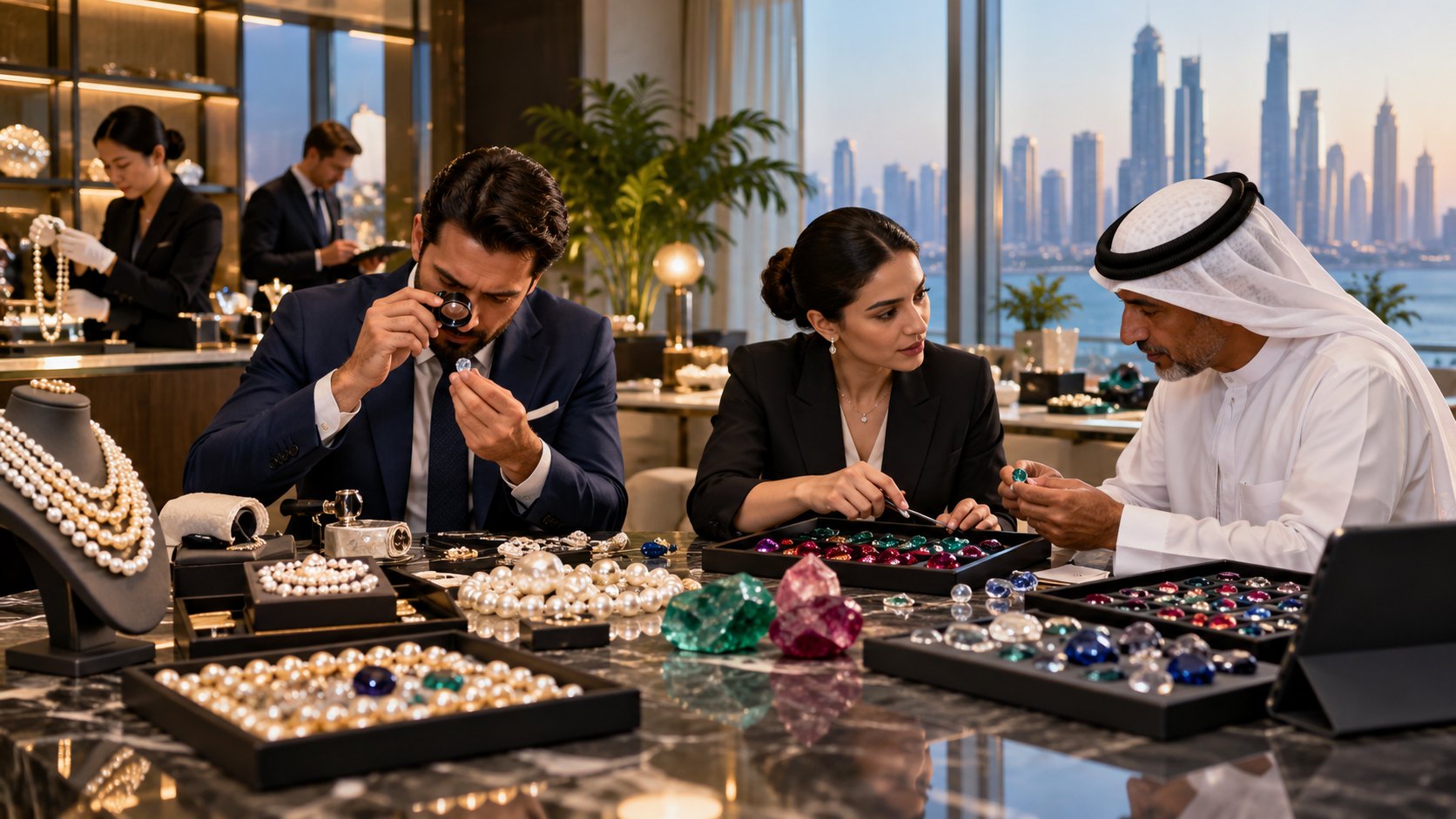
Activity CZ 324
How to Start a Pearls and Precious Stones Trading Business in Dubai
Stones have no price list. Two of the same weight can differ in value many times over, and the only thing that closes that argument is a laboratory report somebody else signed.
ConsultZone licensing desk
- Activity code
- CZ 324
- Category
- Trading
- Reviewed
- Read
- 7 min
Topic summary
How to Start a Pearls and Precious Stones Trading Business in Dubai
There is no price list in this trade and there never has been. Two diamonds of identical weight can differ in value by a large multiple, and the whole of that difference is a judgement about colour, clarity and the quality of the cut — made by eye, under a particular light, by somebody whose opinion the buyer either trusts or does not. Coloured stones are worse, because origin matters to price in a way no instrument settles on its own and treatment history can halve a value without changing anything visible.
So the trade runs on two things: grading and reputation. Everything else — the stock, the premises, the freight — is secondary to whether a buyer believes what you say a stone is. That is why the independent laboratory report has become the central document in the business, and why the decision about whether to deal in certified or uncertified goods is not a preference but a choice of business model with different capital, different margins and different customers on either side of it.
This coast has an older claim on the subject than almost anywhere. Natural pearl was the economy of the lower Gulf before oil, dived from these waters and sold into India and Europe, and the trade collapsed within a generation when cultured pearl arrived. That history is commercially relevant rather than decorative: the difference between a natural and a cultured pearl is invisible to the eye and is settled by laboratory examination of the interior, and the price gap between them is enormous. A pearl dealer who cannot tell the two apart is not a dealer, he is a gambler.
CZ 324 — Pearls & Precious Stones Trading
The line covers buying, importing, holding and selling on the stones themselves, loose rather than set. In practice that is five groups.
Rough diamonds, sold by parcel on an assessment of what can be cut out of them, which is a specialist skill and a specialist risk. Polished diamonds, which are the most nearly standardised goods in the family because a widely understood grading vocabulary exists for them. Coloured stones — ruby, sapphire, emerald and the rest — where origin, treatment and the absence of enhancement drive price, and where the market is far less transparent. Semi-precious and ornamental stones, sold in volume at modest value to manufacturers and the craft trade. And pearls, natural and cultured, loose or strung, sold on lustre, surface, shape, nacre and matching.
Two further matters belong in the licence conversation rather than in a later surprise. Laboratory-grown stones are a legitimate product and a growing one, and the obligation attaching to them is disclosure rather than prohibition: the trade's whole price structure depends on a buyer knowing which he is being offered, and a business that blurs the distinction has a problem that is commercial before it is anything else. And treatments — heating, filling, irradiation, dyeing — are normal in parts of this market and must be declared, because an undisclosed treatment is a misdescription of the goods.
The central operating decision follows from all of that, and it is best read as a sequence.
- Decide which of the five groups the business actually tradesRough, polished, coloured, semi-precious and pearls have different buyers, different skills and different risks
- Buy on an examination you performed or paid an independent party to performA supplier's description is a claim about goods you have not seen
- Does the stone carry an independent laboratory report
- YesIt can be offered on paper, sight-unseen, to a buyer anywhere — and the margin is narrow, because so can everybody else's
- NoEvery sale needs the buyer to look, so the market is local and relationship-bound, and the margin lives in your own judgement
- Declare treatment and origin in writing, and keep what the declaration rests onAn undisclosed treatment is a misdescribed good, whatever the price was
- Match the payment terms to how long the stone will actually sitStones do not spoil, which is exactly why capital disappears into them
- A sale that holdsThe report, the declaration and the examination are the three things a buyer can come back on
The split in the middle is the business model. A certified-stone desk is nearly a commodity operation: it trades on specification, it can sell to a buyer who never sees the goods, it can be run from an office, and it competes on price and availability against everybody else holding the same grade. An uncertified or coloured-stone desk is the opposite — it must travel to source, it must be able to grade for itself, its customers buy because they trust its eye, and its margins are correspondingly better and much harder to defend if the eye is wrong.
Both are subject to the same two conditions that attach to the goods rather than to the business. Consignments of stones are high-value and easily concealed, so customs treatment is careful and document-heavy on every shipment. And dealers in precious stones sit inside the anti-money-laundering framework, which in practice means establishing who the counterparty is before value moves and keeping the record in a form an inspection can read — a duty on the company that cannot be handed to an agent, and whose categories and thresholds are to be confirmed against the current instruments for a specific business.
Adjacent lines people confuse with it
Finished jewellery is a different activity. A set ring is an article with a design and a making charge, sold to a consumer; a loose stone is a material sold to somebody who will set it or resell it. The customer, the margin and the premises are all different, and a business doing both needs both lines in its wording.
Unwrought precious metal is the other half of the raw-materials trade and is genuinely nothing like this one, because metal is interchangeable and stones are not. A gram of fine gold is a gram of fine gold; two sapphires are two individual objects.
Cutting and polishing is manufacturing. Sawing, bruting, faceting and polishing rough into finished stones is production work with its own licence wording and its own premises conditions. A trader may have rough cut under contract; performing the work is a factory.
Gemmological testing and certification is a laboratory service, and the reason it is a separate business is the reason the report is worth anything. A dealer cannot credibly certify the stones he is selling.
Pearl culture and farming is aquaculture, which sits with the environment and fisheries authorities rather than with a trading licence.
Auctioneering — selling stones on behalf of their owners for a commission — is an agency service rather than trade on one's own account.
Who is this for?
The broker holds no stock at all and lives on knowing who has what and who wants it. The capital requirement is almost nil and the asset is entirely relationships, which makes it the usual way into the trade and a precarious place to stay.
The supplier to manufacturers sells calibrated goods in repeating sizes to workshops that need consistency for a production run. It is the least glamorous position and the most forecastable, because the customer's order book drives yours.
The certified-diamond dealer trades on specification, often with buyers he never meets, and competes on price and speed. The business is a trading desk with a safe rather than a shop.
The coloured-stone specialist travels to mining regions and auctions, buys on his own judgement and sells on his reputation. It is the highest-margin and highest-risk shape in the family.
The pearl dealer works in a category where matching a strand can take years of accumulation, and where the distinction between natural and cultured is a laboratory finding with an enormous price consequence attached.
What the licence costs to hold, what conditions attach to a particular premises or vault, and how a given consignment is treated at the border depend on the emirate, the site and the goods. ConsultZone confirms those with the relevant authorities for the specific case.
References
- Dubai Customs — import, export and re-export, customs codes, and the handling of high-value consignments. Dubai Customs
- UAE Government portal — the federal anti-money-laundering framework and general government information. UAE Government portal
- Ministry of Economy — commercial matters, consumer protection and intellectual property. Ministry of Economy
- Ministry of Climate Change and Environment — fisheries and aquaculture, which is where pearl culture sits rather than with a trading licence. Ministry of Climate Change and Environment
Elsewhere in Trading
Activities that sit beside this one
Most licences carry more than one activity. Adding a neighbouring line at the application stage costs a fraction of amending the licence afterwards.
Begin with a clear conversation
Tell us what you intend to build.
A consultant will map the structure, jurisdiction, approvals and likely cost against what you actually described — not against a package.
