

Activity CZ 329
How to Start a Pipes and Fittings Trading Business in Dubai
Pipes are the one line in this family sold by the tonne, so the stock changes value while nobody sells anything. The certificate that travels with the material decides who may buy it.
ConsultZone licensing desk
- Activity code
- CZ 329
- Category
- Trading
- Reviewed
- Read
- 7 min
Listen instead
39 seconds
An audio summary of this guide.
Topic summary
How to Start a Pipes and Fittings Trading Business in Dubai
Everything else in this corner of the catalogue is sold by the piece. Pipes are sold by the tonne and the metre, and that single difference changes the shape of the business entirely.
It changes the premises first: this is a yard business rather than a shelf business, and it needs length, a hard surface, a forklift and usually a crane, because six-metre lengths of steel pipe cannot be carried in and stacked by hand. It changes the labour, which is loading and cutting and threading rather than counting. And it changes where the risk sits. A trader holding two hundred tonnes of steel pipe is exposed to the global steel price, which moves without anybody in the yard selling or buying anything. Being long on material in a falling market loses money standing still — the exact opposite of the appliance-parts trader's problem, which is stock that never moves at all.
So this is a trade with two quite different skills bolted together. One is physical: handling, storage, cutting, delivery, and knowing what a bundle costs to break. The other is financial: buying at the right point in a commodity cycle, and collecting money from contractors who are themselves waiting to be paid. Neither is about the pipe.
What the line covers, and where a valve stops being a fitting
Pipes & Fittings Trade covers the pressure envelope and the pieces that join it. The pipe itself runs across materials that have almost nothing in common except their shape: carbon and alloy steel, stainless, galvanised steel, copper, ductile iron, and the plastics — PVC and uPVC, PPR, HDPE, PEX, GRP. Fittings are elbows, tees, reducers, bends, couplings, unions, flanges, nipples, caps and plugs, clamps and supports, and the gaskets and bolt sets that make a flanged joint actually seal.
The useful boundary to draw is with a neighbouring line in the same catalogue, because a plumber on a site will call both of them fittings and the licences are different. Pumps, Engines Valves and Spare Parts Trading covers valves. The practical distinction is that pipes and fittings are the static part of the system — they contain the fluid and direct it, and they have no moving parts — while a valve is a mechanism that controls it. The commercial logic follows the same line: a fitting is sold by material, dimension and pressure class, and a valve is sold by type, actuation and function. Traders routinely hold both and it is sensible to check which activity names the intended range rather than to assume one covers the other.
What this line does not cover is the installation. Running pipework on a site, welding or fusing it, pressure-testing a completed system and signing it off are contracting activities with their own licences and their own competence requirements. Nor does it cover making pipe or fabricating a spool piece from it, which is manufacturing. Cutting and threading to a customer's dimension in the yard is a normal part of a trading operation; building a system out of it on a site is not.
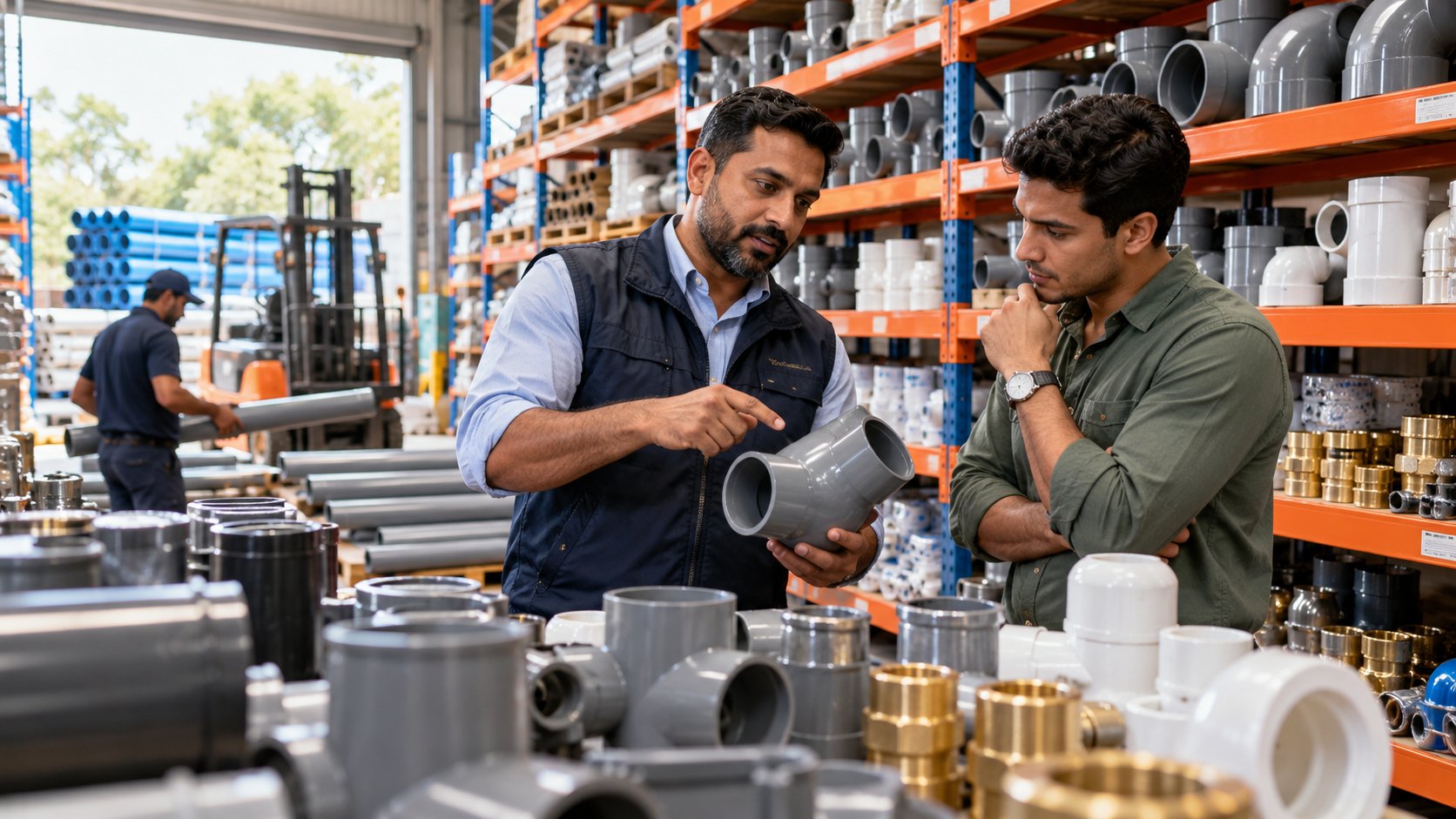
The buyer is a contractor on somebody else's payment chain
Almost nobody walks in and buys pipe for themselves. The customers are mechanical and plumbing subcontractors, main contractors, infrastructure and utility contractors, district cooling installers, fit-out firms, irrigation and landscaping contractors, industrial maintenance departments, and the retail plumbing merchants who buy in bulk and break it down.
The route to them is not advertising. It is the quotation against a bill of quantities, returned quickly, priced line by line against a specification somebody else wrote, and won or lost on whether the material offered matches what the consultant asked for. Being able to quote on the day the enquiry lands matters more than being the cheapest, because a subcontractor pricing a tender has a deadline and will use the quotation he has.
And then the part of this trade that actually decides whether it survives, which is not the goods at all. A plumbing subcontractor pays when the main contractor pays him, and the main contractor pays when the developer pays. Supplying material into that chain means extending credit into it, and the trader is at the far end — last to be paid and first to be squeezed. Credit control, retention of title in the supply terms, knowing which contractors pay and which argue, and the willingness to stop supplying a good customer who has gone ninety days late are the real skills in this business. A yard full of well-chosen material and a ledger full of uncollected invoices is the standard way this trade fails, and it fails while the sales figures look excellent.
The certificate travels with the pipe
Conditions in this trade attach to the material rather than to the trader, and they are specific enough to plan around.
On any serious project the consultant will not accept material on a delivery note alone. He wants the mill test certificate — the document tying that particular production heat to its chemical composition and its mechanical test results — and he wants the standard the pipe was manufactured to. That has a consequence inside the yard that new entrants discover expensively: traceability has to survive storage. A bundle broken, restacked and mixed with another batch is material that can still be sold to a villa job and can no longer be sold to a water authority or a process plant, because nobody can prove what it is any more. Which standard a material is held to is a matter for the federal industry ministry's technical regulation and conformity regime, and specifications name those standards rather than describing them.¹
What the pipe is going to carry decides the rest. Material intended to carry drinking water has to be approved as suitable for contact with potable water, and that approval sits with the municipality rather than with the licensing authority — it is asked before the material is offered to a water project, not after it is delivered.² Pipework serving a firefighting system is a fire-safety matter and the specification for it is settled with the civil defence authority at the design stage.³ Pipework for process fluids and gas carries pressure classes and material requirements that come out of the design. Irrigation and surface drainage carry almost none of this, which is precisely why the same hundred-millimetre plastic pipe is three different commercial propositions depending on what it is bought for.
the six gates named on this page
The emirate's economic department
- The trade licence with this activity recorded on itFirst; nothing is quoted before it
- A yard the stock will physically fit intoWith the tenancy, not after it
The municipality
- Whether a material may carry drinking waterBefore it is offered to a water project, not after delivery
The civil defence authority
- Whether pipework may serve a firefighting systemAt the design stage, in the consultant's specification
The emirate's customs authority
- A customs code, and clearance of every consignmentOnce the licence is cut, then on each shipment
The federal industry ministry
- Which national standard the material is held toWritten into the specification before you bid
The shape of that drawing is the point. Two of the six gates sit with the economic department and those are the two an entrant plans for; the other four sit elsewhere, none of them is part of getting a licence, and between them they decide which projects the material in the yard may be sold into. A trader who treats the licence as the end of the approvals question finds out the rest of it when a consultant rejects a delivery.
Finally, the structural choice. A mainland licence is the ordinary answer here, because the customers are contractors working on UAE soil, the material clears into the country, and a yard in a municipality's industrial area is what the trade physically requires. A free zone licence describes a different business — holding regional stock for onward export without clearing it locally — which is real in this category given the port, but it is a stockholding and re-export operation rather than a supplier to local contractors.
Which activity name fits the intended range, whether valves need a separate line, which approvals attach to a particular yard, and what the licence costs to hold all depend on the emirate, the premises and the activity mix. ConsultZone confirms that for the specific case before a yard is leased.
References
- Ministry of Industry and Advanced Technology — national standards, technical regulation and conformity marking for piping materials. Ministry of Industry and Advanced Technology
- Dubai Municipality — premises suitability and the public-health approvals covering materials in contact with drinking water. Dubai Municipality
- Dubai Civil Defence — fire-safety requirements for pipework serving firefighting systems. Dubai Civil Defence
- Dubai Customs — customs codes, classification and clearance of pipe and fitting consignments. Dubai Customs
Elsewhere in Trading
Activities that sit beside this one
Most licences carry more than one activity. Adding a neighbouring line at the application stage costs a fraction of amending the licence afterwards.
Begin with a clear conversation
Tell us what you intend to build.
A consultant will map the structure, jurisdiction, approvals and likely cost against what you actually described — not against a package.
