
Activity CZ 320
How to Start a Parties and Entertainments Services Business in Dubai
Most parties happen in a villa or a garden, which is a place with no event licence and no venue manager to take the decisions. Who sells entertainments, what the line covers, and what the licence never reaches.
ConsultZone licensing desk
- Activity code
- CZ 320
- Category
- Arts, Events & Entertainment
- Reviewed
- Read
- 8 min
Topic summary
How to Start a Parties and Entertainments Services Business in Dubai
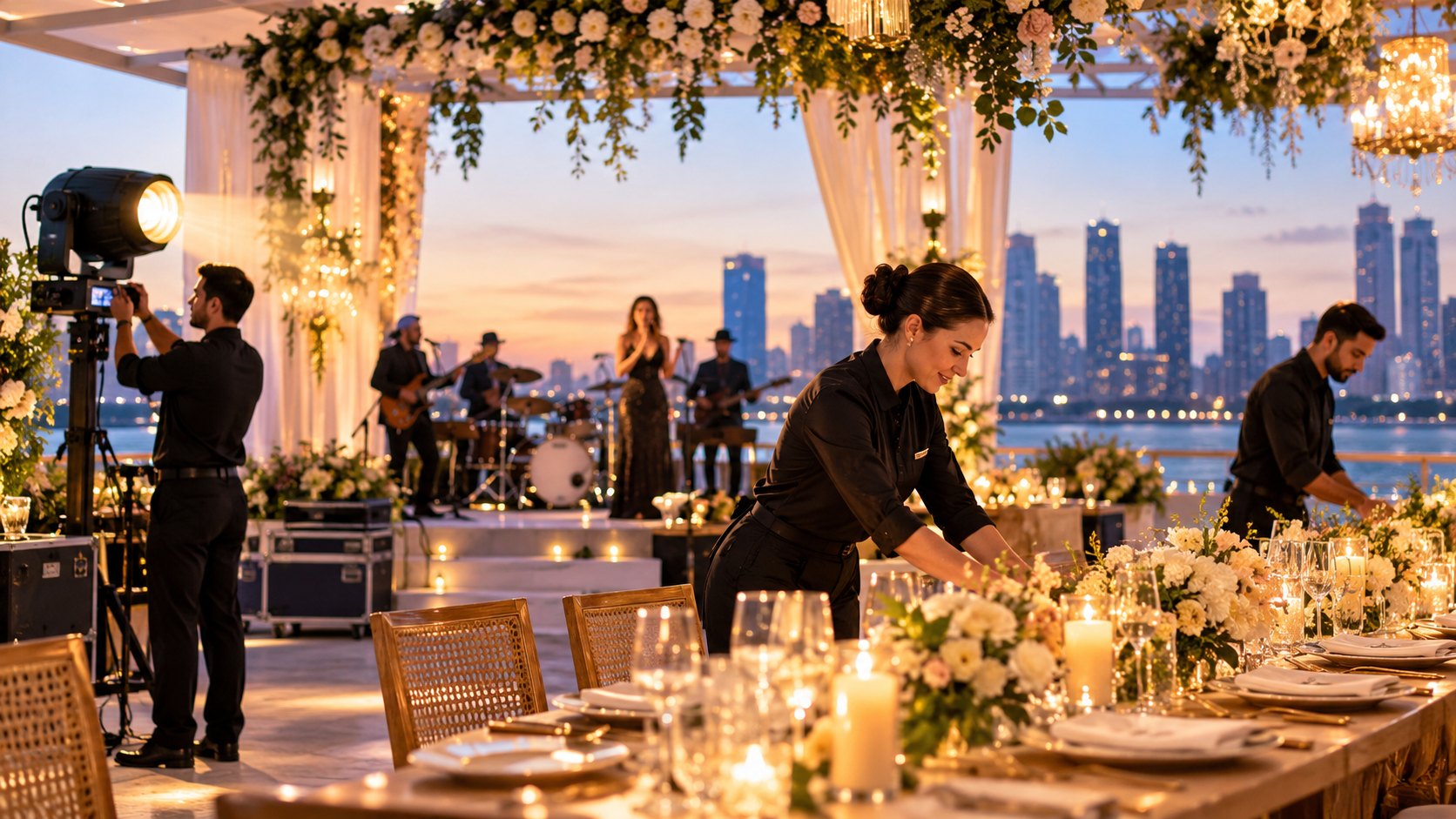
A hotel ballroom comes with somebody whose job is to say no. Capacity, hours, where a speaker may stand, whether a flame is allowed indoors, what time the music stops — a venue has a licence and a duty manager, and both of them have already thought about all of it. The commonest place a party actually happens on this line has neither. It is a villa, a garden, a rooftop, a majlis, a community hall or a function room inside a residential tower, and nobody there holds an event licence or has any professional view about amplified sound at eleven o'clock. The decisions a hotel would make for you fall instead to a landlord, a community management office, and the three neighbours who will decide how the evening ends.
That is the structural fact about parties and entertainments work, and almost every expensive surprise on this line is a version of it. The client does not know any of this either. He is a host rather than a professional buyer: he has booked a date because it is his daughter's birthday, he is paying out of his own money, and what he is really purchasing is how the evening makes him look in front of people whose opinion he minds about. He will not ask what happens if the generator trips. He will remember it for years.
The second structural fact is commercial. Very little of what gets delivered is yours. The décor is bought, the castle is hired, the performer is somebody else's, the dessert table came from a kitchen, the photo booth belongs to a rental yard — and almost all of them want paying before the night while the host settles afterwards. The margin on this line is not in any of the components, which are near enough at cost; it is in assembling them into one evening that happens on time. A company that prices the components and treats the assembly as goodwill has given away the only thing it sells.
- Settle what the host is buying, item by itemDécor, a cake, a performer, a games station and a photographer are five suppliers rather than one package
- Price the assembly rather than the componentsThe components are close to cost; holding the evening together is the product
- Is it happening in a licensed venue or in somebody's home
- A licensed venueThe venue's own licence settles capacity, hours and whether live performance is permitted in that room, and you work inside its rules
- A home or a community spaceNo event licence exists for it, so the landlord and the community's management decide, and amplified sound is a neighbour question before it is any other kind
- Take a deposit sized to what you have to pay out firstSuppliers and rental yards invoice before the night and private hosts settle after it
- A run sheet agreed in writing with the hostThe only document that settles what was promised once a relative remembers it differently
Five companies sell parties, and only two of them own anything
The décor and styling studio is the most common entry. It owns props, backdrops, balloon stock and a workshop, it sells a look, and its cost base is storage plus the time of people who can build something at speed in somebody's garden. Stock is the asset and also the trap: themes date, and a warehouse of last year's palette is money sitting still.
The children's entertainment company owns almost nothing but a diary and a panel of performers — characters, magicians, face painters, games hosts. Saturdays are the whole business and Saturdays are finite, so growth means more performers, which means a payroll of people whose conduct around children is the company's entire reputation.
The equipment and activity supplier rents out castles, soft play, photo booths, candy carts and games stations. This is a plant-hire business in a party costume: utilisation, maintenance, transport and the condition of returned equipment are what decide whether it makes money.
The package assembler owns nothing and sells everything, taking a brief from a host and subcontracting the lot. The highest margin per hour of effort and the highest exposure, because every promise is somebody else's to keep.
The corporate family-day supplier sells to companies rather than to households: staff days, long-service evenings, children's parties for employees. The sale runs through a human resources team, it repeats annually, it is invoiced on terms rather than in cash, and it is the only one of the five with a forecastable year.

CZ 320 — Parties & Entertainments Services
The line covers supplying entertainment and the furniture of an occasion into somebody else's event: themed décor and balloon work, costumed characters and mascots, magicians, face painting and henna artists, bouncy castles and soft play, games and activity stations, candy and dessert tables, photo booths, hosts and compères, and sound, lighting and effects for a private function. The occasions themselves are the ordinary catalogue of a family's year — birthdays, baby showers, graduations, gender reveals, religious celebrations, engagements, retirement evenings, majlis gatherings — plus the corporate equivalents.
The package is the product, and it has to be written down
What distinguishes a good operator here is not taste, which clients have, but specificity. A quotation reading "full themed set-up" is an invitation to a disagreement; one that says how many balloons, in which three colours, built where, from what hour, with how many people on site and struck at what time, is a contract. Hosts are not withholding the detail — they do not know what they want until somebody lists it — and the list is the only answer available when an aunt decides the backdrop was the wrong pink.
Children change the job rather than decorate it
Where the guests are children the operation changes in ways that are easy to underestimate. Equipment is being used by people who will not read a rule, so inspection and anchoring are daily work rather than annual. Supervision ratios are the difference between a busy afternoon and an incident. Food served to a room of other people's children runs straight into allergies, which is a reason to know exactly which licensed kitchen a dessert table came from. And every performer who will be near children is a hiring decision the company cannot delegate to a booking agent.
What this licence does not reach, starting with the room
The room is first because it is the one that costs money. A venue operates under its own licence and that licence, not yours, settles what may happen inside it. A residential property is not a venue at all, which means the question moves to the lease and the community rules rather than disappearing.
The performer's right to work. A person coming to the UAE to be paid for a performance is coming here to work, and that is a permit matter sitting with the federal labour ministry. Holding performers under contract and supplying them is its own trade — Artistic Talent Contracting (CZ 209) — and a party company that starts flying acts in has acquired that line's problems without its licence.
The food. A cake, a dessert table or a catered buffet comes out of a licensed kitchen under premises and hygiene control. Arranging it is coordination; producing it is a different activity.
The build and anything that burns. Staging, rigging, power and temporary structures are specialist work, and effects involving flame, pyrotechnics or pressurised gas are a fire-safety matter for the emirate's civil defence authority.
Filming it. Video of the occasion is a separate line, Parties & Events Filming (CZ 321), and the fact that most hosts want both does not merge them.
A public event. The moment the guests are strangers rather than invitees — tickets, an open invitation, a public space — the occasion is a permitted event in the emirate and somebody is named as responsible for the crowd. That is Events Organizing & Managing (CZ 248), a trade with a different risk and a different lead time.
A venue of your own. Fitting out a unit and selling party slots inside it makes the company a leisure premises operator — Recreational Services (CZ 343) — with conditions attaching to the site rather than the booking.
What is left is what a host is paying for: a specified evening, suppliers chosen rather than found on the day, somebody on site who knows the order things happen in, and a plan for the half-hour when something has not arrived. Which activity wording covers that mix, and what conditions attach in a given emirate, depend on the authority — ConsultZone confirms them against the actual work rather than a standard package.
References
- Ministry of Human Resources and Emiratisation — work permits and labour contracts for entertainers, hosts and site crews, including part-time and temporary arrangements. Ministry of Human Resources and Emiratisation
- Dubai Municipality — food control and premises suitability, which is where catering and dessert supply for a private occasion originates. Dubai Municipality
- Dubai Civil Defence — fire safety approvals, which is where flame effects, pyrotechnics and temporary structures belong rather than with an entertainment licence. Dubai Civil Defence
- UAE Government portal — federal law and general government information, including the permitting of events and standards for what may be performed. UAE Government portal
- Federal Tax Authority — enrolment and filing on package and supply income, and how a deposit is treated. Federal Tax Authority
Elsewhere in Arts, Events & Entertainment
Activities that sit beside this one
Most licences carry more than one activity. Adding a neighbouring line at the application stage costs a fraction of amending the licence afterwards.
Begin with a clear conversation
Tell us what you intend to build.
A consultant will map the structure, jurisdiction, approvals and likely cost against what you actually described — not against a package.
