
Activity CZ 265
How to Start a Frozen Fish and Seafood Trading Business in Dubai
You buy a harvest you had no part in, on a written specification, from a season nobody can move. What the frozen seafood line covers, and why glaze is where the margin is made and lost.
ConsultZone licensing desk
- Activity code
- CZ 265
- Category
- Trading
- Reviewed
- Read
- 6 min
Listen instead
44 seconds
An audio summary of this guide.
Topic summary
How to Start a Frozen Fish and Seafood Trading Business in Dubai
Everything else in this family is produced to order. Seafood is harvested. A factory can run another shift if you need more tomato paste; nobody can run another shift of shrimp. What exists was caught or farmed in a season that has already happened, in a quantity set by weather, water temperature, feed cost and quota, and your purchase order has no influence over any of it.
That is the defining fact of Frozen Fish & Seafood Trading and it runs through every decision in the business. You are not negotiating with a producer who can flex; you are competing for an allocation of something finite against buyers in Europe, Japan, China and the United States, all of whom are in the same queue. When a season is short, price does not drift upward — it steps. When it is long, the whole market is discounting at once and your stock is worth less than you paid before you have unloaded it.
What the activity actually covers
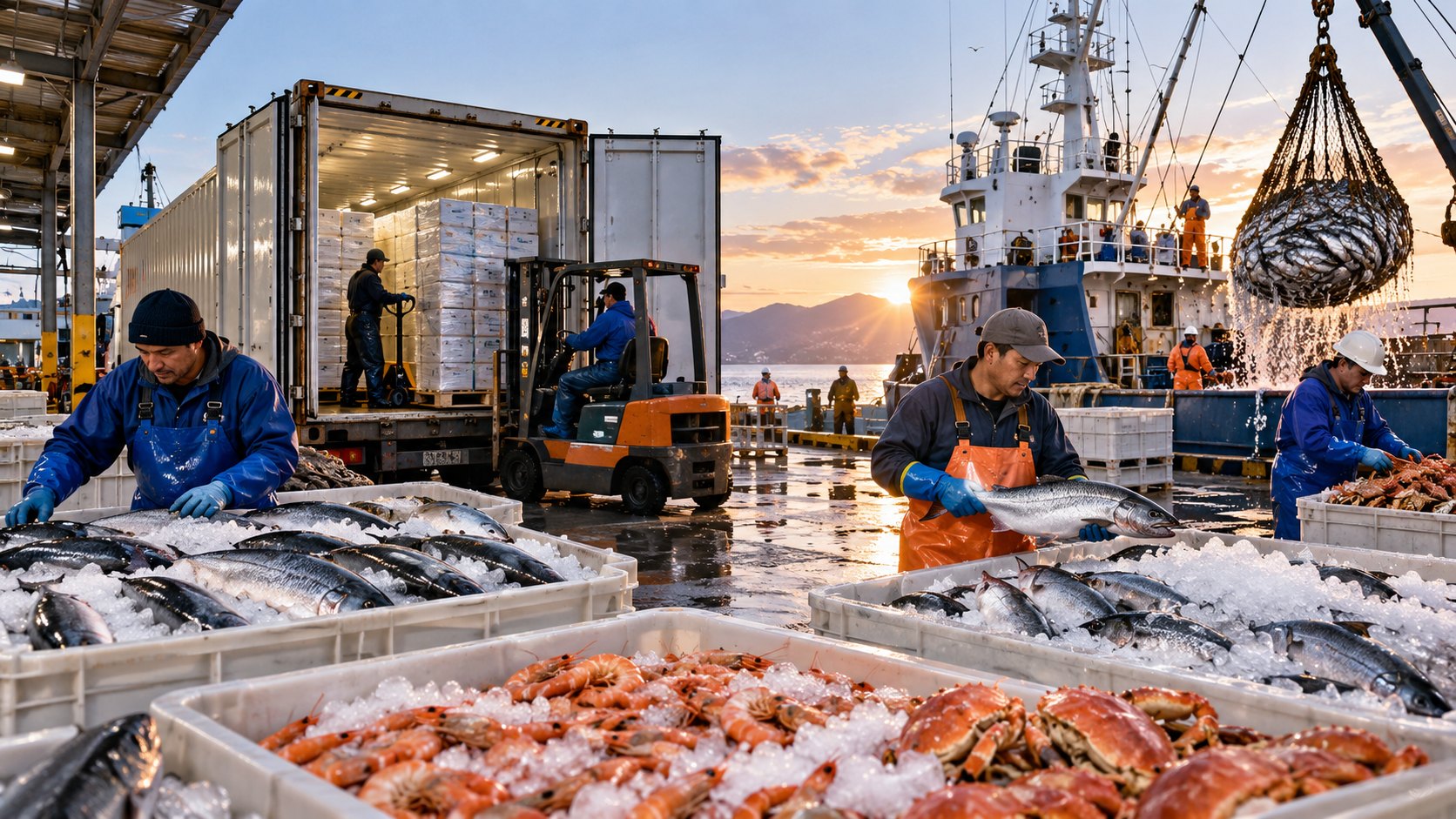
The line covers the import, cold storage and wholesale of frozen aquatic products: whole fish and fillets, prawn and shrimp in their various presentations, squid, cuttlefish and octopus, crab and lobster, shellfish, and the value-added frozen forms — breaded, skewered, portioned and individually frozen packs. It extends to the re-export of the same goods, which in Dubai is a substantial part of the trade rather than a sideline.
Three things make it a specification business rather than a commodity one, and all three are where money is won or lost.
Species and origin have to be stated and verified. Seafood is the category in which substitution is a recognised global problem, because once a fish is a frozen fillet in a plain poly bag, very few buyers can tell one white fish from another by looking. A trader's reputation rests on the pack containing what the label says, and the only protection is buying from plants with a traceable chain and keeping the documents per lot.
Glaze is a number you must read. Frozen seafood carries a layer of ice applied to protect it, and the difference between gross weight and net weight is glaze. A quotation that does not state the glaze percentage is not a price, because two offers at the same figure per kilo can be twenty per cent apart on actual product. Buyers who do not check it are paying for water, and sellers who do not state it get accused of cheating when the customer eventually weighs it.
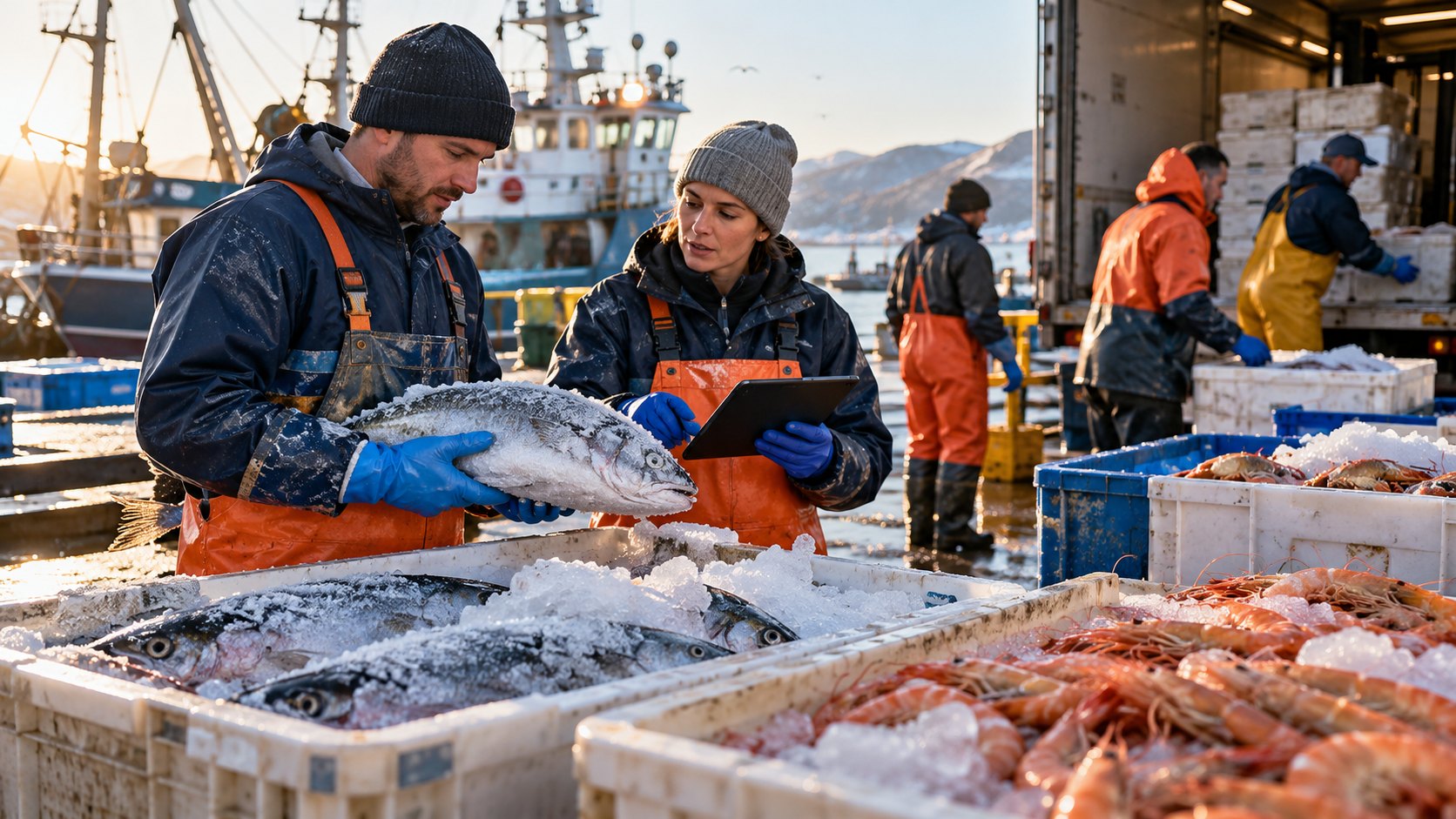
Grade and count size decide the customer. Prawns are sold by count per kilo, fillets by weight band, and a hotel buying portions needs every piece inside a narrow range because a plated dish has to look the same every time. A consignment that is correct in species and wrong in count size is sellable, but not to the account that ordered it.
The cold chain here is long and the breaks are at the ends
A frozen seafood consignment will sit in a producer's cold store, a port's, a vessel's, a reefer's and yours, and the temperature only has to fail once. The characteristic damage is not spoilage but freezer burn and drip loss, which show up as a dried surface, a weight that no longer matches the carton and a texture a chef will reject. It happens at the handover points rather than in the middle of storage, which is why the quay, the gate and the delivery vehicle get the attention.
Who is this for?
six kinds of buyer, two destinations
- Hotels, restaurant groups and catering companiesThe sale and the delivery both land inside the local market
- Supermarkets and retail packersConsumer supply chains contract with mainland suppliers
- Processors and value-added plants inside the UAEA domestic industrial buyer, however far the fish travelled
- Institutional kitchens and government-linked cateringPublic and semi-public procurement expects a mainland supplier
Mainland licence
- Container re-export to other GCC, African and CIS marketsThe goods never clear into the UAE market
- A foreign buyer sourced from foreign plants, with Dubai as the deskNeither end of the transaction is the local market
Free zone licence
Four of the six buyer types in that drawing reach the same place, and the two that do not have one thing in common — the UAE is not the market, it is the route. That is the whole structure of the decision, and it is why the question to answer before choosing a licence is not "where do I want to be" but "whose kitchen does this fish end up in".
The profiles behind those rows are genuinely different trades. The hotel and catering supplier lives on consistency of count size and delivery, carries a narrower range at better margin, and is judged on whether portions match last month's. The retail supplier deals in packs, promotions and listing terms, and needs volume and funded launches. The re-exporter is a trader in the purest sense, buying and selling containers with Dubai as a transit point, earning a thinner percentage on much larger numbers and living on freight rates and currency. The processor's supplier sells raw material by specification and is the least glamorous and most stable of the four.
Where it sits between the mainland and a free zone
This activity has the clearest mainland-versus-zone answer in the whole food family, and the reason is geographic rather than legal: Dubai is a re-export point for frozen seafood, so a real part of this trade genuinely never touches the local market.
A mainland licence is the ordinary answer when the buyers are UAE hotels, retailers, caterers or processors. Those customers expect to contract with a mainland supplier, the goods clear into the country, and the whole operation — cold store, vehicles, sales — sits where the customers are.
A free zone licence suits the transit trade. If containers arrive and leave without entering the UAE market, a zone address with cold storage inside it is coherent, and the duty and documentary handling is designed for exactly that movement. What a zone licence will not do is let you serve the hotel down the road directly; selling into the local market from a zone means working through a mainland distributor and accepting a cut of the margin for it.
The trap is the business that intends to do both and plans for one. Many seafood traders here start as re-exporters and find local demand, or start locally and win an export account. The honest position is that the two routes have different strengths, and that a trader who expects a serious volume on both sides should take that decision explicitly at the start rather than discover halfway through a season that the licence he holds cannot invoice the customer he just won.
What the licence costs to hold, which emirate and which route suit the real buyer list, which plants and origins are acceptable, and what the cold store must provide all depend on the licensing authority and the premises. ConsultZone settles those against the actual specification sheet and buyer list, because in seafood the supplier approvals and the cold store are committed before a single carton is sold.
References
- Ministry of Climate Change and Environment — fisheries, aquaculture, aquatic animal health and the food security framework behind seafood imports. MoCCAE
- Dubai Municipality — food control for frozen aquatic products, labelling, and cold storage premises suitability. Dubai Municipality
- Dubai Customs — import, re-export and transit procedures, customs codes and restricted consignments. Dubai Customs
- Abu Dhabi Agriculture and Food Safety Authority — food safety control where the trade operates in Abu Dhabi. ADAFSA
- UAE Government portal — the federal food safety framework and national food security policy. UAE Government portal
Elsewhere in Trading
Activities that sit beside this one
Most licences carry more than one activity. Adding a neighbouring line at the application stage costs a fraction of amending the licence afterwards.
Begin with a clear conversation
Tell us what you intend to build.
A consultant will map the structure, jurisdiction, approvals and likely cost against what you actually described — not against a package.
