
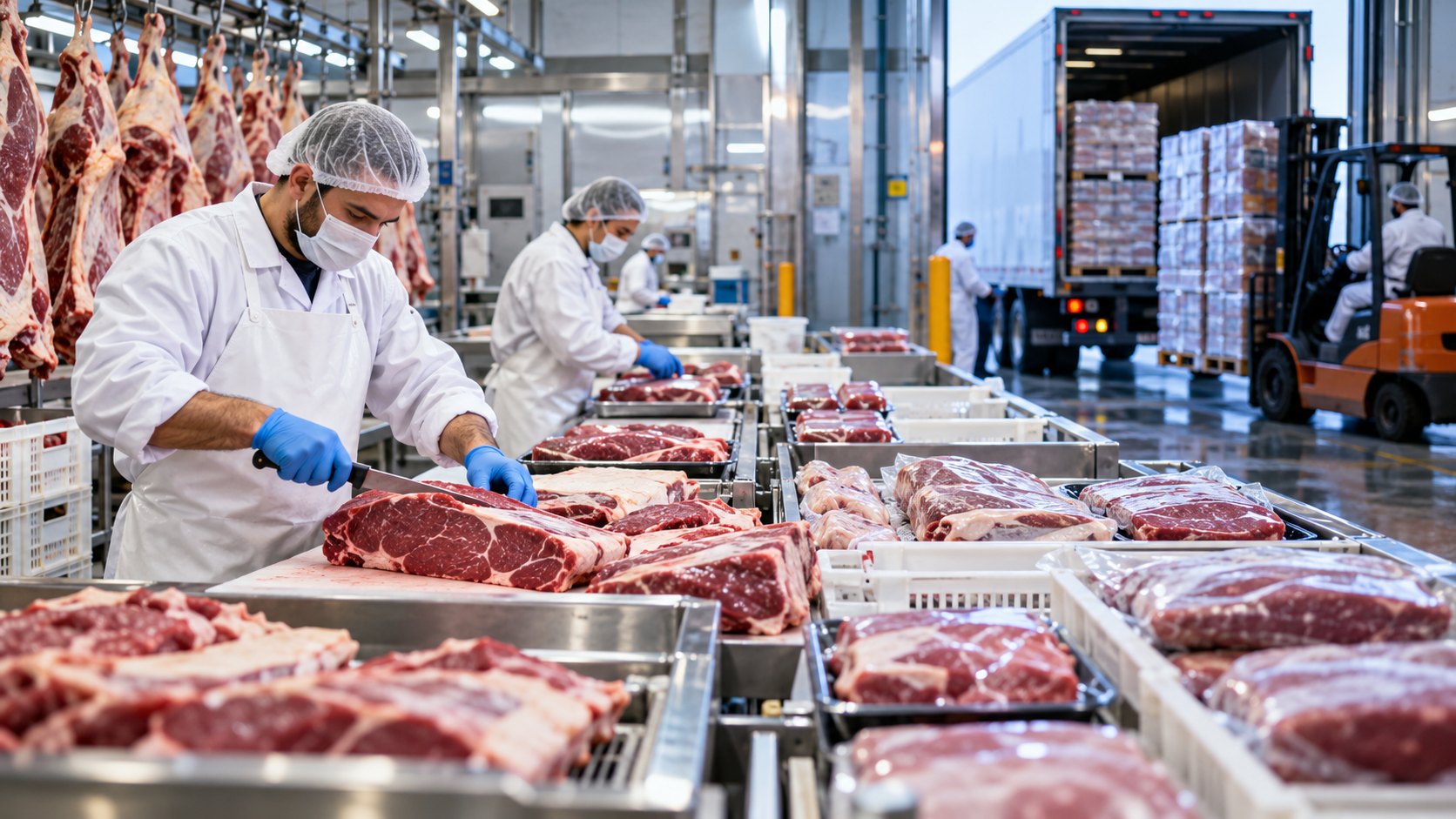
Activity CZ 264
How to Start a Fresh, Chilled and Frozen Meat Trading Business in Dubai
One activity name holds three businesses. Chilled meat is sold against a clock measured in days and frozen against a cold-store bill measured in months, and the documents travel with the goods.
ConsultZone licensing desk
- Activity code
- CZ 264
- Category
- Trading
- Reviewed
- Read
- 8 min
Topic summary
How to Start a Fresh, Chilled and Frozen Meat Trading Business in Dubai
Read the activity name slowly and it contains three businesses, not one. Fresh & Chilled & Frozen Meat Trading puts two completely different trades under a single line, and an operator who has not decided which of them he is in will buy the wrong cold store, hire the wrong salesman and price the wrong product.
Chilled meat is sold against a clock. The shelf life is measured in days, it typically arrives by air or on a short sea leg, it commands the best price in the market, and every day it sits in your chiller is a day of its value gone. Frozen meat is sold against a bill. The life is months, it travels by sea in container loads, the price per kilo is a fraction of chilled, and the cost that decides whether you made money is the capital and the electricity standing in a cold store for however long the stock takes to move.
They share a licence, a product category and a customer list. They share almost nothing else.
The commercial case
Chilled is a margin business with an operational clock. The buyers are hotels, restaurant groups, premium butchers and the retailers who sell on quality. They pay for consistency of cut, of grade and of arrival, and they will pay a genuine premium for it because their own menus depend on it. The trade is won on the reliability of your supply line and on the quality of your grading, and it is lost in a single week by an airfreight delay that puts a short-life consignment on the market with half its life gone.
The arithmetic is unforgiving in the right way: airfreight is expensive, so every kilo has to be sold near full value. A chilled trader who discounts is usually not discounting — he is liquidating something he failed to place in time.
Frozen is a volume business with a financing cost. The buyers are the broad food trade: caterers, canteens, institutional kitchens, processors, supermarket value lines and the re-export market. They buy on specification and price, and they do not pay a premium for anything. The money is made at the buying end, by taking a position on a market and a currency and buying well, and it is lost by holding too long — because stock has a storage cost per month and a price that moves while it sits.
This produces the two characteristic failures of the trade, and they are opposites. The chilled operator fails by running out of time. The frozen operator fails by running out of patience with a market and buying a large position that then moves against him.
A third fact sits over both and belongs in the commercial case rather than in a compliance footnote. Meat is one of the few goods where a rejection is total. Dry grocery with a label problem is re-labelled. Supplements are re-worked. A refused meat consignment is not corrected, re-presented and sold — it is returned or destroyed, and destruction is a cost on top of the loss. That single asymmetry is why experienced meat traders spend disproportionate effort on documents and on suppliers, and why the cheapest offer in this trade is very often the most expensive.
six choices, weighed against the same rule
What it givesWhat it costs
- Airfreighting chilled cutsThe best price in the market, and buyers who stayFreight per kilo that only full-value selling can carry
- Buying frozen by the containerVolume, a long selling window and a position you can tradeCapital and electricity standing still until it moves
- Taking carcasses and breaking them yourselfYield control, and cuts matched to each customerA cutting room, skilled butchers and a different activity to hold it
- Buying ready primals and portionsA simpler operation and no processing standard to meetThe processor's margin, and his pack sizes rather than yours
- Renting third-party cold storeCapacity that rises and falls with the stockA rate per pallet per month, and somebody else's priorities at the door
- Selling to hotels rather than retailSpecification buying, stable volumes, better pricesApproved-supplier paperwork and a delivery window you cannot miss
The focus row is the one that quietly changes the business. Breaking carcasses is where the yield and the margin are, and it is also the moment the operation stops being a trade and becomes a processing one, with the premises standard, the staff requirements and the inspections that go with it. It is an excellent decision made deliberately and an expensive one made by drift.
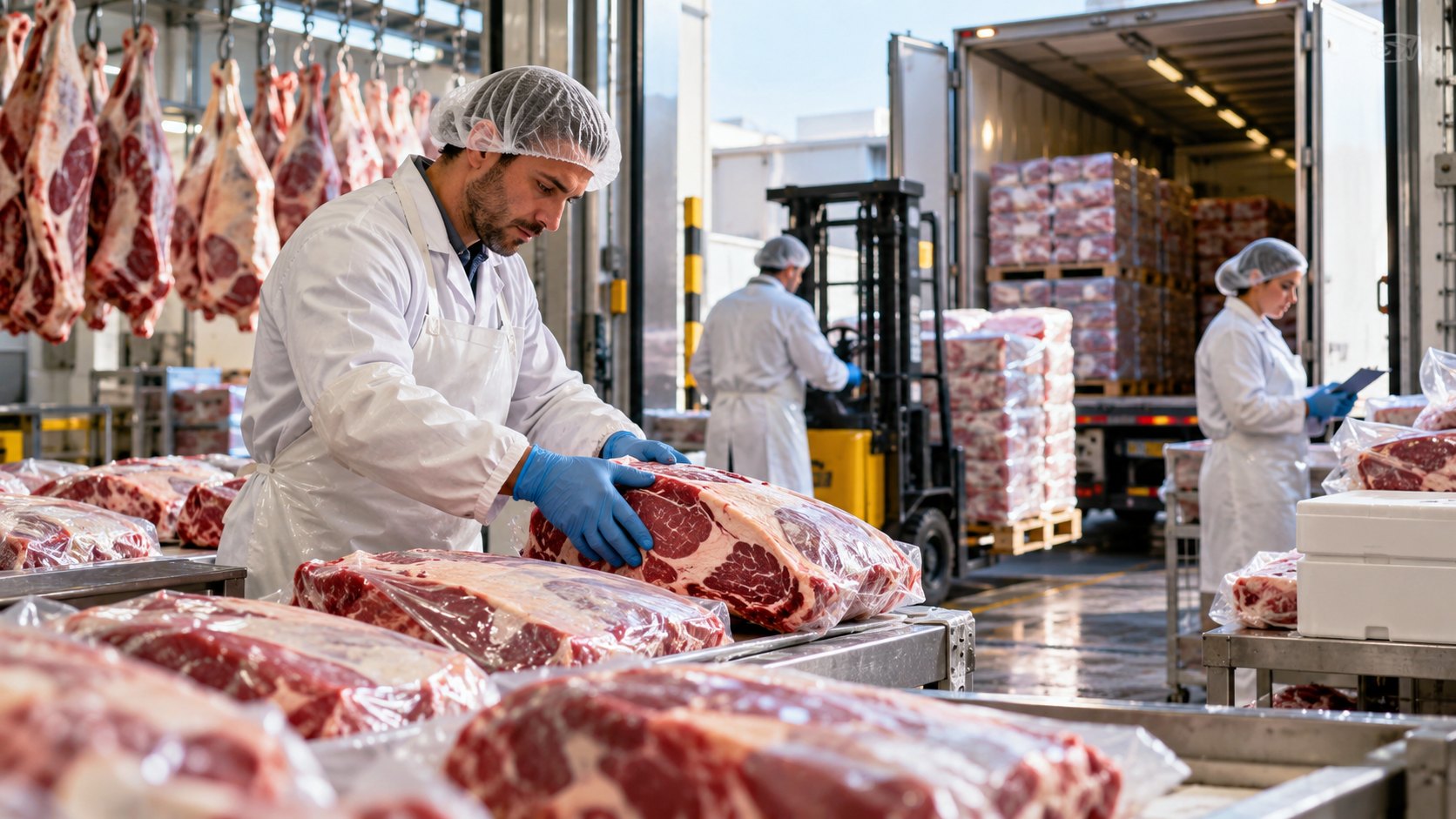
CZ 264 — Fresh & Chilled & Frozen Meat Trading
The line covers the import, holding and wholesale of meat and poultry in the states its name gives: fresh and chilled carcasses, primals, portions and offal; frozen carcasses, cartoned primals, portions, trim and poultry; beef, veal, lamb, mutton, goat, camel and poultry; and the packaging and labelling those arrive in.
What the trade is actually about, in one paragraph
You are buying a perishable commodity from a slaughterhouse abroad, on a specification that describes species, cut, grade, weight range, chill or freeze state and production date, and you are selling it to buyers who will reject it for any deviation from that description. The skill is in writing the specification tightly, choosing suppliers who meet it without being chased, and matching what arrives to the customers who want exactly that. Everything else — the cold store, the vehicles, the paperwork — exists to protect goods you have already committed to.
The cold chain is the only thing with no second chance
Temperature is not a quality attribute in this trade, it is the product's validity. A chilled consignment that rises above its range, or a frozen one that softens and is re-frozen, is not a lower grade of the same thing — it is unsellable, and the evidence is usually in the data logger rather than in the appearance. That is why traders in this line monitor and keep the temperature record per consignment, and why the handover points — the quay, the reefer, the cold store door, the delivery van — get more attention than anything inside the warehouse.
Approvals and conditions that attach to it
The documents travel with the goods, not with the trader. This is the structural fact that distinguishes meat from every other line in this family. Each consignment arrives with its own set — what it is, where it was slaughtered, under what health conditions, and the halal slaughter certification issued by a body the UAE recognises for that country and that plant. Your licence is not a substitute for any of it. A container whose papers do not match its contents is a refused container, and as the commercial case above explains, that is a loss rather than a delay.
The plant matters as much as the product. Meat is accepted from establishments the UAE authorities are willing to accept it from, which means the identity of the slaughterhouse is part of your buying decision rather than a detail of it. Changing supplier is therefore never purely commercial, and a price from an unfamiliar plant is not comparable with a price from an approved one.
Food control reaches the premises as well as the goods. The cold store, the chillers, the loading area and the vehicles are assessed on what is actually kept and carried in them, by the municipality in the emirate concerned, and meat attracts closer attention than ambient goods because the consequences of getting it wrong are higher. Raw meat separation, drainage, cleaning and temperature recording are the ordinary subjects.
Processing is a separate standard. As the focus row above says, cutting, de-boning, mincing, marinating or re-packing into retail packs is production rather than trading, with its own activity and its own premises expectations.
And health standing for the people is part of it. Staff who handle meat are subject to health and handling requirements, continuously rather than at hiring.
What the licence costs to hold, which emirate suits the customer base, which plants and origins are acceptable for a given product, what the cold store must provide and what changes if the operation starts cutting are all settled by the licensing authority, the food control authority and the premises. ConsultZone establishes those against the real product list and the real supplier list before stock is committed, because in meat the supplier and the cold store are chosen before the first sale and are both expensive to change.
References
- Dubai Municipality — food control for meat and poultry, premises and vehicle suitability, and food handler requirements. Dubai Municipality
- Ministry of Climate Change and Environment — animal health, veterinary control and food security behind the import of animal products. MoCCAE
- Abu Dhabi Agriculture and Food Safety Authority — food safety and animal health control where the trade operates in Abu Dhabi. ADAFSA
- Dubai Customs — import procedures, customs codes and the handling of restricted consignments. Dubai Customs
- UAE Government portal — the federal food safety framework and the halal conformity system behind consignment certification. UAE Government portal
Elsewhere in Trading
Activities that sit beside this one
Most licences carry more than one activity. Adding a neighbouring line at the application stage costs a fraction of amending the licence afterwards.
Begin with a clear conversation
Tell us what you intend to build.
A consultant will map the structure, jurisdiction, approvals and likely cost against what you actually described — not against a package.
