
Activity CZ 258
How to Start a Food and Beverages Trading Business in Dubai
The widest line in the catalogue hides three different businesses. Which part of food and beverages trading you actually fund matters far more than the licence that lets you touch all of it.
ConsultZone licensing desk
- Activity code
- CZ 258
- Category
- Trading
- Reviewed
- Read
- 7 min
Listen instead
40 seconds
An audio summary of this guide.
Topic summary
How to Start a Food and Beverages Trading Business in Dubai
This is the broadest activity in the catalogue and the one chosen most often for the wrong reason. Food & Beverages Trading will let you buy and sell nearly anything a person can swallow, and a new entrant reads that breadth as freedom. It is not. It is a licence that declines to make the only decision that matters, which is which part of the trade you are actually going to fund.
Dry grocery, fresh produce and packaged drinks sit under this one line and they are three businesses with three different balance sheets. The goods behave differently, the customers pay differently, the vehicles are different and a bad week costs a different amount of money in each. A trader who has not chosen between them before he signs a tenancy will end up with premises that suit none of them.
What the activity covers
The line is a general wholesale and import trade in food and drink: dry and ambient grocery, canned and packaged goods, rice, flour, pulses, oils, sugar, tea and coffee, confectionery and snacks, dairy and chilled lines, fresh produce, and the whole range of packaged beverages from water and juices to carbonated and energy drinks. It covers bringing goods in, holding them, and selling them on to businesses that will sell or serve them.
What it does not do is tell you anything about the shape of your working capital, and that is where the three businesses pull apart.
Dry grocery is slow and forgiving. A pallet of rice does not care how long it takes you to sell it. Shelf life is measured in months or years, the warehouse is ambient, and a mistake is recoverable — you discount, you wait, you sell it next quarter. The price of that forgiveness is that everybody else can do it too, so the margin is thin and the game is buying volume well and turning stock often enough to make a small percentage worth having.
Chilled is fast and unforgiving. Dairy, chilled juice, short-life ready lines. Here the clock starts at the factory and does not stop, you need refrigerated storage and refrigerated vehicles before the first order, and a delivery that misses its window is a credit note. Margins are better precisely because the barrier is real.
Drinks are a freight business wearing a food label. This is the half most new traders mis-price. Bottled water, soft drinks and juices are heavy and cheap: a pallet is worth a fraction of what the same pallet is worth in confectionery, while costing exactly the same to lift, store and move. The whole commercial question is cost per case delivered, which means route density and vehicle fill rather than clever buying. A drinks trader with scattered customers loses money on good orders.
The question that settles the premises
- Fix what the company will genuinely carry, by category and not by ambitionThe licence covers everything; your money does not
- Name the customer type before the product list — groceries, caterers, hotels or retail chains all buy differently
- Must the goods hold a temperature from the factory to the shelf
- YesRefrigerated storage and refrigerated vehicles are a condition of the first order, not an upgrade for later
- NoShelf life buys you the time to sell, and ambient warehousing is enough to start
- Size the store and the fleet against that answer, then sign the tenancy
- A premises and a product list that agree with each otherThe commonest expensive mistake in this line is a warehouse chosen before the range was
That fork is the whole planning problem in one drawing. Everything above the question is a commercial choice you are free to make; everything below it is decided for you by the answer. Traders who reverse the order — premises first, range afterwards — spend the first year carrying what the building allows rather than what the market wanted.
The buyers, and the route to them
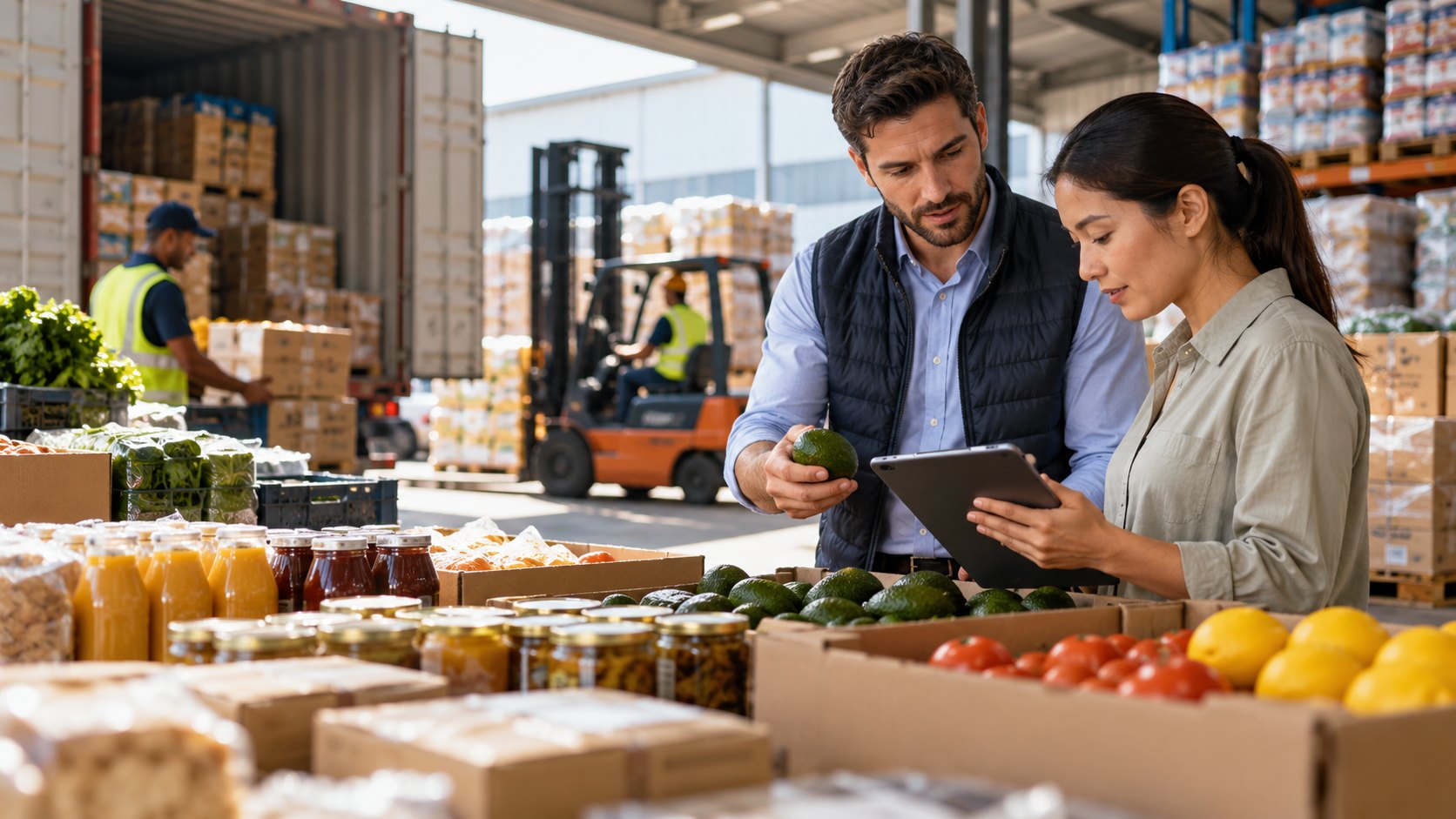
Four buyer types, and they pay on very different terms.
Groceries and independent retailers buy small, buy often and buy on credit they will stretch. They are the easiest accounts to open and the hardest to collect from, and a trader who opens fifty of them without a credit discipline has sold his stock and bought a debtor book.
Hotels, restaurants and catering buy to a specification and a delivery window, and they expect consistency above price. The order sizes are good and the paperwork is heavier — approved supplier lists, product documentation, delivery schedules. They are slower to win and much better to hold.
Supermarket chains are the prize and the trap. Volume that transforms a small trade, against listing terms, promotional support, strict delivery performance and payment on their calendar. A trader who wins a chain listing without the working capital to carry it finds that growth and insolvency look the same from inside.
Other traders and re-exporters buy container loads and pay fast, and give you almost no margin for doing so. Useful for clearing position and for turning capital; not a business on its own.
The route to all four is sampling and proof rather than advertising. Nobody in this trade buys from a brochure: they buy because somebody they trust already carries you, and because your last ten deliveries arrived complete and on time. Fill rate is the sales pitch.
Conditions that attach to the goods
Food is controlled everywhere in the world and the UAE is no exception, so the honest way to think about this line is that two separate things have to be in order: the company, and each product.
The product has to be cleared before it can be sold. Every food and drink line brought into the country is assessed on what it is — composition, ingredients, origin, shelf life, intended use — and on its label. The company's licence gets you the right to trade; it says nothing about any particular carton. That is why a first shipment can sit while a product file is completed, and why experienced importers start the product work before the goods are ordered rather than after they land.
The label is a document, not decoration. What a pack may say, in which languages, and which details must appear are matters of food control rather than marketing. The practical consequence is a sharp difference between the three halves of this trade: a dry grocery consignment with a label problem can usually be re-labelled and presented again, while a short-life chilled line in the same position is losing days of its life every day the question is open, and produce in that position is simply lost.
Some drinks sit inside the excise regime and some do not, and which is which is decided by what the product is rather than by where it is sold. For a trader in sweetened and energy drinks this is a tax enrolment question that belongs in the plan from the start, because it changes the landed cost of the goods and therefore the price list.
And the premises are part of the goods' condition. Food storage is inspected against what is actually stored — temperature, separation, pest control, cleaning, how stock is rotated. A unit that is adequate for packaged grocery is not automatically adequate for chilled, and the authority looks at the building rather than at the activity name on the licence.
What the licence costs to hold, which emirate suits the customer base, what the store must provide for the range actually carried and what each product needs before its first sale all depend on the licensing authority and the goods themselves. ConsultZone settles those against a real product list, because in this line the range decides the premises and the premises decide what the business can ever sell.
References
- Dubai Municipality — food control, product and label assessment, and the suitability of food storage premises. Dubai Municipality
- Dubai Customs — import procedures, customs codes and the treatment of restricted and prohibited goods. Dubai Customs
- Federal Tax Authority — VAT and the excise regime that applies to certain beverages, and enrolment for both. Federal Tax Authority
- UAE Government portal — federal food safety and food security policy behind the import framework. UAE Government portal
- Abu Dhabi Agriculture and Food Safety Authority — food safety control where the trade operates in Abu Dhabi. ADAFSA
Elsewhere in Trading
Activities that sit beside this one
Most licences carry more than one activity. Adding a neighbouring line at the application stage costs a fraction of amending the licence afterwards.
Begin with a clear conversation
Tell us what you intend to build.
A consultant will map the structure, jurisdiction, approvals and likely cost against what you actually described — not against a package.
