

Activity CZ 168
How to Start an Amusement and Arcade Equipment Trading Business in Dubai
Arcade and amusement equipment is a capital sale to a venue operator, so uptime and spares win the order rather than price. What the line covers, who buys it, and where the licence sits.
ConsultZone licensing desk
- Activity code
- CZ 168
- Category
- Trading
- Reviewed
- Read
- 8 min
Listen instead
50 seconds
An audio summary of this guide.
Topic summary
How to Start an Amusement and Arcade Equipment Trading Business in Dubai
Nobody buys an arcade machine. A venue operator buys a certain number of paid plays per week, for the next five years, out of a cabinet that has to survive children, humidity and a cleaner with a wet mop. That is why almost no order in this trade is won on the price of the machine, and why a supplier who cannot answer a question about spares lead times loses to one who can.
It makes this a capital-equipment business wearing a toy shop's clothes. The buyer has a floor plan, a rent per square metre and a payback calculation, and the machine is an item on a schedule of assets. The supplier's real product is the combination of the cabinet, the installation, the technician who arrives when it stops working, and the parts on the shelf that keep it earning.
What sits inside this line, and what the word "equipment" hides
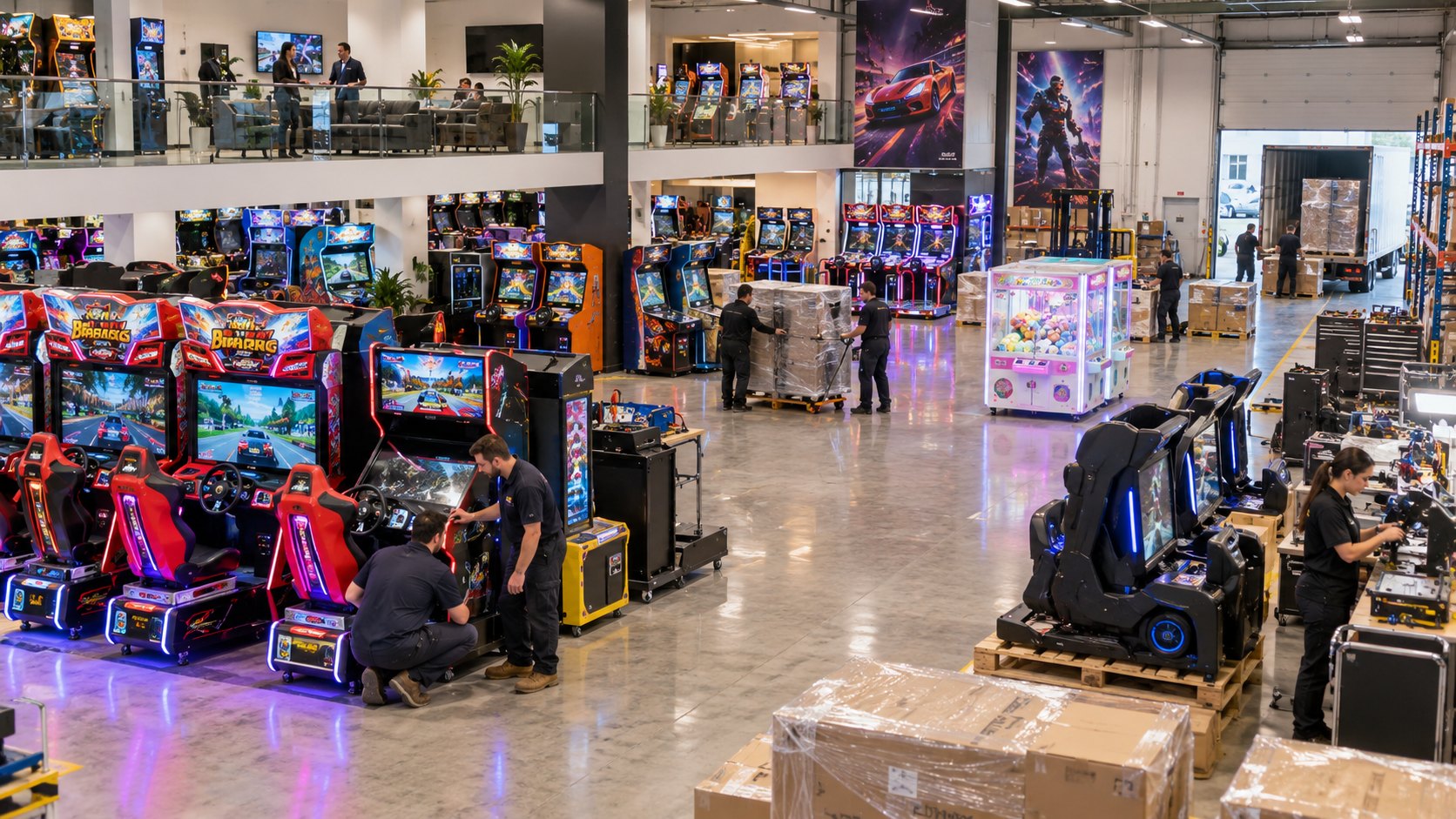
The visible half of the catalogue is the cabinets: coin- and card-operated amusement machines, driving, racing and shooting simulators, virtual reality rigs and motion platforms, air hockey, basketball and boxing machines, crane and prize cabinets, ticket-dispensing redemption machines, photo booths, pinball, bowling lanes and their pinsetters, and the soft-play structures, climbing frames and party fit-out that fill the rest of a family entertainment centre.
The half that decides the relationship is less obvious. It is the cashless play system — the card readers on every machine, the top-up kiosks, the back-office software and the reporting the operator's whole revenue picture depends on. An operator can change a machine next year. Changing the card system means re-fitting every cabinet on the floor, so whoever supplies it holds the account. It is routinely the most commercially important item on the first invoice and it is the one buyers scrutinise least.
Then the consumables and spares: monitors, joysticks and buttons, bill validators and coin mechanisms, ticket printers and the tickets themselves, motors, belts, bearings, wiring looms, prize stock for the crane cabinets. The machine sells once. The parts sell for as long as the machine runs, and that is the recurring revenue the capital sale exists to create.
This is a trading line, not an operating one
Supplying equipment to venues is a different business from running an arcade. Operating a public amusement floor means premises, footfall, staff, public-safety conditions and its own licensing conversation in the emirate where the venue sits. Some suppliers do both deliberately, and when they do it is two activities and usually two structures — not one licence stretched over both.
The buyer is a venue operator with a payback target
The customer list is narrower than the catalogue suggests: family entertainment centres, mall and retail-park operators, cinema lobbies, hotel and resort kids' clubs, bowling and karting centres, holiday and water parks, residential compound clubhouses, larger schools occasionally, and the fit-out contractors who buy on all of their behalf.
What they are actually deciding is revenue per square metre. The first question a serious operator asks is not what the machine costs but what it earns per week and how that compares with the machine it would replace. The answers that win orders are a proven earner with a track record in this region, parts availability measured in days rather than weeks, a technician who can be on site the same weekend, installation and commissioning included, and the ability to supply a whole floor from one invoice so the operator is not coordinating five suppliers against an opening date.
That opening date is the other thing to understand about the route to market. Sales here are tied to venue openings and refurbishments, which means a long cycle, a pipeline built out of fit-out contractors and mall leasing teams, and delivery dates that slip because the venue's own handover slipped. A supplier who has committed capital to stock for a January opening that becomes an April opening has learned the working-capital lesson of this trade.
And the service tail is not aftercare, it is the proposition. A cabinet that is down on a Friday evening has lost the whole weekend, which on a busy floor is most of its week. Operators remember response times far longer than they remember discounts.
There are three ways to be in this trade, and most established suppliers end up in more than one. Selling and installing machines on your own account ties up capital in stock and hands the earning risk to the operator. Placing machines on a share of what they take keeps the asset and the risk with you and pays back slowly, but it opens doors with operators who will not spend capital. Supplying spares, parts and service alone needs almost no stock of cabinets, starts immediately, and is the part of the business that keeps earning when nobody is opening a venue.
judged on the same six rows
| Judged on | Distribution and install | Machines on revenue share | Spares and service only |
|---|---|---|---|
| Capital tied up in machines | Heavy | Heaviest, and it stays yours | Light |
| Where the income comes from | The margin on the sale | A share of what the machine takes | Parts and labour |
| Who carries a cabinet that earns nothing | The operator | You | Nobody |
| Needs technicians on call | Yes | Yes | It is the product |
| Needs a parts stock and a workshop | Some | Yes | Yes |
| How quickly it can be started | Once the first stock lands | Slowly | Almost immediately |
Two boundaries worth settling before the first container
Prize and redemption machines sit close to a line that matters here, and it is not a line to test with stock already on the water. A machine that takes payment and returns tickets or tokens exchangeable for merchandise on a prize wall is understood as amusement equipment. A machine whose outcome turns on chance against a stake and returns something of monetary value is a different proposition entirely, and it belongs to a category that is treated very differently in this region. The honest advice is not a rule of thumb: it is to put the exact model, its payout mechanism and its software in front of the licensing authority in the emirate concerned, get the position in writing, and only then order. Every other condition in this trade is a commercial cost of being wrong. This one is not.
An imported machine is electrical equipment before it is entertainment. A mains-powered cabinet is a product placed on the UAE market and carries the conformity expectations that go with that, and anything containing a wireless card reader, a network module or a radio is separately a matter for the telecommunications regulator, product by product, before import rather than after. The physical items have a second layer: a motion simulator, a climbing frame or a soft-play structure is a structure as well as a machine, and the venue's own premises and public-safety approvals will require documentation from you. A supplier who can hand over a complete file with the delivery is worth more to an operator than one who cannot, and it costs nothing to build that habit from the first shipment.
Where the licence sits depends on whether you install, or only ship
The mainland and free zone question in this line is decided by one thing: whether the company intends to sell to UAE venues and put its own technicians on their sites, or to hold regional stock and move it on.
A mainland licence is what lets a company invoice a UAE venue directly, hold a customs code in its own name, send service engineers to a customer's premises inside the country, and be considered for work at government and semi-government venues. A free zone licence suits the warehousing and re-export half of the business — holding stock for the wider region, shipping to operators in neighbouring markets, and selling into the UAE through a mainland distributor rather than to the end venue.
Suppliers of any size here frequently run both, on purpose: the free zone entity carries the regional stock and the import flow, and a mainland entity carries the UAE sales and the service arm. That is a structuring decision with real consequences for cost, staffing and how a warranty is honoured, and it is worth making deliberately rather than discovering after the first service call.
What any of it costs — the licence, the warehouse, the workshop space, the approvals a particular product range attracts — depends on the emirate, the jurisdiction and the mix. A small office selling against a manufacturer's stock and a distributor holding forty cabinets and a parts store are not comparable numbers, and we establish them against the actual plan.
References
- Ministry of Industry and Advanced Technology — national standards and conformity marks for equipment placed on the UAE market. Ministry of Industry and Advanced Technology
- Telecommunications and Digital Government Regulatory Authority — type approval for card readers, wireless modules and any radio device inside a cabinet. Telecommunications and Digital Government Regulatory Authority
- Dubai Customs — import clearance, the importer's own customs code, and restricted and prohibited goods. Dubai Customs
- Dubai Municipality — premises suitability and public health conditions for venues and storage in Dubai. Dubai Municipality
- UAE Government portal — federal law and general government information on activities subject to special control. UAE Government portal
Elsewhere in Trading
Activities that sit beside this one
Most licences carry more than one activity. Adding a neighbouring line at the application stage costs a fraction of amending the licence afterwards.
Begin with a clear conversation
Tell us what you intend to build.
A consultant will map the structure, jurisdiction, approvals and likely cost against what you actually described — not against a package.
