
Activity CZ 220
How to Start a Cafeteria Business in Dubai
A cafeteria sells a cheap item to the same people every working day, so the catchment decides the revenue before the menu is written. The kitchen approval is cheapest to ask for before fit-out, not after.
ConsultZone licensing desk
- Activity code
- CZ 220
- Category
- Food & Hospitality
- Reviewed
- Read
- 7 min
Listen instead
41 seconds
An audio summary of this guide.
Topic summary
How to Start a Cafeteria Business in Dubai
A cafeteria earns by selling something inexpensive to the same people on most of the days they go to work. Nobody travels to one. The trade comes from a labour accommodation, an industrial yard, a hospital, a school, an office block, a souq or a bus route — somewhere a population of people is already obliged to be at eight in the morning and at one in the afternoon. The implication is blunt and it decides everything else: the site caps the revenue, and it caps it for the entire length of the lease. A better cook on a quiet street loses to an ordinary one beside a gate four hundred people walk through twice a day.
The second fact follows from the first. A customer buying breakfast five mornings a week has a price in his head that barely moves, and he will not wait. Two things therefore decide whether the outlet works: how many people pass the door, and how fast the queue clears at the only two moments of the day that matter. A cafeteria is a throughput business with a kitchen attached, which is why the layout behind the counter earns more attention from an experienced operator than the recipes do.
A cafeteria is a counter, a short menu and a queue that has to keep moving
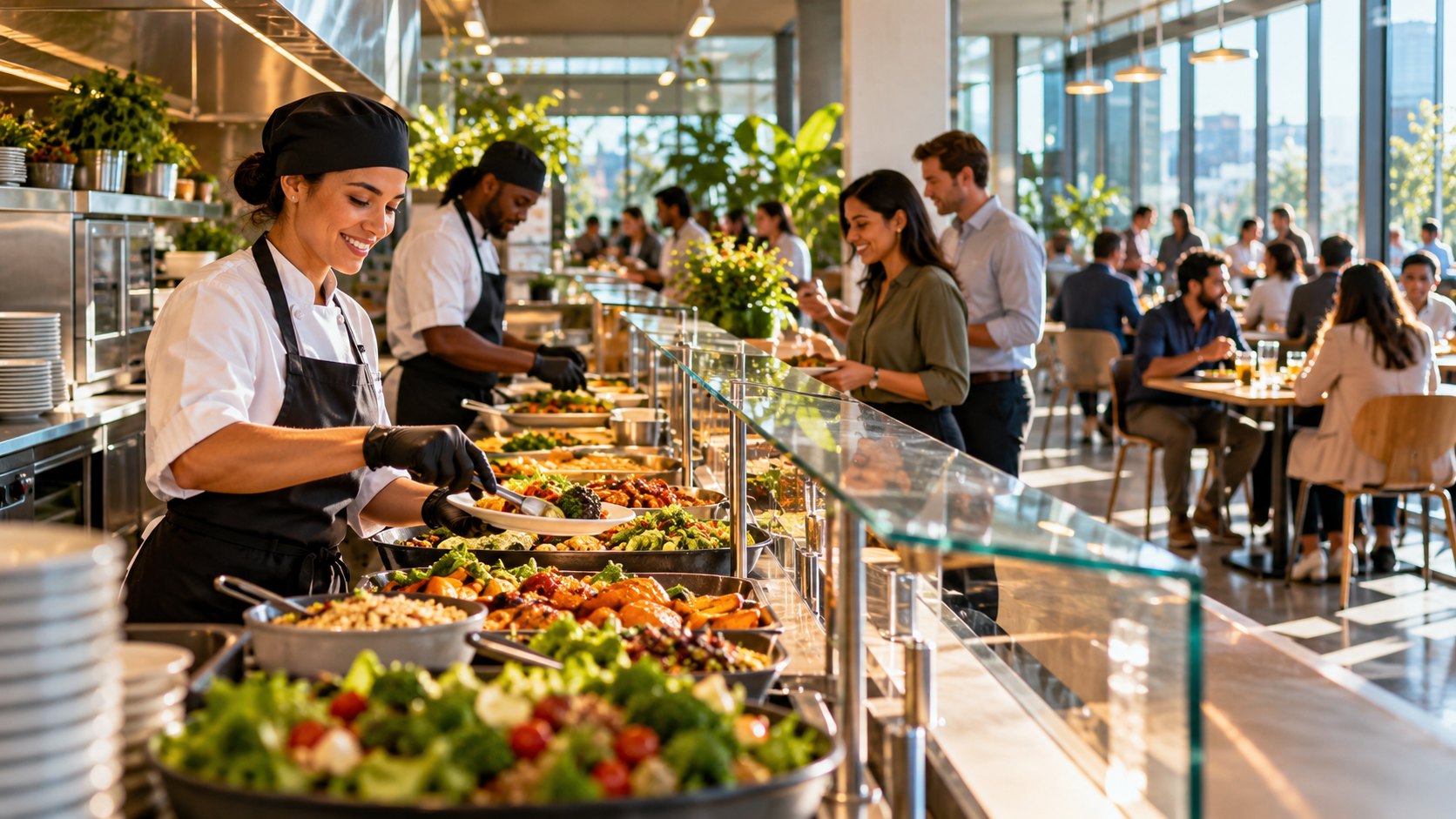
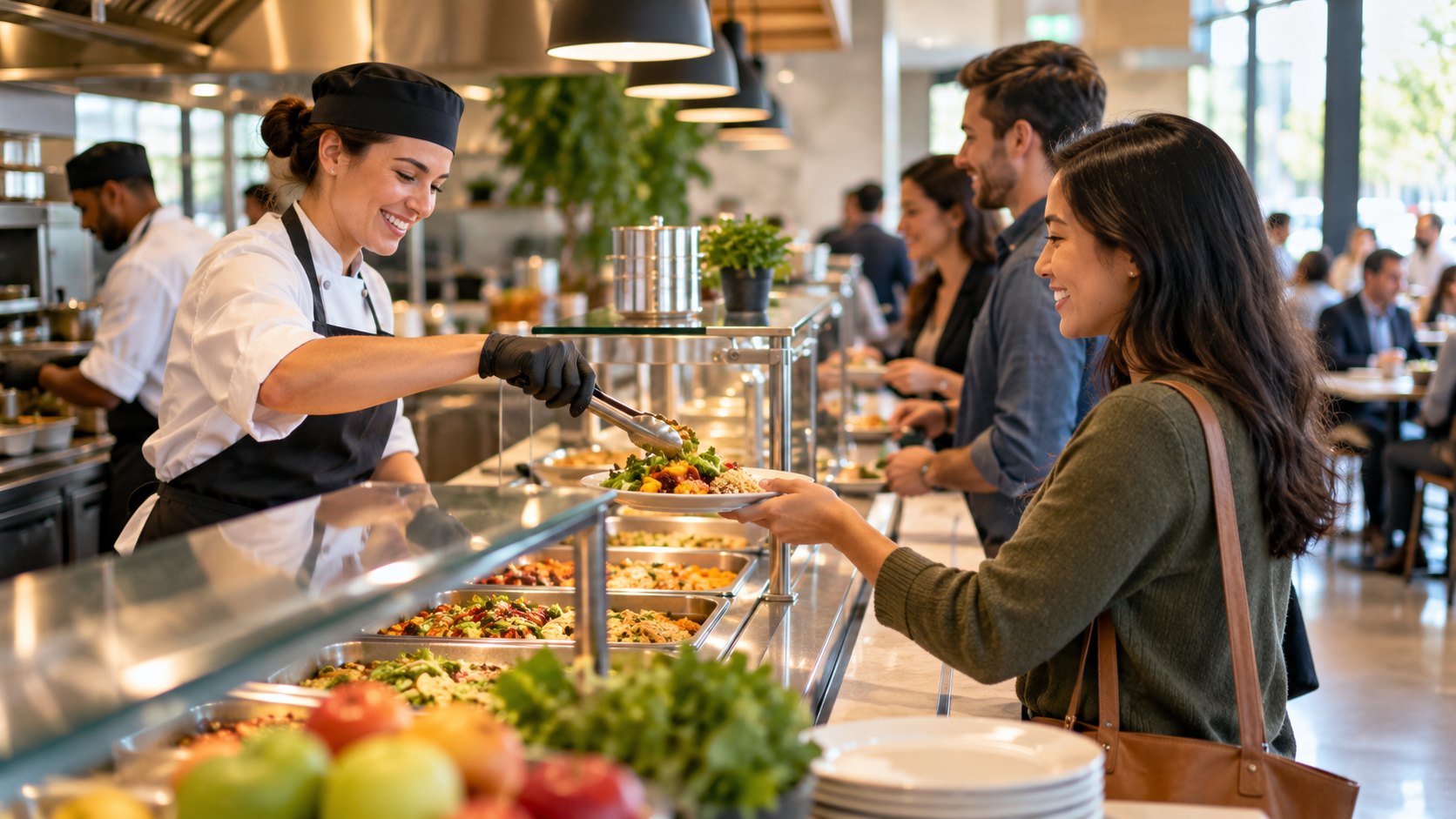
The activity covers preparing and serving food and drink from fixed premises for immediate consumption, over a counter rather than at table, with a limited menu produced in a small kitchen. In practice that means breakfast and lunch service, hot drinks and juices, sandwiches and a handful of cooked dishes made in volume, packaging for takeaway, and in many cases delivery to nearby offices and yards — which is often a third or more of the revenue and is planned for rather than discovered.
What distinguishes it from the restaurant line, CZ 344, is not the quality of the food but the service model and the cost base it implies. There are no waiters, no reservations, no long menu and no expectation that a customer will stay. The kitchen is small, the equipment list is short, the staff are few and the ticket is low. Those constraints are the business model: a restaurant covers a higher rent with a higher spend per head, while a cafeteria covers a lower rent with volume. Mixing the two — a long menu and table service on cafeteria pricing — produces the one failure mode this trade reliably has.
The licence is the easy part of opening. The sequence around it is not, and it has an owner at every step.
- Choose the catchment before the unit, and the unit before the menuCaps the revenue for the whole length of the lease
- Trade licence carrying the cafeteria activityCreates the company and lets the lease be signed in its name
- Kitchen layout and food premises approval, before any fit-out beginsDecides whether the unit can open at all, and asking first is far cheaper
- Extraction, gas and fire provisions built into the unitFixes what the kitchen can actually cook, whatever the menu says
- Food handler training and health cards for every pair of handsDecides whether the outlet stays open after an inspection
- Work permits and contracts for counter and kitchen staffDecides the headcount a short menu can be run with
The focus row is where money is lost in this trade, and it is lost before a single meal is sold. A unit that suits a shop will not necessarily suit a kitchen: the question is the drainage, the grease interceptor, the extraction route to the outside of the building, the gas supply, the separation of raw and cooked preparation and the washing arrangements. Fitting out first and asking afterwards is how an operator ends up holding a lease on premises that cannot be approved for food, and the landlord's agreement to cut a slab or run a duct has to be negotiated before signing rather than requested later.
The equipment list is decided by the extraction, not by the menu
Worth separating out, because it surprises people. What can be cooked in a given unit is a function of what can be extracted from it. A grill and a fryer need a duct, a canopy and a route that discharges somewhere acceptable; a unit without that route can make sandwiches, drinks and reheated food and nothing else, no matter what the signage promises. Operators who write the menu first and look at the ceiling second rewrite the menu.
The operator this suits is buying a catchment, not a cuisine
The entrant who does well here has usually worked in one. A supervisor or head cook from an established cafeteria knows the two rush hours, knows what sells at each of them, knows what gets thrown away and knows how many hands are needed at the counter — and that knowledge is worth more than capital in a business decided by throughput.
It also suits an operator with a supply relationship rather than a cooking one: somebody already feeding a workforce, running a catering contract, or holding an arrangement with a building or a yard that guarantees a base of covers from the first week. A cafeteria with a captive population is a far better business than one on an open street, and the arrangement behind it is worth more than the fit-out.
It does not suit someone whose plan is a cuisine. A cafeteria is not where a distinctive kitchen is appreciated or paid for, and an operator who wants that should read the restaurant line instead. It does not suit a passive investor, because the margins are thin enough that an absent owner's losses show up in portions, waste and theft before they show up in the accounts. And it does not suit anyone who has not stood at the door of the proposed unit at the exact hours the trade would arrive — which costs a morning and is the single most useful thing a prospective operator can do.
The premises decide this, and a free zone unit serves only its own population
The structural question answers itself more neatly here than on most activities. A food outlet is licensed where its premises are, and its customers are the people within a few minutes' walk of the counter. A mainland licence puts the unit on an ordinary street, in an ordinary building, serving whoever passes — which is what a cafeteria is for.
A free zone licence is not wrong, but it means something specific: the outlet sits inside that zone, under that zone's own authority and its conditions, and serves that zone's workforce and visitors. For a cafeteria attached to an industrial zone, a port area or a large single-employer site that is a genuinely good business with a captive catchment, and in several cases a better one than a street-front unit. It is simply a different customer base rather than a cheaper version of the same one, and it is chosen because of where the people are.
The food approvals do not change with the choice. Food control, premises suitability, extraction and fire conditions attach to the kitchen wherever it stands, and both the detail and the authority administering them differ between emirates. How value added tax applies to the sales, and corporate tax enrolment on the profit, follow the ordinary rules for a trading business. ConsultZone confirms the licence form, the emirate and the conditions attaching to the specific unit before a lease is signed, because the lease is the commitment that cannot be undone.
References
- Dubai Municipality — food control, food premises approval, kitchen layout requirements and food handler obligations for outlets in Dubai. Dubai Municipality
- Dubai Civil Defence — fire safety, extraction and gas provisions in a commercial kitchen. Dubai Civil Defence
- Ministry of Human Resources and Emiratisation — work permits, labour contracts and wage obligations for counter and kitchen staff. Ministry of Human Resources and Emiratisation
- Federal Tax Authority — value added tax on food and drink sales, and corporate tax enrolment and filing. Federal Tax Authority
Elsewhere in Food & Hospitality
Activities that sit beside this one
Most licences carry more than one activity. Adding a neighbouring line at the application stage costs a fraction of amending the licence afterwards.
Begin with a clear conversation
Tell us what you intend to build.
A consultant will map the structure, jurisdiction, approvals and likely cost against what you actually described — not against a package.
