
Activity CZ 214
How to Start a Linens and Towels Trading Business in Dubai
A hotel does not judge a towel in the box. It judges it after the hundredth wash. What the linens trading line covers, who reorders on it, and where it stops.
ConsultZone licensing desk
- Activity code
- CZ 214
- Category
- Trading
- Reviewed
- Read
- 8 min
Listen instead
43 seconds
An audio summary of this guide.
Topic summary
How to Start a Linens and Towels Trading Business in Dubai
A hotel does not judge a towel in the box. It judges it after the hundredth industrial wash, when the pile has flattened, a hem has pulled, or the white has gone faintly grey against the one still folded in the store cupboard. That is the commercial problem of the line his sheet calls Blankets, Towels & Linens Trading, and it is why this trade is won on reorders rather than on first orders.
The goods are straightforward. Bed linen — sheets, duvet covers, pillowcases, protectors. Bath linen — towels, bath mats, robes. Table linen — cloths, napkins, runners. And the warm layer: blankets, throws, duvets and pillows. Four families under one licence line, with almost nothing in common with clothing, because none of it is fitted to a body and none of it goes out of fashion.
What they do have in common is that they are specified rather than chosen. A buyer names the fibre — cotton, a polyester-cotton blend, microfibre, bamboo — then the weight, because towelling is bought by weight per square metre and sheeting by thread count, then the finish, then the dimensions, which in a hotel are set by the mattress rather than by a size chart. Two suppliers quoting the same article name are often quoting two different products. The buyer who cannot read a specification is the buyer who ends up with the cheaper one.
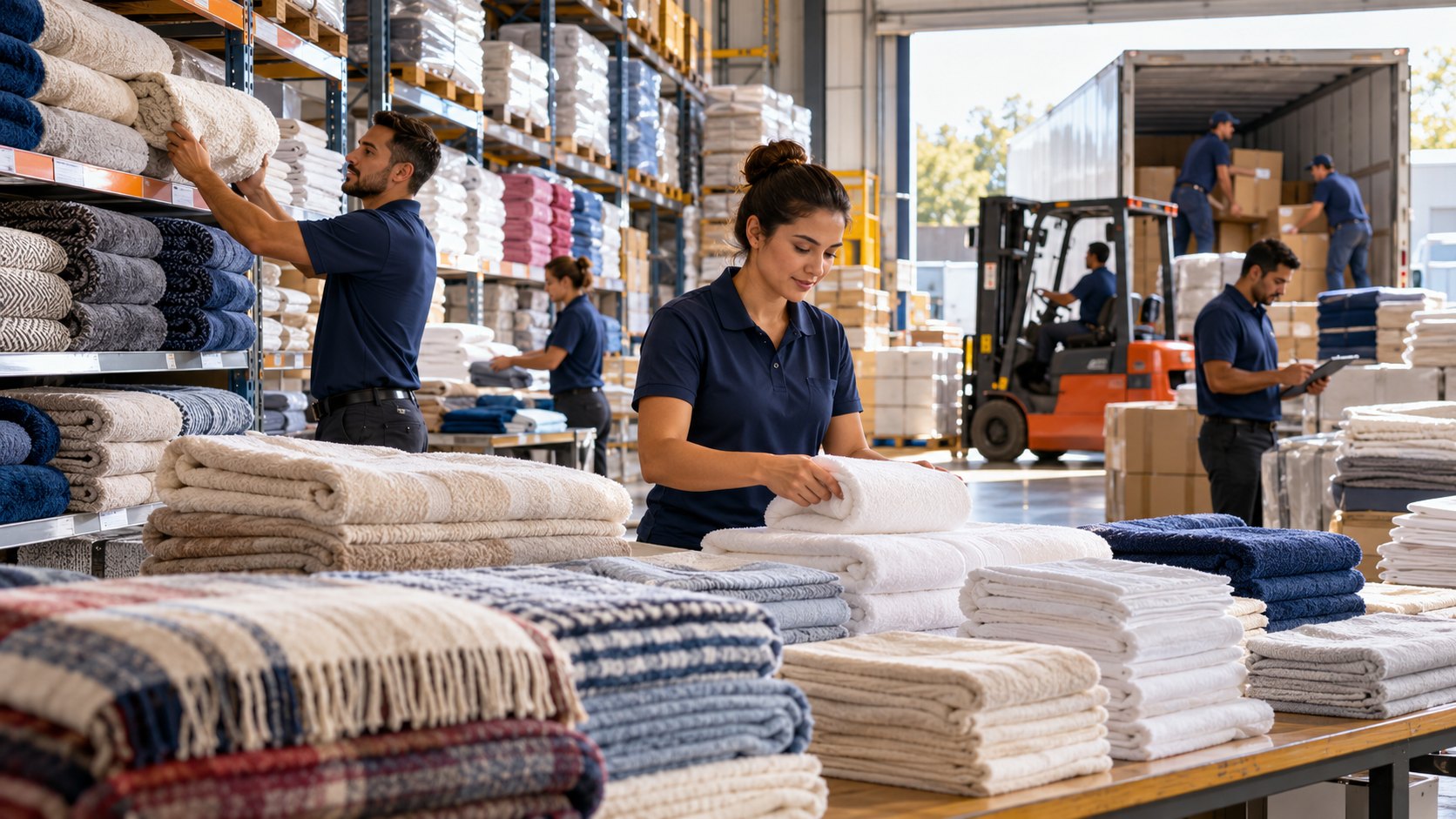
Stock behaves awkwardly here compared with most trading lines. Linens are bulky, light and low in value for the space they occupy, so the warehouse is sized in cubic metres rather than by the invoice value of what is standing in it, and sea freight is the only economic route. That one fact sets the working capital: goods have to be on the ground before the contract that consumes them, and they have to be stored dry and out of sunlight. The compensation is that the shelf life is effectively indefinite, which is unusual and genuinely useful — nothing in this warehouse expires.
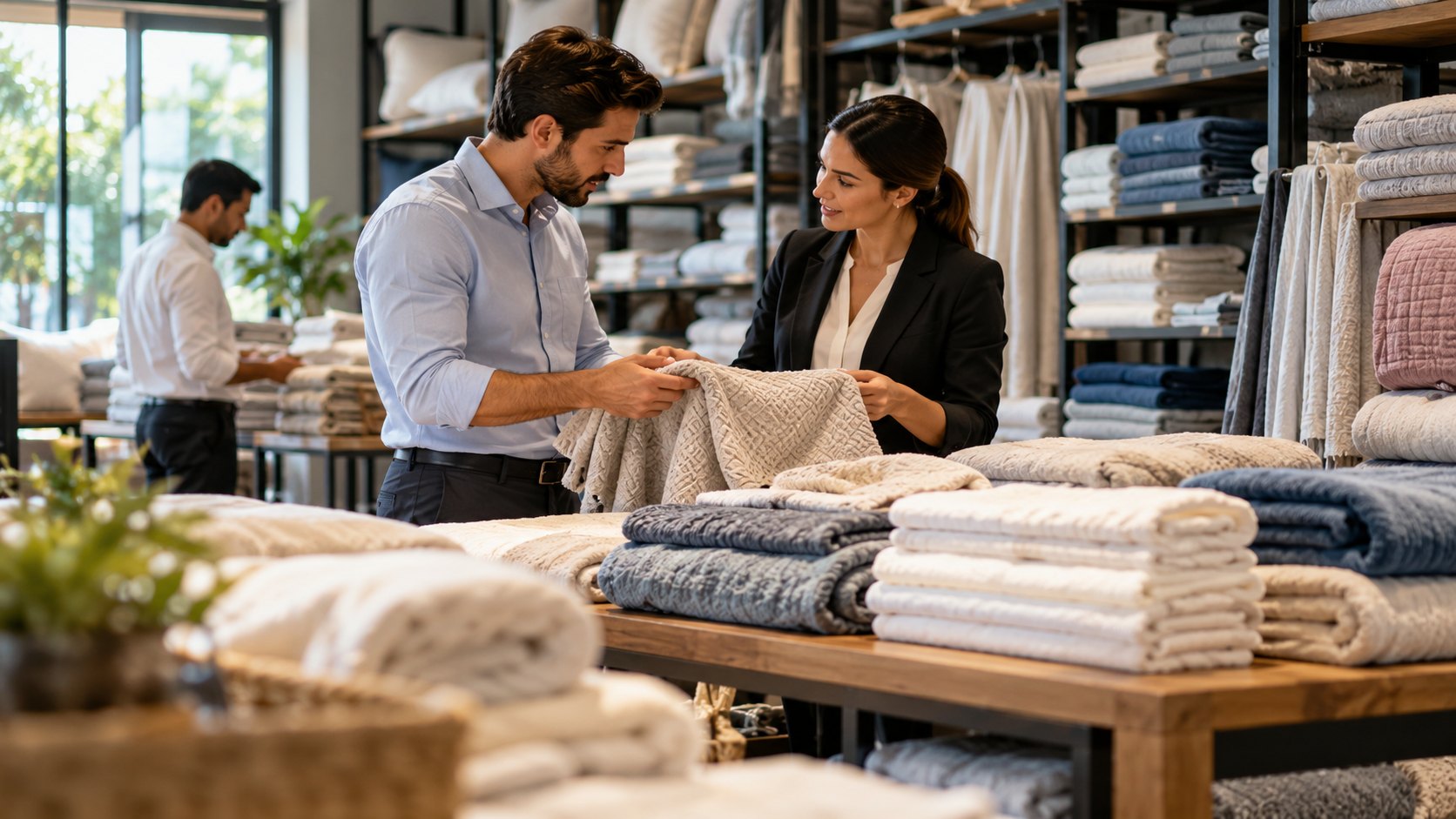
The buyer, though, comes in two kinds, and which one you are serving changes everything downstream. A contract account — a hotel, a hospital, a labour accommodation operator, a serviced-apartment manager — approves a sample and then expects every delivery for years afterwards to match it. A retail shelf buys what is in front of it, sells it, and decides afterwards whether to buy again. The first is a supply obligation. The second is a sale.
- Fix which family the goods are — bed, bath, table or the warm layer
- Settle the specification the buyer will judge on: fibre, weight, finish, size
- Is the buyer a contract account or a retail shelf
- ContractOne sample is approved, and every reorder for years has to match it
- RetailThe first order is the whole order, and the shelf decides whether there is a second
- Take warehousing sized by volume rather than by value
Who is this for?
Suppliers who already sell into hotels
Operators selling amenities, crockery or cleaning chemicals into hospitality, who want a second line through a buyer they have already won. Linen reorders on a predictable cycle and the account is open. This is the cheapest way into the trade and the one with the shortest path to a first schedule.
Importers with a shade discipline
Traders sourcing from the mills of South and East Asia, where nearly all of this product is woven. The skill is not finding a factory — that takes a week. It is holding one factory to one shade and one weight across years of reorders, and refusing the substitution the mill will offer when a yarn lot runs out.
Institutional contractors
Companies supplying accommodation, healthcare or catering under framework agreements, for whom linen is one line on a longer schedule. The attraction is the schedule. The exposure is that the specification belongs to the client and so does the remedy for missing it.
Home-textile retailers
Sellers working a shop, a department-store concession or a marketplace listing. A different business from all three above: the buyer is one household at a time, a photograph does the selling, and returns are a cost of trading rather than a fault.
CZ 214 — Blankets, Towels & Linens Trading
What sits inside the line
Buying, holding, importing, exporting and selling finished soft furnishings for bed, bath and table, together with blankets, duvets and pillows. Finished is the operative word: the goods arrive hemmed, sized and packed, and you sell them as they are. Supplying them to a hotel against a specification, to a hospital against a tender, to a shop against a purchase order or to a household over a counter are all the same activity doing the same thing to four different buyers.
Shade is what breaks contracts, not quality
White is not one colour. A towel woven from one cotton lot and a towel woven from the next differ by an amount nobody notices in a warehouse and everybody notices folded on the same rail in a bathroom. A buyer with several hundred rooms is replacing stock continuously, so every replacement is being compared against something bought two years ago.
Suppliers who keep these accounts do three unglamorous things. They keep retained samples of what was approved. They record the production lot against each delivery, so a complaint can be traced to a batch instead of argued about. And when the mill changes a dye lot they say so before shipping, rather than hoping the difference passes. A supplier who volunteers that conversation keeps the account through it; one who does not loses it on the second delivery.
The product is not used the way it was tested
An institutional laundry washes hot, with chlorine and heavy mechanical agitation, and a towel that survives domestic laundering may not survive that. The useful conversation with a hospitality buyer is about the wash the goods will actually get — the temperature, the chemistry, the number of cycles a year — because that is what decides whether the account renews. It is also the conversation that justifies a higher unit price, which is the only way to escape competing purely on it.
The reorder is where the money is
A hotel's linen is consumed rather than kept. A first fit-out order is large, visible and frequently priced to win; the account's real value is the replacement cycle behind it, which runs for as long as the property does. That reverses the usual arithmetic of a trading business. Here the opening order is the cost of entry and the margin arrives later, in small repeat deliveries nobody competes for, provided the shade still matches.
What the licence does not cover
This is a trading line, and it stops at both ends — before the goods are made, and after they are sold.
Weaving, knitting, dyeing, cutting and hemming are manufacturing, not trading. So is finishing greige towelling bought by the roll. The cloth side of the trade sits on its own line in the same sheet: CZ 363 — Textile Trading is fabric by the roll, sold to somebody who will cut it, and that is a different buyer, a different stockroom and a different conversation.
Industrial laundry and linen rental are not on this line either. The rental model, where the supplier owns the stock, launders it and delivers clean linen weekly, is the sale of a service rather than of goods. It needs plant, water, chemicals and routing, and it is the single thing new entrants most often assume is included because the customer list looks identical.
Curtains, blinds, upholstery and soft-furnishing fit-out are measured, made up and installed on site, which makes them contracting work. Supplying the fabric to the contractor is trading; hanging it is not. Mattresses and bed frames are furniture.
Clothing belongs to the garment lines: CZ 267 — Garments Trading, CZ 341 — Readymade Garments Trading and CZ 266 — Garments Accessories Trading. The boundary is finer than it sounds. A bathrobe sits here, as bath linen. A dressing gown sold as nightwear sits on the clothing lines. Settle that before the activity is chosen, because an activity is amended at a cost and the need to amend it surfaces at the least convenient moment — usually with stock already landed and no lawful way to invoice it.
Where a control does attach
Finished textiles carry the ordinary obligations of any consumer product: an accurate care and fibre-content label, dimensions that match what is claimed, and conformity with the national standards applying to that class of goods. Children's bedding and anything sold as flame-retardant are treated more strictly, because the claim itself is what gets checked. Imports clear on a declaration of what the goods are and what they are made of, and a composition declared wrongly becomes a problem at the border rather than in the warehouse. Which standards and marks apply to a particular article, and what the licensing authority in your chosen emirate will ask to see, are confirmed case by case — they turn on the goods and on the jurisdiction, and neither is uniform across the country.
References
- Ministry of Industry and Advanced Technology — national standards and conformity marks, which is the framework a finished textile article is assessed against. Ministry of Industry and Advanced Technology
- Dubai Customs — import and export declarations, customs codes, and the treatment of restricted goods in Dubai. Dubai Customs
- Dubai Municipality — premises suitability and public health conditions attaching to a warehouse or shop in Dubai. Dubai Municipality
- Federal Tax Authority — VAT and corporate tax enrolment and filing for a trading company. Federal Tax Authority
Elsewhere in Trading
Activities that sit beside this one
Most licences carry more than one activity. Adding a neighbouring line at the application stage costs a fraction of amending the licence afterwards.
Begin with a clear conversation
Tell us what you intend to build.
A consultant will map the structure, jurisdiction, approvals and likely cost against what you actually described — not against a package.
