
Answered plainly
Every founder support programme in the UAE has a gate, and the government funds are gated on an Emirati passport
Mentorship, grants, incubators, women's and youth programmes, discounted licensing — the support ecosystem is the most-cited reason to form a company in Dubai and the least-checked.
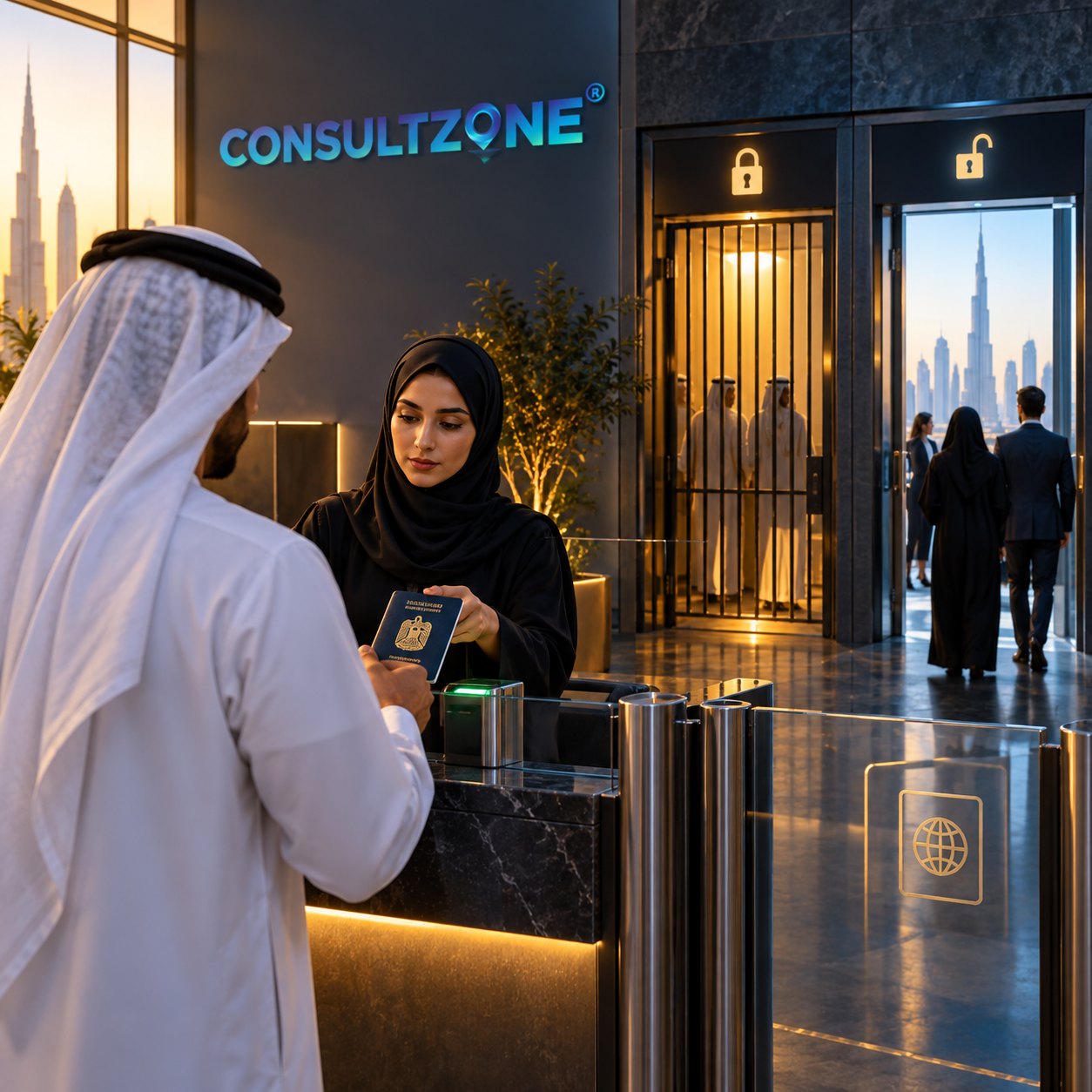
The programme is the headline; the screen is the fact
Almost every argument for forming a company in Dubai eventually reaches the ecosystem. Incubators. Grants. Mentorship. Councils for women founders and programmes for young ones. Government funds with names that sound like doors.
The programmes are real. What is almost never printed alongside them is the screen — the specific thing each one checks before it will look at you. And the screens differ so widely that "support is available" is close to meaningless as an input to a decision. One programme screens on your passport, and no company you could form would change the answer. Another screens on whether you already hold a licence, which reverses the order everyone assumes. A third screens on a panel's opinion. A fourth is not a screen at all but a price.
A founder who understands which of the four they are looking at can budget honestly. A founder who does not will choose an emirate, sometimes a zone, on the strength of a door that was never open.
| The screen | What it actually checks | What forming a company changes |
|---|---|---|
| A passport screen | Whether the owners are UAE nationals | Nothing — no company you could form would change the answer |
| A licence screen | Whether you already hold a trade licence or a freelance permit | It comes after formation, so it reverses the order everyone assumes |
| A selection screen | A panel's opinion, behind an application open to all nationalities | Nothing you can budget on — an open application is not an entitlement |
| A price | Nothing at all; this one is a commercial offer, not a condition | Nothing to qualify for, so the only question left is whether the price is good |

The passport screen is written into the instrument, not into a policy
Dubai's flagship enterprise fund was created by an emirate law in December 2012 — Law No. (11) of 2012, establishing the Mohammed bin Rashid Fund to Support Small and Medium-sized Enterprises. It is worth reading rather than reading about, because the restriction is not buried in an application form where it could be waived. It is in the definitions.
The law defines the enterprises the programme exists for as enterprises owned by UAE nationals who are members of the programme. Its stated objectives run the same way: enhancing entrepreneurship among UAE nationals, and encouraging UAE national youth into the private sector to establish and own enterprises. The Fund is affiliated to the Mohammed bin Rashid Establishment for Small and Medium-sized Enterprises Development, which sits inside the emirate's economic department.
Abu Dhabi's equivalent reaches the same place by a different route. Khalifa Fund for Enterprise Development publishes its own funding-scheme conditions, and they require the business to be wholly owned by UAE nationals and to be established and operating in the Emirate of Abu Dhabi.
This is not an obstacle to be worked around, and any adviser who suggests a structure that gets you through it is proposing something you should decline. A shareholding arrangement contrived to present a business as nationally owned when it is not is a misrepresentation to a government fund. The correct response to a nationality screen is to stop reading that page.
What deserves saying plainly is that this is entirely ordinary. Development banks and national enterprise funds in most countries exist to build a domestic entrepreneurial class and are restricted accordingly. The failure is not the policy. It is the market of articles that lists these funds under "support available to entrepreneurs in Dubai" without once printing the word that decides it.
The same institution runs closed programmes and open ones
The interesting nuance, and the one that survives longest, is that the gate belongs to the programme rather than the institution.
The Establishment behind the nationals-only Fund also runs activity aimed at other groups entirely — the Ministry of Economy and Tourism's own description of its programmes lists differing target groups, including work addressed to entrepreneurs of any nationality in Dubai and work aimed specifically at foreign startups moving into focus sectors. Abu Dhabi's SME support hub separates the same way: advisory, training and incubation on one side, the fund's own lending on the other.
So "Dubai SME is for Emiratis" is as wrong as "Dubai SME is for entrepreneurs". Neither statement is about a programme, and only programmes have conditions. The unit of eligibility is never the institution and never the emirate. It is the page describing the specific thing you are applying to.
The membership screen runs backwards from the way it is sold
The Dubai Business Women Council is the most frequently cited support body for women founders in the emirate, and the way it is cited is usually inverted.
It was established in 2002 under the Dubai Chamber of Commerce, and its membership is genuinely wide: UAE nationals and expatriates, applicants living in the UAE and applicants based outside it, women aged 21 and above who are working or employed — owners, partners, executives, freelancers, graduate entrepreneurs. There is no nationality screen. There is an annual fee, published at AED 1,500.
And there is a document requirement that changes what the council is. A business owner applying is asked for a valid trade licence. A freelancer is asked for a valid freelance permit.
- NationalityUAE nationals and expatriates alike; there is no nationality screenMet
- Where you are basedApplicants living in the UAE and applicants based outside itMet
- A woman aged 21 and above, working or employedOwners, partners, executives, freelancers, graduate entrepreneursMet
- A valid trade licence, or a freelance permit for a freelancerThe document the council asks an applicant to produceNot met
Read that in the order it actually happens. The council is not a route into a licence, and it does not price one. It is a body you join once you already hold one — a place to be after formation, not a reason to form. Every article that lists it among the reasons a woman should set up in Dubai has the sequence the wrong way round, and a founder who joins expecting the sequence they were sold will find they were the input, not the beneficiary.
That is not a criticism of the council. A chamber body composed of licensed businesses is exactly what a chamber body should be, and it sits alongside the membership your Dubai licence already obliges you into. It is a criticism of how it gets quoted.
The selection screen is open to everyone and owed to nobody
Sheraa, Sharjah's entrepreneurship centre, is the clean example of the third kind. Applicants of all nationalities may apply for its founder membership, applications run on a rolling basis, and what a selected founder gets includes discounted licensing and workspace alongside advisory access.
Two things follow, and the second is the one that costs money.
First, an open application is not an entitlement. Accelerators, incubators and founder memberships exist to choose, and the reason they publish no nationality condition is that they have a harder screen behind it. Budgeting on a place you have not been offered is budgeting on a maybe.
Second, and more expensively: the licensing discount is a discount on licensing in Sharjah. That is what it can be. A founder who accepts it has answered the jurisdiction question — the most consequential and least reversible decision in a UAE formation — by taking the cheapest offer on the table rather than by asking where the customers are. Sharjah may well be right. It should be right for a reason that survives the programme ending.
The fourth thing is not a gate at all, it is a price
Search for a licence discount for women founders, or a startup rate for entrepreneurs under thirty, and results appear in volume. Read where they come from. They are consultancies and free zone authorities marketing packages.
That distinction matters more than it sounds. A published fee schedule is set by an authority and applies to whoever meets its terms. A package is a commercial offer from a vendor: real money, genuinely cheaper, and withdrawable next quarter without amending anything. It has no instrument behind it and creates no right.
the distinction this section turns on
| Judged on | A published fee schedule | A marketed package |
|---|---|---|
| Set by an authority | Yes | No |
| Applies to whoever meets its terms | Yes | No |
| Survives next quarter without anyone amending it | Yes | No |
| Has an instrument behind it | Yes | None |
| Creates a right you can rely on | Yes | None |
| Actually cheaper, today | No | Yes |
As far as the published schedules go, no UAE licensing authority appears to run a licence fee category conditioned on the applicant being a woman or being under a given age. The concessions in circulation are vendor pricing described in the language of policy. If you are quoted one, the test is short and it is the same test as any other incentive claim: ask which authority publishes it, and where.
Some of the people chasing this are chasing residence, not a company
A recognisable share of founders reading about support programmes do not want a company. They want to be in Dubai while continuing to earn from work or a business located somewhere else, and a licence is simply the only route anyone has described to them.
There is a route addressed to exactly that, and it is not a licence. The federal portal describes remote work visas, and Dubai runs a virtual working programme, both aimed at people employed by or running a business outside the country. It is a residence permission with its own conditions, its own fee and its own term, obtained from an immigration authority rather than an economic department.
one question, two counters
- Say what you want to be able to doEarn from abroad while living here, or invoice customers from a UAE entity
- Name where the income is actually earned and taxedWhat decides whether forming a company beats the visa
- Do you need a UAE entity, or do you need to be resident in the UAE
- You need the entityA licence, an annual renewal, an office obligation and a filing history
- You only need residenceA remote work visa or Dubai's virtual working programme, with its own conditions and term
Whether it beats forming a company depends on where your income is actually earned and taxed, which is the subject of UAE tax residency and what your home country still taxes. But a founder who forms a company purely to obtain residence has bought a licence, an annual renewal, an office obligation and a filing history in order to solve a problem that has a purpose-built answer.

Where chasing support is the wrong purchase
You are choosing an emirate because a programme is there. Jurisdiction determines who you may invoice, what your activity line may say, what premises you are committed to and what your tax position is. A programme is an annual arrangement someone can discontinue. Let the smaller decision follow the larger one, never the reverse — the ones that cannot be undone are set out in the setup decisions you cannot undo later.
You are forming the company to become eligible to apply. Formation costs are certain, immediate and recurring. A place in a cohort is uncertain and one-off. Where a programme accepts pre-formation applications, apply first and form on the answer.
The programme is being used to justify a package price. Where a quotation bundles a licence with mentorship, an incubator seat or a network, ask which of those the vendor issues and which belongs to a third party with its own application. Bundled value that another organisation decides is not value the invoice can promise, and this is the same failure mode as what a low-cost licence leaves out.
You are relying on funding you have not read the conditions for. The two largest government enterprise funds in the country restrict themselves to nationally owned businesses, one of them in the law that created it. If a plan needs that money to work, the plan does not work. Where financing for a young company comes from once those funds are closed to you is worked through on a new UAE company has nothing a lender can hold.
You have been offered a structure that gets you past a nationality condition. Decline it. The exposure is not a rejected application; it is a misrepresentation to a government body, and it attaches to the person who signed, as delegating the work never delegates the answerability.
The support is real but the business is not ready to use it. Mentorship and network access are consumed with time you do not have in the first year, and a discount you took to get them will have chosen your jurisdiction. Support compounds for a business that already knows what it is doing. It does not substitute for knowing.
Three questions that settle any support claim
- Who is the screen on — the applicant or the business? Nationality, gender, age and residence attach to a person and travel with them. Ownership, emirate, sector and trading history attach to a company and can sometimes be arranged. Only one of those two lists is worth planning around, and no honest arrangement crosses from the second into the first.
- Who publishes the conditions? The body that runs the programme, on its own page. Not a consultancy, not a summary, not a media report. If the conditions cannot be found on the programme's own site, the programme is not yet something you can act on.
- What does it change if you are accepted? Name the line: a fee reduced, a facility available, a seat in a cohort, an introduction. If none of those can be named, the programme is atmosphere, and atmosphere should not be moving a jurisdiction decision.
Frequently asked questions
Can a foreign founder get any government funding in the UAE?
Not from the two main enterprise development funds. The Mohammed bin Rashid Fund in Dubai and Khalifa Fund's core lending in Abu Dhabi both restrict themselves to businesses owned by UAE nationals, and in the Dubai case the restriction sits in the law that created the fund. Non-financial support — advisory services, incubation, some accelerator programmes — is a different matter and is frequently open to all nationalities, and what the UAE actually offers a small business separates the support from the money. Read the specific programme page rather than the institution's homepage.
Are there cheaper licences for women entrepreneurs in Dubai?
There are packages marketed to women founders by free zones and consultancies, and some of them are genuinely good value. What does not appear on any published authority fee schedule is a category priced on the applicant's gender. Treat the offers as vendor pricing, compare them the way you would compare any other quotation, and do not let the framing persuade you the price is a policy you can rely on next year.
Is joining the Dubai Business Women Council worth it?
It is a reasonable thing to join after you are licensed, for the network and the events, at a published annual fee. It is not a route into a licence and cannot make one cheaper — business owners applying are asked to produce a valid trade licence, which tells you where in the sequence the council sits.
An accelerator has offered a licensing discount. Should I take it?
Only if you would have licensed in that jurisdiction anyway. The discount is on licensing in the authority's own emirate or zone, and taking it settles the single decision you would most regret settling for the wrong reason. Work out the jurisdiction question on its own terms first, then see whether the discount happens to land where you were already going.
Why do so many business setup articles list these programmes without the conditions?
Because the conditions shorten the list. An article that names the fund and prints its nationality restriction has just told most of its readers that this section does not apply to them, which is accurate and unpersuasive. The omission is not usually a lie — the fund exists, the name is right — it is a selection, and the selection runs one way every time.
Begin with a clear conversation
Tell us what you intend to build.
A consultant will map the structure, jurisdiction, approvals and likely cost against what you actually described — not against a package.
