

Activity CZ 363
How to Start a Textile Trading Business in Dubai
Two rolls carrying the same article number are not the same cloth. Textile trading is the business of breaking bulk without losing the lot, and that one fact shapes the stockroom and the sale.
ConsultZone licensing desk
- Activity code
- CZ 363
- Category
- Trading
- Reviewed
- Read
- 8 min
Topic summary
How to Start a Textile Trading Business in Dubai
The join shows in the corridor. A hotel hangs a run of curtains, two of the drops were cut from different rolls of the same article, and from twenty paces one reads very slightly warmer than the other in daylight nobody thought to check the cloth under. Nothing was faulty and nobody was careless. The rolls were dyed in separate baths weeks apart, and an article number records what a cloth is rather than what shade it came out. Every serious problem in Textile Trading descends from that, and every discipline the good traders keep exists to manage it.
This is a trade in cloth, not in clothes, and it is worth being emphatic about the distinction because the two sit side by side in the same sheet and have very little in common. Clothing is sold finished, in sizes, to somebody who will wear it. Textile is sold by the metre, off a roll, to somebody who will cut it — a tailor, a uniform maker, an upholsterer, a fit-out contractor, a factory. The buyer is a maker, the specification is technical, and nothing is seasonal in the way a garment range is.
The money is in breaking bulk, and the risk is in the lot
A container of cloth arrives as a few dozen rolls of a few articles. It leaves as hundreds of cut lengths and part-rolls going to many buyers. That transformation — bulk in, metres out — is where the margin is, and it is a real service rather than an arbitrage: almost none of the people who need cloth can buy a container of it, store it, or wait for one.
What makes the service hard is that the unit you bought is not the unit you sell. A roll is a lot, and the lot has an identity: a shade, a batch, a width, a weight and a finish. Sell two lots to one customer for one job and you have sold a defect. Lose track of which length came off which roll and you cannot answer a complaint, settle a claim or supply a matching extra two months later when the client wants one more pair of curtains.
The traders who hold accounts in this business therefore do four things that look like clerical overhead and are actually the product. They keep the lot number against the length sold. They keep a cuttings library — physical shade cards filed by article and lot — so a match can be made against a real swatch rather than a memory. They sell a job's full requirement from one lot or tell the customer plainly that they cannot. And they hold a reserve of the lot a repeat buyer is working through, because the alternative is telling a uniform maker halfway through a contract that the cloth has changed.
Who buys, and where they are, then decides the shape of the licence, because these buyers are not in the same place in any sense.
five kinds of buyer, two destinations
- Cut lengths sold over a counter to UAE tailors and householdsA sale made to a person standing on UAE soil
- Rolls supplied to UAE workshops, uniform makers and factoriesInvoicing a UAE business that takes delivery here
- Furnishing fabric into hotel and fit-out contractsInstitutional buyers expect a mainland counterparty
Mainland licence
- Containers broken down and shipped onward to Gulf and African marketsThe cloth never enters the UAE market at all
- Lots held while a buyer in another market is foundStorage without clearing the goods in
Free zone licence
The grouping is the useful part. Three of the five buyer types put the company on the mainland, and they are the three that involve a UAE customer taking delivery. The two that point to a free zone share one property: the goods are passing through. Many real textile businesses do both, which is a structural question rather than a licensing one, and the right answer depends on the actual split of turnover rather than on the lower headline cost.
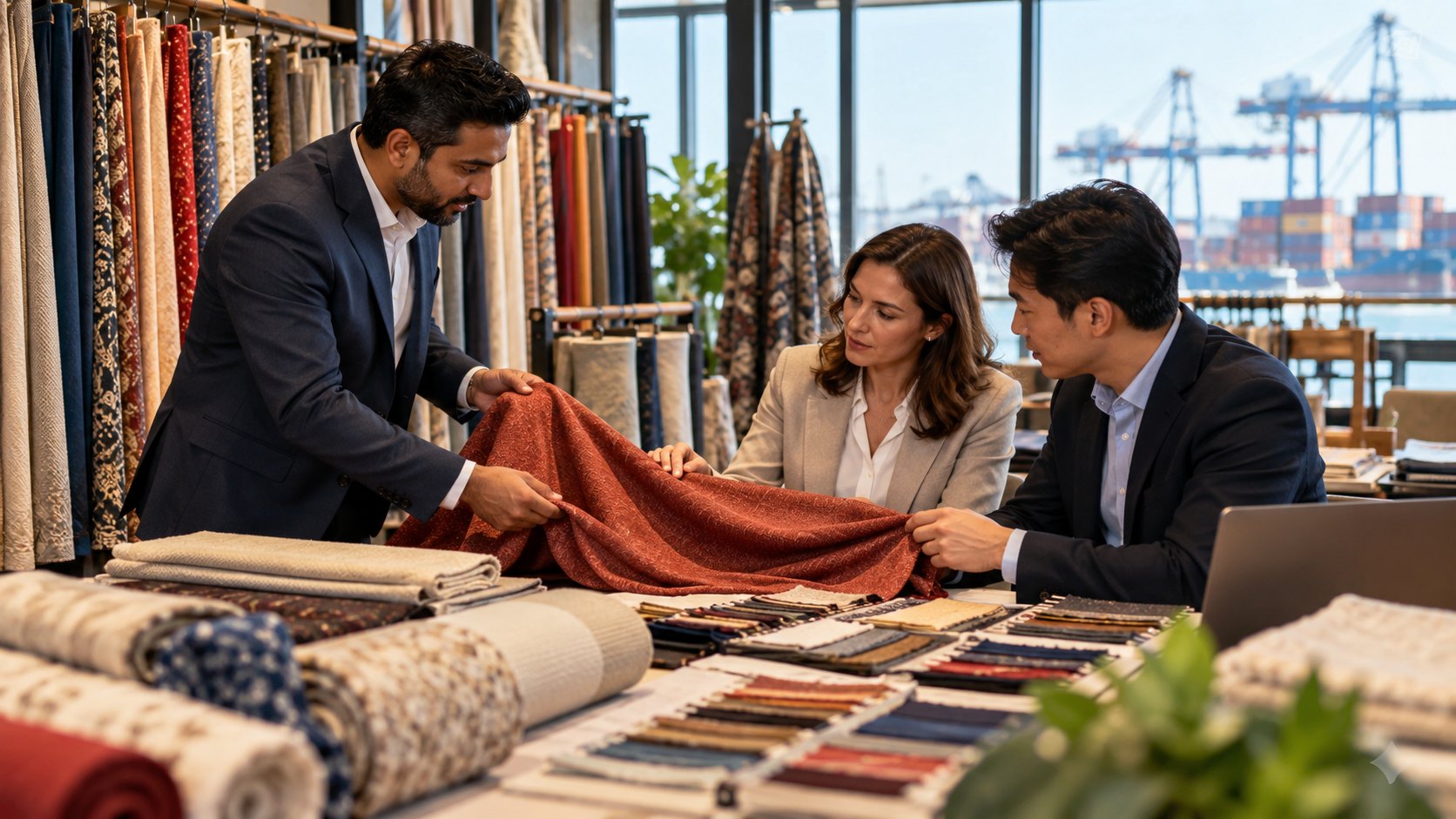
CZ 363 — Textile Trading
What the line covers
Buying, importing, holding, exporting and selling fabric in piece-goods form. In practice that spans four groups that behave quite differently.
Apparel cloth — cottons, poplins and shirtings, wool and wool blends for suiting, linen, viscose, silk, the heavy blacks and fine whites used for abayas and kanduras, and the knitted jerseys and interlocks a garment factory buys by the kilo rather than the metre.
Furnishing and upholstery cloth — curtaining, sheers, blackout linings, upholstery weaves, velvets and faux leather. Sold into fit-out and hospitality, judged on durability and on how it hangs, and specified by an interior designer rather than by the person paying.
Workwear and uniform cloth — twills, drills, poly-cottons and the specialist finishes behind protective clothing. This group is bought by CZ 367 — Uniforms Trading and by the uniform makers, and it is the one where a shade has to be reproducible for years rather than for a season.
Technical and industrial cloth — tarpaulin and canvas, awning fabric, filter and geotextile media, coated and laminated fabrics. A different trade again, sold on performance to engineers and contractors.
How cloth is specified
A roll is described by composition, by weight — grams per square metre, or ounces for denim and canvas — by width, by construction, and by finish. Each of those changes the price and all of them change what the cloth is usable for, which is why a buyer on this line specifies rather than browses and why a trader who cannot read a specification is quoting on something other than the goods.
Composition carries a second consequence that catches new importers. Textiles are classified for customs on what they are made of, so the fibre content declared on arrival is the basis on which the consignment is treated. Blends are where this goes wrong: a fabric described loosely by a mill as cotton-rich is a specific ratio for declaration purposes, and a declaration that does not match the goods is dealt with at the port rather than in the warehouse.
The stockroom is the trade
Rolls are heavy, awkward and damaged by the three things a cheap warehouse supplies — sunlight, damp and being stacked wrongly. Cloth stored in direct light fades along one edge. Cloth stored damp marks and smells. Cloth stacked on its side under weight takes a crease along its length that does not come out and ruins the roll. Racking that holds rolls horizontally, a dry unit, a cutting table with good and consistent light, and an orderly way of recording where a lot is standing are the whole of the physical requirement, and together they are the difference between a stock list and an inventory.
The conditions attach to the fibre and the finish, not to the roll
Plain cloth sold to a maker attracts little in the way of special control. Three things change that, and all three turn on what the fabric is for rather than on what it is.
A claim about performance is a claim that gets checked. Fabric sold as flame-retardant, antibacterial, water-repellent or protective is being sold on a property, and the property is assessed against the national standards that apply to that class of goods, with the conformity marking those standards require. The kind of control here is conformity assessment, and what it demands in a particular case depends on the article and on the use it is sold for. The honest commercial point is that these finishes are also perishable: a flame-retardant applied as a topical treatment is not the same as one built into the fibre, and the two behave very differently after laundering. Selling the first as the second is the sort of mistake that ends a hospitality account.
Fabric for furnishing and for children is treated more strictly than fabric for adult clothing, for the obvious reason that the hazard is different. Curtaining and upholstery going into a hotel or a public building are specified to a fire performance by the people designing the building, and that specification is the client's requirement as much as a regulatory one.
Dyes and chemical finishes are a product-safety matter. Certain colourant chemistries and finishing agents are restricted in consumer textiles in most markets, and a mill's assurance is not a substitute for knowing what is in the cloth. A trader importing to supply UAE makers is the party making the declaration, which makes this worth asking about before the container is paid for.
Beyond those, the ordinary obligations of imported goods apply: an accurate declaration, correct classification on composition, and labelling that supports what the next party down the chain will tell a consumer. Which standards and marks bite on a given article, and what the licensing authority in a particular emirate asks of a textile warehouse or a cut-length shop, are confirmed for the real case — both differ by jurisdiction and by product.
References
- Ministry of Industry and Advanced Technology — national standards and conformity marks, which is the framework a performance claim on a fabric is assessed against. Ministry of Industry and Advanced Technology
- Dubai Customs — import and export declarations, classification on fibre composition, and restricted goods in Dubai. Dubai Customs
- Dubai Civil Defence — fire safety requirements bearing on furnishing materials used in buildings in Dubai. Dubai Civil Defence
- Federal Tax Authority — VAT and corporate tax enrolment and filing, which differ in treatment between cloth sold into the UAE market and cloth passing through it. Federal Tax Authority
Elsewhere in Trading
Activities that sit beside this one
Most licences carry more than one activity. Adding a neighbouring line at the application stage costs a fraction of amending the licence afterwards.
Begin with a clear conversation
Tell us what you intend to build.
A consultant will map the structure, jurisdiction, approvals and likely cost against what you actually described — not against a package.
