
Activity CZ 348
How to Start a Scrap and Metal Waste Export Trading Business in Dubai
The word doing the work in this activity name is Abroad. Scrap and metal waste trading for export is a cargo business, and the price is decided by an assay taken after you have already paid.
ConsultZone licensing desk
- Activity code
- CZ 348
- Category
- Trading
- Reviewed
- Read
- 7 min
Topic summary
How to Start a Scrap and Metal Waste Export Trading Business in Dubai
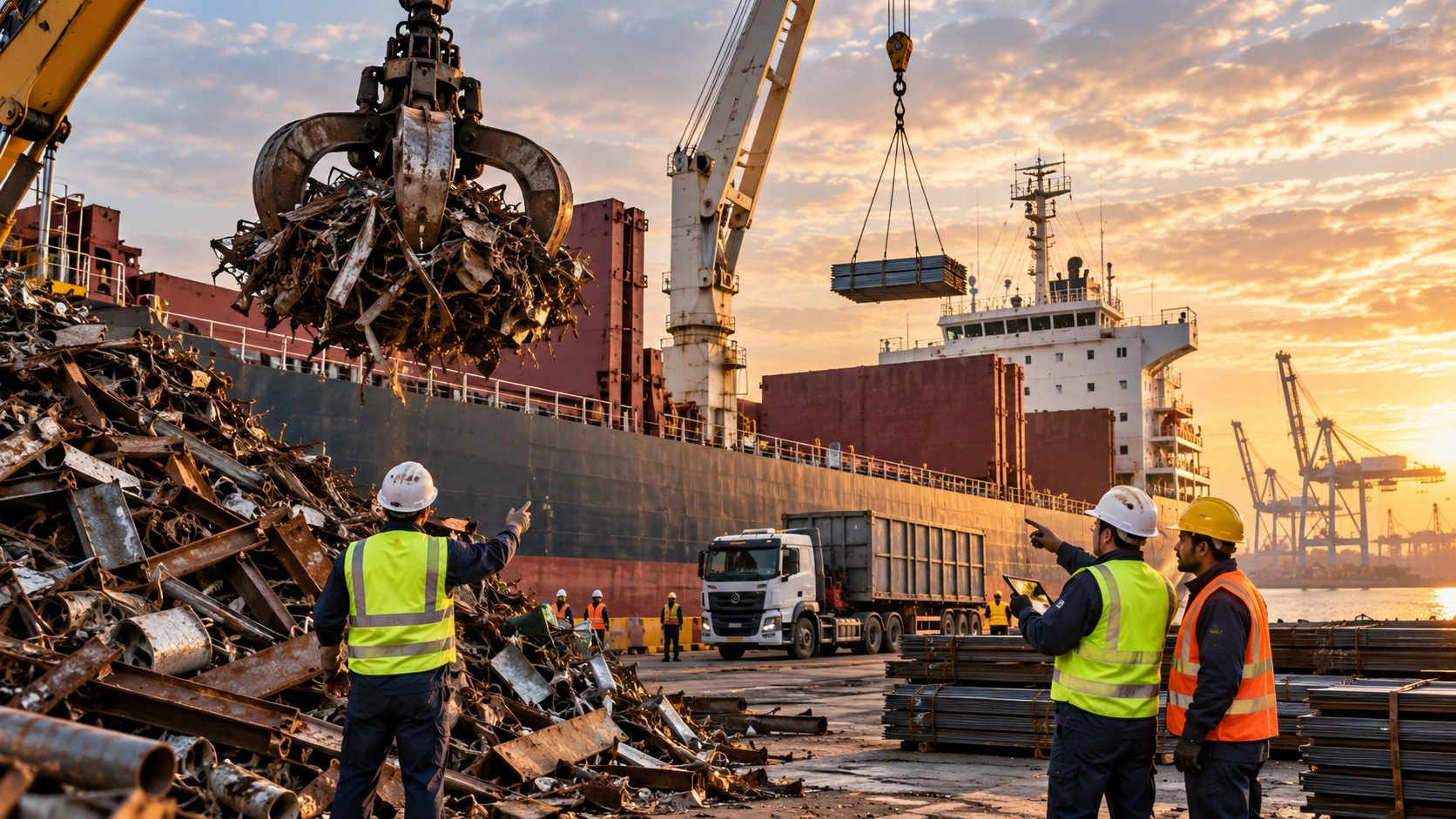
The word doing the work in Scrap & Metal Waste Trading-Abroad is Abroad. This is not a licence to run a yard, collect waste metal around the emirate or buy from the public. It is a trading line for material that leaves — bought in commercial lots, loaded into containers or onto a vessel, and discharged in a mill or a smelter somewhere else. Read it as an export desk rather than a scrapyard and the rest of the page follows.
What makes it unlike every other metal line in the catalogue is where the price is decided. Non-ferrous trading sells certified material at a premium over a published daily reference, so both sides know the number before they start. Scrap sells uncertified material at a discount to an index, and the discount depends on the grade — and the grade is established by an analysis at the discharge port, weeks after you paid the yard in cash. The commercial risk in this trade is not that the market moves. It is that a cargo loaded as one description is discharged as another and re-priced downward, against a laboratory report you were not present for.
That is the whole business. Everything a scrap exporter does — inspecting at load, photographing, weighing, buying prepared rather than loose, insisting on a pre-shipment inspection — is an attempt to narrow the gap between what the cargo was called and what it is found to be.
Who survives in scrap export
Three kinds of operator do well, and they are all solving the description problem rather than the price problem.
The exporter with a sorting relationship buys from two or three yards whose grading he has learned to trust and whose material he has seen often enough to predict. He pays slightly more per tonne than the market and loses almost nothing on arrival. The relationship is the asset, and it takes years rather than months.
The consolidator with his own quality control puts a person on the loading, grades by eye against a specification, rejects what does not belong and keeps a photographic record of each container. He is effectively buying insurance by employing it.
The broker who never owns the cargo matches a regional supplier to an overseas mill and takes a commission, with the mill's letter of credit opened in the supplier's favour. No stock, no assay exposure, much smaller margin, and the only version of this trade that can be started with modest capital.
The operator who gets hurt is the one attracted by the headline spread between a local purchase price and an overseas index. That spread is wide precisely because it contains the grade risk, the shipping risk and the working capital cost, and a newcomer who treats it as margin has simply not been charged for the risk yet.
What it givesWhat it costs
- Buying loose, unsorted material at the yard gateThe lowest price per tonne, and the whole upgrade marginYou pay cash before anybody has agreed what the grade is
- Buying a cargo already sorted and graded for youA description the buyer's own analysis is likely to confirmThe preparer keeps the margin that his sorting created
- Loading under an independent pre-shipment inspectionA document to argue with when the discharge port re-pricesA cost on every cargo whether or not it is ever needed
- Selling against the published index rather than at a fixed priceBoth sides accept a number neither of them setYour purchase price is already fixed and the index is not
The focus row is where most successful exporters end up, and it is worth saying why the obvious answer is the wrong one. Buying loose looks better on a spreadsheet because the upgrade margin is visible and the risk is not. The exporter who buys prepared material gives away a slice of the margin and buys back the thing he cannot afford to lose, which is the match between the bill of lading description and the discharge analysis. One disputed cargo costs more than a year of the margin that sorting would have taken.
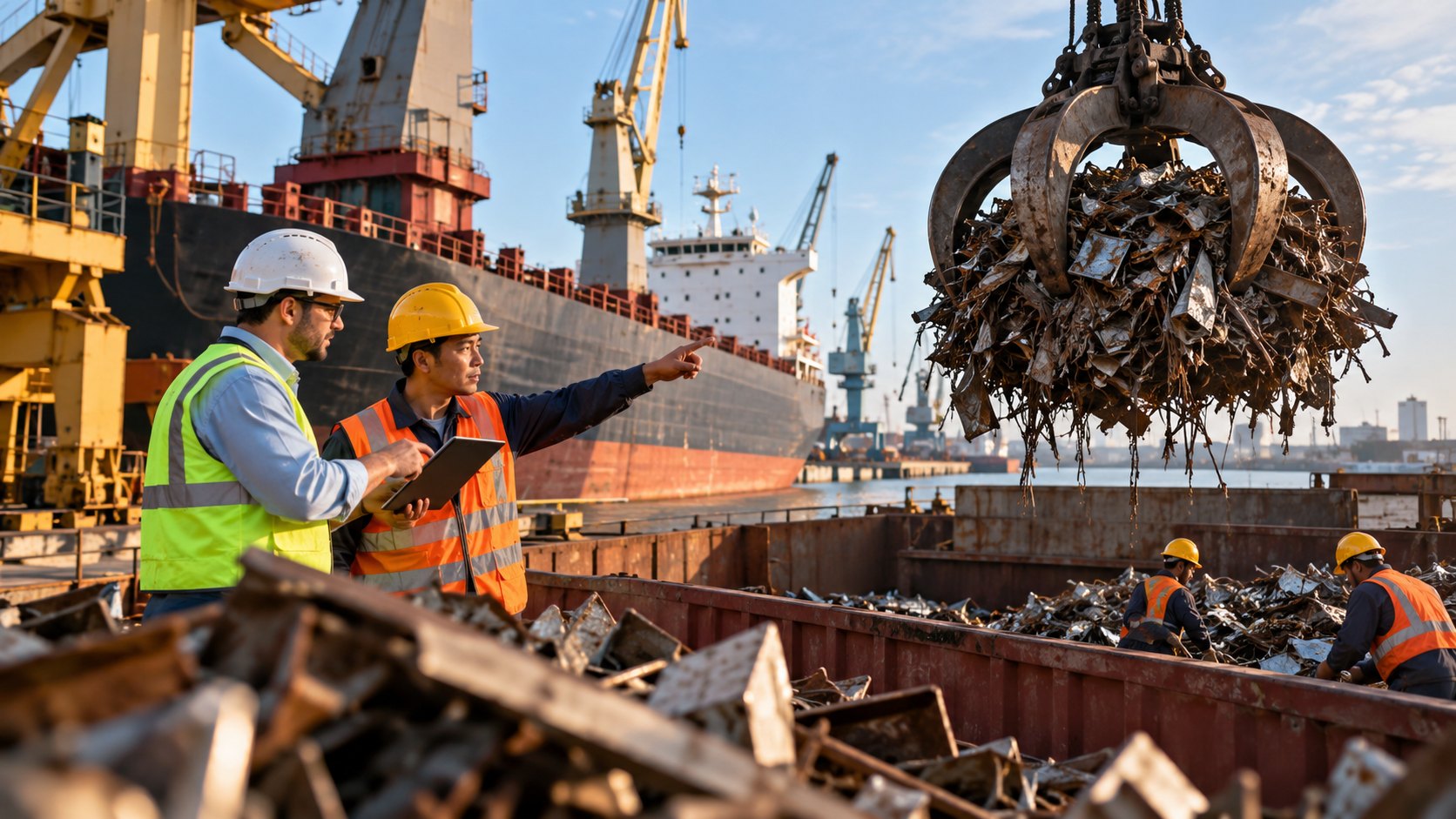
CZ 348 — Scrap and Metal Waste Trading for Export
The material divides into two trades that behave differently enough to be worth separating.
Ferrous scrap — steel and iron in the shapes the trade names: heavy melting scrap, shredded, bundles, turnings, rebar offcuts, plate and structural. Low value per tonne, so the economics live and die on freight and on filling a container to its weight limit. Sold mainly to re-rolling mills and steel plants, in bulk vessel parcels or in containers, and the grade descriptions are conventional and widely understood, which narrows the argument on arrival.
Non-ferrous scrap — copper, brass, aluminium, zinc and lead, in the forms recovered from cable, radiators, extrusion offcuts, litho sheet and machining swarf. Far higher value per tonne, so a single container carries real money and the grade dispute is correspondingly expensive. This is where the analysis matters most, because the price is a function of the recoverable metal content and that is a laboratory question rather than a visual one.
Two documents are the commercial instruments in both trades. The weighbridge ticket at load fixes quantity. The analysis or assay at discharge fixes value. Between them sits the pre-shipment inspection certificate, which is the only thing a seller can hold up when the two disagree.
Demand is the stable feature. Scrap is the feedstock of the electric arc furnace, and mills buying it are competing against ore, so the trade has a floor that a purely cyclical commodity does not. The region's own construction and industrial activity generates material continuously, and the mills that want it are largely elsewhere, which is exactly why this line is written for export.
What the licence does not cover
This is the section that matters most on this page, because the activity name is short and the list of things it excludes is long.
It is not a collection licence. Gathering waste metal from premises, from the public or from a municipal stream is a waste-collection activity with its own licence, its own vehicles and its own permissions. This line buys from parties who are already lawfully holding the material.
It is not a yard. Operating a scrap yard — receiving, storing, cutting, baling, shearing, shredding or sorting at scale — is a processing operation with premises conditions and environmental obligations attached to the site, not to the trading licence. An exporter who wants a yard needs the yard's own permissions.
It is not recycling. Melting, refining or turning scrap into billet, ingot or any new product is manufacturing, with an industrial licence and industrial conditions.
It is not a general waste trade. Waste moving across a border is controlled, and controlled in a way that has nothing to do with the commercial licence: there are international and national controls on the movement of waste between countries, they are stricter where the material is hazardous, and consent is a document that travels with the shipment rather than something the licence grants in advance. Material contaminated with oil, batteries, electrical and electronic waste, catalytic converters, insulated cable with burn residue, and anything with a radiological question attached are all a separate conversation and some of them are a different licence entirely. Clean, sorted metallic scrap is the straightforward case; the further material drifts from that, the more the conditions multiply.
And it does not settle the premises question for you. Even a pure export desk needs somewhere the material is held between purchase and loading, and the suitability of that place for heaped metal is decided with the tenancy by whoever has authority over the site.
What each of those conditions actually requires — which consents a given material needs before a container may be sealed, what the premises must satisfy, what the licence costs to hold, and whether a specific grade is treated as controlled waste rather than as commercial scrap — depends on the emirate, the destination country and the exact material. Those are not figures anybody can responsibly quote in advance, and in this line getting them wrong does not delay a shipment; it strands one in a port. ConsultZone establishes them against a named material list and a named destination before the first purchase is committed.
References
- Ministry of Climate Change and Environment — environmental controls and the framework governing waste and its movement. Ministry of Climate Change and Environment
- Dubai Customs — export procedure, customs codes, and restricted or prohibited goods, which is where a sealed container meets the controls on waste movement. Dubai Customs
- Dubai Municipality — waste handling and premises conditions for a site holding scrap metal in Dubai. Dubai Municipality
- Environment Agency Abu Dhabi — environmental permits where the material is held or loaded in Abu Dhabi. Environment Agency Abu Dhabi
Elsewhere in Trading
Activities that sit beside this one
Most licences carry more than one activity. Adding a neighbouring line at the application stage costs a fraction of amending the licence afterwards.
Begin with a clear conversation
Tell us what you intend to build.
A consultant will map the structure, jurisdiction, approvals and likely cost against what you actually described — not against a package.
