

Activity CZ 103
How to Start a Scooter Trading Business in Dubai
Scooters reached this market in volume before the rules on where they could be ridden did. What the trading line covers, why the volume buyer is a fleet rather than a rider, and what the battery brings with it.
ConsultZone licensing desk
- Activity code
- CZ 103
- Category
- Trading
- Reviewed
- Read
- 6 min
Listen instead
57 seconds
An audio summary of this guide.
Topic summary
How to Start a Scooter Trading Business in Dubai
The machines arrived before the rules did. For a few years an electric scooter was something a shop could import, put on a shelf and sell without anybody being able to say clearly where the buyer was allowed to ride it. That gap has closed — Dubai's roads authority now runs a rider permit and has designated where these machines may and may not be used — and the closing of it is what makes this trading line more interesting than it first looks.
It matters commercially because the question a customer asks in the showroom is no longer how fast the machine goes but where he is allowed to take it. A shop that can answer that accurately sells more, takes fewer returns and keeps the fleet accounts that pay the rent. A shop that cannot is selling a product its customer may not lawfully use, and finding that out at the counter rather than in the brochure.
What a scooter licence actually puts on the shelf
The activity name is short and the shelf it describes is not. In practice it reaches three quite different products that happen to share a word.
The petrol scooter and moped is the oldest of them and the simplest to explain: a road vehicle, with plates, an entry in the traffic authority's own record and a rider who needs the right licence class. Nothing about how it is sold is novel.
The standing electric scooter is the one that changed the trade. It is bought like an appliance and used like a vehicle, which is precisely the tension the permit regime exists to resolve. Its value is concentrated in a battery and a controller rather than in an engine, and so is its risk.
The seated electric scooter and e-moped sits between the two, and it is where confusion costs the most, because a machine that looks like a bicycle and performs like a moped will be treated according to what it does rather than what it resembles.
Around all three sits the accessory trade that actually carries the margin: helmets, locks, spare batteries, chargers, tyres, controllers and display units. Parts and accessories are how a scooter business earns twice from the same customer, and they are rarely the reason a founder applies for the licence.
Two boundaries are worth fixing before the licence is cut. This is a trading line, so assembling or building machines is a different activity with different premises. And running the machines — a rental fleet on a beachfront, a delivery operation, a guided tour business — is an operating activity rather than a trading one. A shop that sells scooters and also hires them out is two businesses, and the licence has to say so.
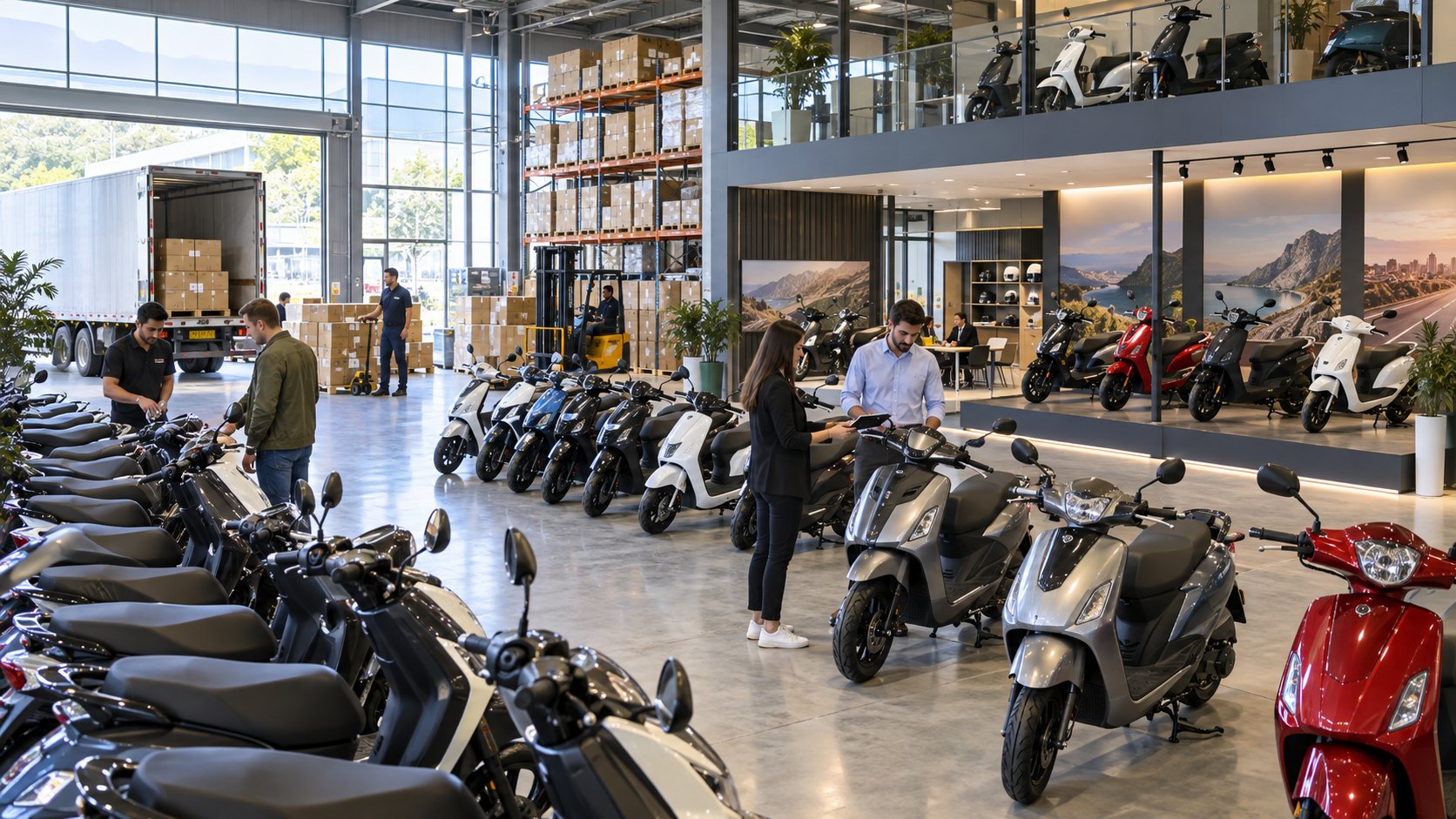
The volume buyer is a fleet, not a rider
Retail is the visible half of this trade and the smaller one. A walk-in customer buys one machine, compares three shops on price and may never return except for a tyre. The accounts that make the business durable buy in tens and come back on a cycle.
Last-mile and delivery operators replace machines as they wear out, which makes them a recurring buyer rather than a single sale, and they buy on total cost rather than on ticket price — battery life, repair turnaround and parts availability decide the order. Rental and tour operators buy fleets seasonally and want the same model repeatedly so that one pool of spares serves the whole fleet. Hotels, resorts, master developers and community managers buy for guests and for their own grounds staff, against a specification a procurement officer has already written. Universities, business parks and large industrial sites buy for movement inside their own perimeter. Municipal and government buyers appear for park patrol and facilities use, and they buy through a tender rather than across a counter.
The route to each of those is nothing like the route to a rider. A fleet buyer wants a named supplier who can produce a spare next week and take a machine in for repair without the fleet stopping, which is why a workshop arrangement beside the shop — yours or somebody else's — is worth more to this business than another metre of showroom frontage.
The battery is the part with conditions attached
Most of what governs a scooter shop attaches to the goods rather than to the company. Four things follow from that, and only one of them is the trade licence.
Lithium cells are a fire question before they are a product question
A stockroom holding spare batteries, and a bench charging a dozen of them overnight, is a fire-safety arrangement. How it is laid out, contained and ventilated is a civil defence matter rather than a commercial preference. It is the condition new entrants underestimate most often, because the goods look like consumer electronics and behave, in bulk, like stored energy.
Anything connected is radio equipment
An app-paired scooter, a wireless key, a Bluetooth display or a fitted tracker makes the machine radio equipment, and radio equipment carries type approval from the federal telecoms and digital government regulator before it is placed on the market here. This surprises sellers more than any other condition, because the feature that triggers it is described in the catalogue as a convenience.
Road-legal is a property of the machine, not of the shop
A petrol scooter enters the traffic authority's record and carries plates. A standing electric scooter does not, and what governs it is the permit regime and the designated routes instead. Selling the second while implying the first is how a shop acquires a complaint it cannot answer.
six gates, and only one of them is the licence
The emirate's economic department
- Trade licence carrying the scooter trading activityFirst, and every other gate waits behind it
The emirate's roads and transport authority
- Where the machines may lawfully be ridden, and the rider permit behind itContinuously — it is the answer a customer needs at the counter
- Plates and the vehicle record for road-legal machinesPer machine, on the ones that are road vehicles
Civil defence
- Battery storage, charging and containment on the premisesWith the premises, before the first stock arrives
The federal telecoms and digital government regulator
- Type approval for app-paired, wireless or tracked machinesBefore the model is offered for sale
The emirate's customs authority
- Entry of each imported consignmentEvery shipment, in the importer's own name
Read the shape of that rather than the rows. Two of the six gates sit with the roads authority and one with civil defence, which is another way of saying that the hard part of this business is not obtaining permission to trade. It is the conditions the goods carry once you hold them. The economic department can be satisfied with paperwork; a stockroom of lithium cells and a customer asking where he may ride cannot.
What the licence costs to hold, which conditions a particular emirate attaches, and what a given model needs before it can be offered all depend on the jurisdiction, the premises and the product mix. ConsultZone confirms those for the specific case rather than quoting a figure that will not survive the first shipment.
References
- Roads and Transport Authority — where electric scooters may be ridden in Dubai, the rider permit behind it, and vehicle records for road-legal machines. Roads and Transport Authority
- Dubai Civil Defence — fire-safety approval for the storage, containment and charging of lithium batteries on commercial premises. Dubai Civil Defence
- Telecommunications and Digital Government Regulatory Authority — type approval for radio and connected equipment placed on the UAE market. Telecommunications and Digital Government Regulatory Authority
- Dubai Customs — entering imported consignments and the importer's own customs code. Dubai Customs
Elsewhere in Trading
Activities that sit beside this one
Most licences carry more than one activity. Adding a neighbouring line at the application stage costs a fraction of amending the licence afterwards.
Begin with a clear conversation
Tell us what you intend to build.
A consultant will map the structure, jurisdiction, approvals and likely cost against what you actually described — not against a package.
