

Activity CZ 309
How to Start a Non-Ferrous Material Trading Business in Dubai
In non-ferrous metal the price is not yours to set. Copper, aluminium and brass trade at a premium over a published reference, which moves the whole business from selling to position management.
ConsultZone licensing desk
- Activity code
- CZ 309
- Category
- Trading
- Reviewed
- Read
- 6 min
Topic summary
How to Start a Non-Ferrous Material Trading Business in Dubai
In non-ferrous metal the price is not yours to set. Copper, aluminium, zinc, lead, nickel and tin are quoted every working day on international exchanges, and both you and your customer can read that quotation before either of you speaks. What you negotiate is not a price but a premium — a few dollars per tonne over the published reference, earned for shape, alloy, delivery point and credit. That single structural fact separates Non Ferrous Material trading from almost every other wholesale line in the catalogue, and it changes what the business is.
A merchant whose price is published cannot hide a poor buy inside a markup. If you buy a parcel of copper on Monday and sell it on Thursday, your profit is the premium you captured minus whatever the reference did to you in between. Hold the metal unpriced for a month and you are no longer a trader of goods; you are carrying an open position on an exchange, with a customer attached. The question that decides whether a non-ferrous business makes money is therefore not "what margin do I charge" but "how long am I exposed, and against what".
CZ 309 — Non Ferrous Material Trading
Non-ferrous means every commercial metal that is not iron or steel. In practice a trading house in this line handles a narrower set than the definition allows, and the shapes matter as much as the metals.
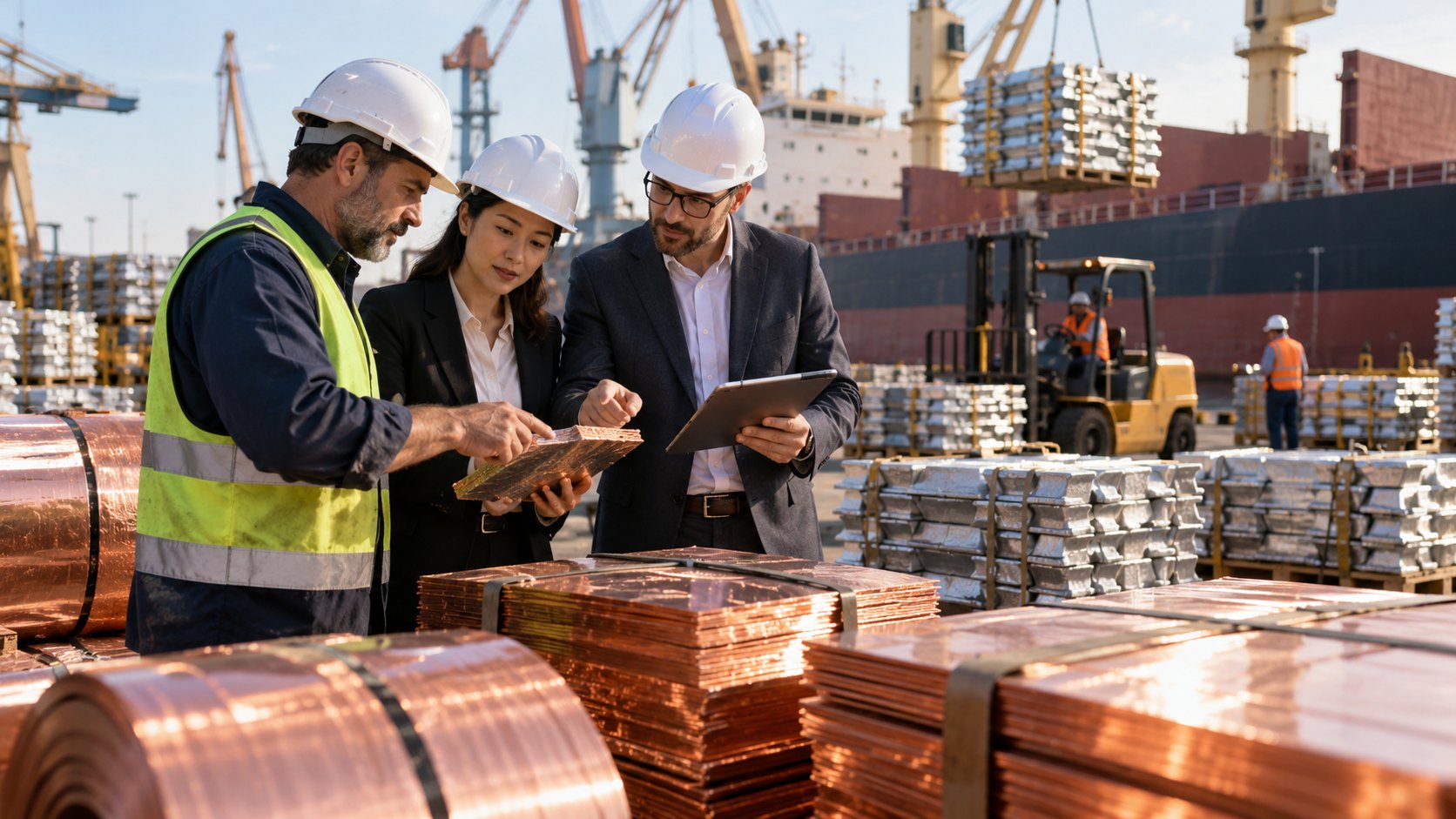
Copper moves as cathode, rod, busbar, tube and wire, and it is the metal with the deepest demand in this region because of cabling, switchgear and plumbing. Aluminium moves as ingot, billet, coil, sheet, plate, extruded profile and foil, and the UAE is itself a significant producer of primary aluminium, which means a local trader is often buying domestically and selling outward rather than the reverse. Brass and bronze move as rod, sheet and fittings, and sit closer to a component trade than a metal trade. Zinc, lead, nickel and tin turn up as ingot and as alloying additions, usually in smaller parcels against a specific industrial requirement.
Two documents do the commercial work in every one of those cases. The weighbridge ticket fixes quantity, because everything here is sold by weight and a tonne is a tonne only once somebody has weighed it. The mill certificate or analysis fixes quality, because an alloy is a chemical specification and a buyer's own inspection will check it. A parcel without both is not a parcel anybody will pay for.
judged on the same five rows
| Judged on | Mainland | Free zone |
|---|---|---|
| Sell cathode or billet to a UAE fabricator directly | Yes | Through a mainland distributor |
| Hold metal in store and price it to a buyer weeks later | Yes | Yes |
| Move a parcel onward without it entering the UAE market | Possible, with duty handling | Yes, and this is the case it is built for |
| Open an importer code in the company's own name | Yes | Within the zone's own arrangement |
| Bid for a UAE utility or main contractor supply contract | Yes | Generally not |
The pattern that table shows up is the one most new entrants get wrong. If the customers are UAE fabricators, cable makers, extruders and contractors, the mainland licence is the straightforward answer and the free zone adds a distributor's cut to every invoice. If the business is genuinely a transit one — buying regional production and placing it in other markets — the zone exists for exactly that and the goods never need to clear into the UAE at all. Very few houses are honestly both, and the ones that are run two companies rather than one licence.
Adjacent lines people confuse with it
Three other activities in the same family sit close enough to this one to be chosen by mistake, and the boundary is worth drawing precisely because getting it wrong means amending a licence rather than using it.
Scrap and metal waste trading is the one most often confused with it, and it is a different business with the same chemistry. Non-ferrous trading deals in material of known, certified specification at a premium over a reference price. Scrap deals in material of disputed specification at a discount to an index, where the grade is argued about on arrival and the cargo can be re-priced after you have already paid for it. One trade is about managing price exposure; the other is about managing description risk. They attract different people and they need different cash.
Raw materials trading is the wide generic line, and a trader who takes it expecting it to include metals may find the licence read more narrowly than the name suggests. If non-ferrous metal is the actual business, the specific line is the one to hold.
Building and construction materials wholesale overlaps in the customer and not in the goods. Reinforcing bar, mesh and structural sections are steel, which is ferrous and therefore outside this line entirely, even though the contractor buying them may also want copper tube from you.
And the line stops short of making anything. Smelting, casting, extruding, drawing wire or rolling sheet is manufacturing with its own licence, premises and industrial conditions. Precious metals — gold, silver, platinum — are their own regulated world and are not reached by a general non-ferrous activity.
Who is this for?
This suits three kinds of operator and punishes a fourth.
It suits someone who has already sold metal for somebody else and knows a customer list, a premium structure and which fabricators pay on time. The relationships in this trade are long and the switching costs are real, so an entrant with no book is starting from a genuinely cold position.
It suits a producer's or mill's agent setting up locally to serve a region, where the supply side is settled and the task is distribution rather than sourcing.
It suits an operator with access to patient money and a hedging discipline, who understands that the capital at risk is not just the invoice value but the price movement underneath it.
It does not suit a trader whose instinct is to buy cheap and wait. In a market with a published daily price, waiting is a bet, and it is a bet taken with borrowed working capital against a number nobody in the business controls.
Where the specific conditions land — what the licence costs to hold, which premises or storage arrangement the activity mix requires, whether a particular metal or alloy is restricted on entry, and how the customs position works for a transit parcel — depends on the emirate and the licensing authority. ConsultZone confirms those for the actual trade before the structure is fixed, because the choice between mainland and zone here is a commercial decision dressed as an administrative one.
References
- Dubai Customs — importer codes, import and export procedure, and restricted goods on entry for metal consignments. Dubai Customs
- Ministry of Industry and Advanced Technology — national standards and conformity marks, which is the framework the mill certificates and analyses in this trade sit against. Ministry of Industry and Advanced Technology
- Federal Tax Authority — VAT treatment and enrolment, which differs for goods sold into the local market and goods moved onward. Federal Tax Authority
- Ministry of Economy — commercial agency arrangements, which is how many producers appoint a local distributor for a metal. Ministry of Economy
Elsewhere in Trading
Activities that sit beside this one
Most licences carry more than one activity. Adding a neighbouring line at the application stage costs a fraction of amending the licence afterwards.
Begin with a clear conversation
Tell us what you intend to build.
A consultant will map the structure, jurisdiction, approvals and likely cost against what you actually described — not against a package.
