

Activity CZ 245
How to Start an Appliance and Electronics Spare Parts Trading Business in Dubai
An appliance spare parts trade is won on identification rather than on price. The part that fits one model number and not the near-identical one beside it is the whole business.
ConsultZone licensing desk
- Activity code
- CZ 245
- Category
- Trading
- Reviewed
- Read
- 7 min
Listen instead
41 seconds
An audio summary of this guide.
Topic summary
How to Start an Appliance and Electronics Spare Parts Trading Business in Dubai
A photograph of a rating plate arrives on a phone at nine in the morning. A washing machine in a villa, a model number half worn off the sticker behind the door, and a technician standing in the kitchen with the back panel already off. Whether that message becomes an invoice has very little to do with price. It depends on whether somebody at your counter can read that plate, find the exploded diagram it belongs to, and say within a few minutes that the drain pump is on the shelf.
Electrical and Electronics appliance Spare parts Trading is the licence line behind that exchange, and it is worth being precise about what sort of trade it is, because the name makes it sound like a warehouse proposition. It is not. A warehouse business is measured in pallets and turns; this one is measured in lines. A serious counter holds thousands of part numbers, most of them worth very little individually, and a large share of them will turn once a year or not at all. The money does not come from moving volume. It comes from being the place that has the one line nobody else kept.
That inverts the usual logic of stockholding. In most trades dead stock is a mistake to be eliminated; here a certain amount of it is the cost of the proposition, because breadth of model coverage is the only thing a repairer cannot get from a cheaper competitor. The discipline is not avoiding slow lines — it is knowing which slow lines to carry and which to let go, and that judgement is the difference between a profitable counter and a storeroom full of capital.
The money is in the line nobody else bothered to stock
Margin in this trade runs in the opposite direction from intuition. The universal items — drive belts, thermostats, capacitors, door seals, a standard heating element — are sold by everybody, priced against a screen the customer is already holding, and earn almost nothing. The money sits in the control board for a seven-year-old oven that the brand stopped supporting two years ago, because finding it was work and nobody else did the work. Every appliance model carries an obsolescence clock: the manufacturer supports it for a period, then the parts move into the aftermarket and the salvage trade, and the independent counter that followed the model through that transition owns the demand that is left.
The second commercial fact is about trust, and it is sharper here than in most trading lines. Two categories fail badly when a cheap substitute is used: electronic control boards and sealed refrigeration compressors. When one of those fails a month after the repair, the technician does not explain to his customer that he bought a grey-market board. He absorbs the complaint, does the job again for nothing, and stops buying from you. A counter that sells the cheapest board available is converting its own customer base into somebody else's, slowly and without noticing.
So there is a real choice to make about how stock is held, and it is better made before the lease is signed than after the shelves are full.
three ways to stock it, judged on the same six rows
| Judged on | An independent aftermarket counter | A brand's authorised parts channel | Sourcing to order with no shelf |
|---|---|---|---|
| Answer within the hour a technician is standing in a kitchen | Yes | Yes | No |
| Supply a model the manufacturer has stopped supporting | Yes | No | Sometimes |
| Hand over a warranty the technician can pass to his own customer | Partial | Yes | It depends on the source |
| Capital parked in lines that may never sell | Heavily | Largely set by the brand | None |
| Who absorbs the complaint when a board fails in a month | You do | The brand does | You do |
| Compete on anything except price | On breadth of coverage | On the box | Rarely |
The authorised channel is the comfortable answer and the narrow one: the brand decides the range, the pricing and often the territory, and the models it has retired are exactly the ones generating repair demand. Sourcing to order needs no capital and loses the business its only real advantage, because the technician with a dismantled appliance in front of him cannot wait three weeks. The independent counter is harder and it is where the trade actually is.
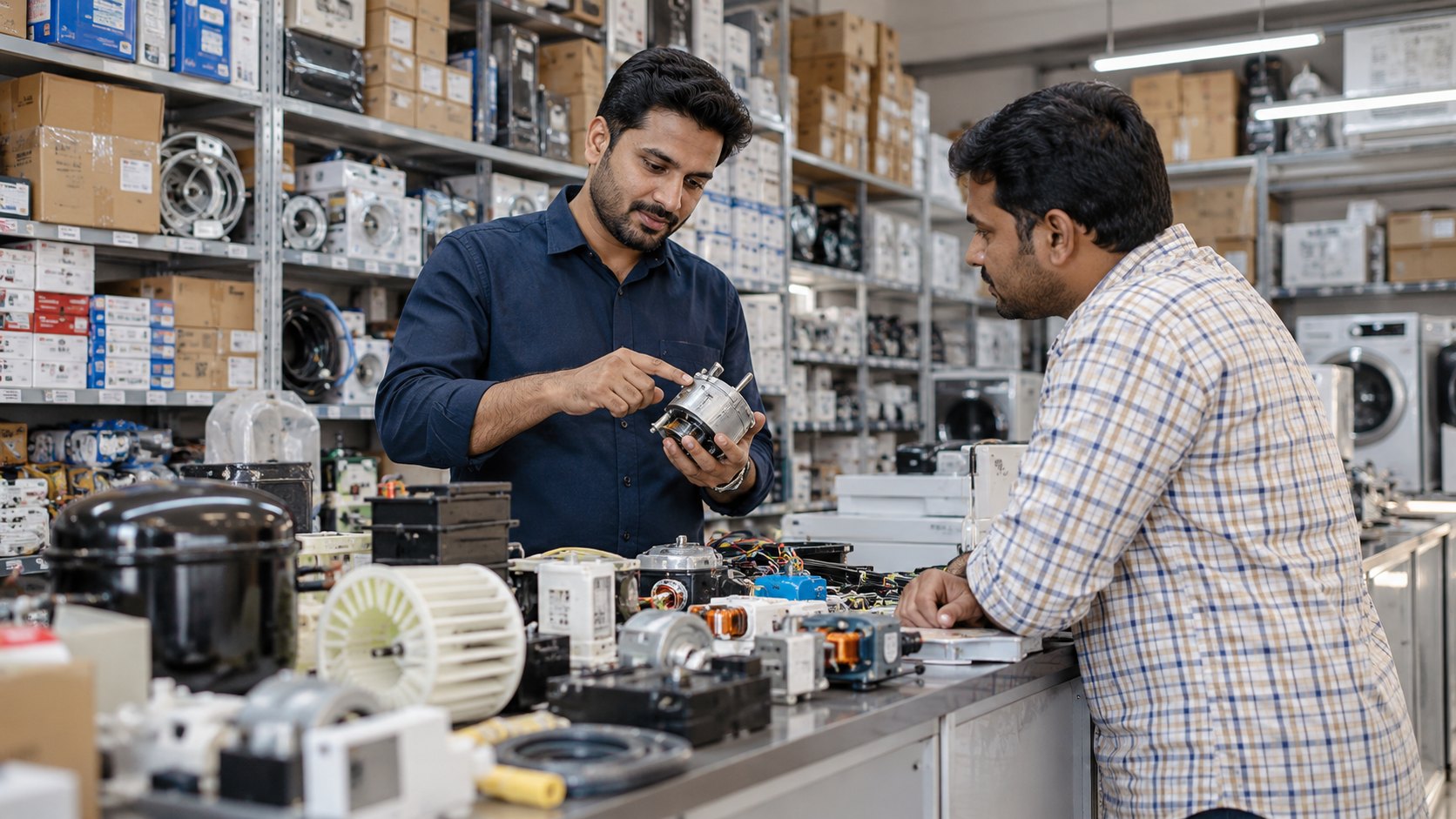
CZ 245 — Electrical and Electronics appliance Spare parts Trading
The line covers components for domestic and light commercial appliances and for consumer electronics. On the appliance side that is washing machines, dryers, dishwashers, refrigerators and freezers, cookers, ovens, hobs and extractors, water heaters, microwaves and the small domestic appliances — and the parts are motors and drain pumps, control boards and modules, thermostats and sensors, heating elements, door seals, hinges and latches, belts, bearings, fans, switches and the sealed compressors used in domestic refrigeration. On the electronics side it is televisions, displays, audio equipment and the parts that fail in them: panels, power supply boards, main boards, backlight assemblies and remote controls.
Where it stops, and the neighbours it is confused with
Three adjacent lines in the same catalogue family are genuinely close, and a reader comparing them should have the boundary drawn rather than guessed.
Air Conditioning and Refrigeration Spare Parts Trading covers the installed system — split units, ducted systems, chillers and commercial refrigeration plant. The blurred edge is the compressor, which exists in both worlds. The practical line is the thing it was built into: a sealed compressor for a household refrigerator belongs here, a scroll compressor for a building's cooling system does not.
Power Generation, Transmission and Distribution Equipment Trading is electrical infrastructure — switchgear, transformers, cable, protection equipment. It shares the word "electrical" with this line and almost nothing else; its buyer is a contractor or a utility rather than a repair workshop.
Engines and Machinery Spare Parts Trading is mechanical and industrial. A motor is the one component that can plausibly appear on either page, and the distinction is the machine it came out of, not the part.
What this line does not permit is the repair itself. Opening an appliance in a customer's home, diagnosing it and charging for the labour is a service activity with its own licence, and a trading licence does not carry it. Selling complete appliances rather than their components is a different trading line again, and making a part rather than importing it is manufacturing.
What attaches to the goods rather than to the licence
The trade licence is the straightforward part of this file. The conditions worth planning for attach to the goods, and they sit with authorities that have nothing to do with the licensing desk.
Electrical goods sold in the UAE are held to national standards and conformity requirements, and the technical regulations and conformity marking regime for electrical products sits with the federal industry ministry.¹ That is a question about the product rather than about the trader, and it is answered before a consignment is ordered rather than when it arrives.
Anything in the range with a radio or a wireless function needs type approval as radio equipment — which catches more lines than people expect, because it includes remote controls, the wireless modules inside connected appliances and the communication boards in smart televisions.² A consignment of boards is not obviously a telecoms matter until a customs officer treats it as one.
Sealed compressors and other refrigerant-bearing components carry a fluorinated gas under pressure, and the handling and disposal of those gases is an environmental control rather than a commercial one.³ It is also the clearest practical reason the boundary with the air-conditioning parts line matters: the same regulatory attention follows the gas into either trade.
Cordless appliance parts containing lithium cells are treated as restricted goods in freight and at the border, and both the shipping arrangements and the way they are stored on the premises follow from that rather than from the sale.⁴ Import classification, the importer's own customs code and the clearance of each consignment all sit with the emirate's customs authority, which is also where the counterfeit question lands: components arriving in a brand's livery without the brand's authorisation are an enforcement matter at the border, not a commercial risk to be priced in.⁴
Which activity name fits the intended range, which of these conditions attach to a particular unit and a particular consignment, and what the licence costs to hold all depend on the emirate, the premises and the activity mix. ConsultZone confirms that for the specific case before stock is ordered.
References
- Ministry of Industry and Advanced Technology — national standards and conformity marking for electrical products. Ministry of Industry and Advanced Technology
- Telecommunications and Digital Government Regulatory Authority — type approval for parts carrying a radio or wireless function. Telecommunications and Digital Government Regulatory Authority
- Ministry of Climate Change and Environment — environmental controls on refrigerant gases held in sealed components. Ministry of Climate Change and Environment
- Dubai Customs — customs codes, import classification, restricted goods and brand-protection controls at the border. Dubai Customs
Elsewhere in Trading
Activities that sit beside this one
Most licences carry more than one activity. Adding a neighbouring line at the application stage costs a fraction of amending the licence afterwards.
Begin with a clear conversation
Tell us what you intend to build.
A consultant will map the structure, jurisdiction, approvals and likely cost against what you actually described — not against a package.
