
Answered plainly
When a shareholder dies the UAE company keeps existing, and stops being able to act
A UAE company is a separate legal person, so it survives its owner.
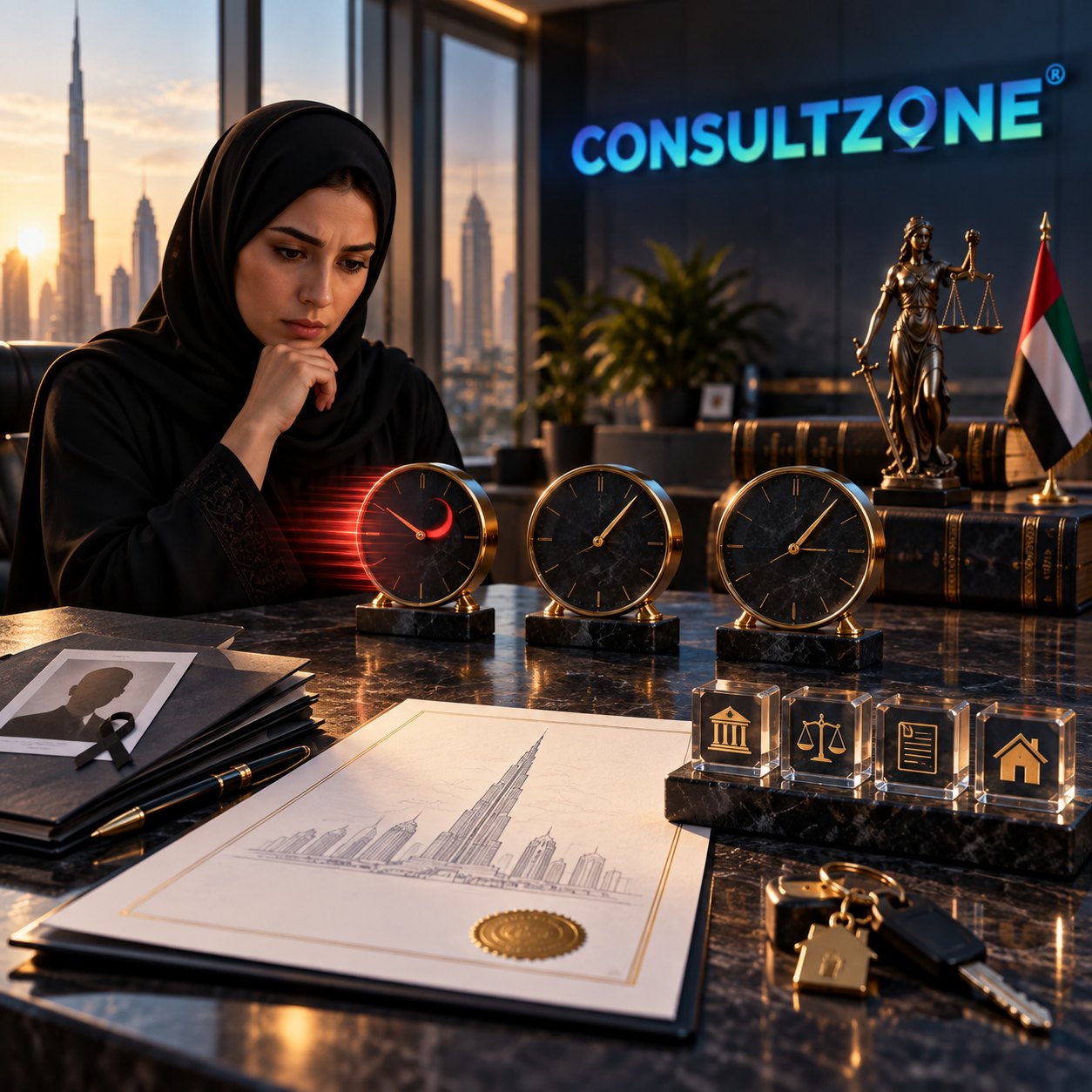
Three clocks start on the day of death, and only one of them is quick
A UAE company is a separate legal person. That is the point of it, and it is why the answer to "what happens to the company" is, in the first instance, nothing. The entity does not dissolve. Its licence does not lapse. Its contracts do not terminate. Its landlord, its customers and the Federal Tax Authority are unaffected by the fact that one of the people who owned it has died.
What stops is narrower and far more disruptive: the company's ability to do anything that requires a shareholder to act, or a specific person to sign.
Three separate things are now running on three different clocks.
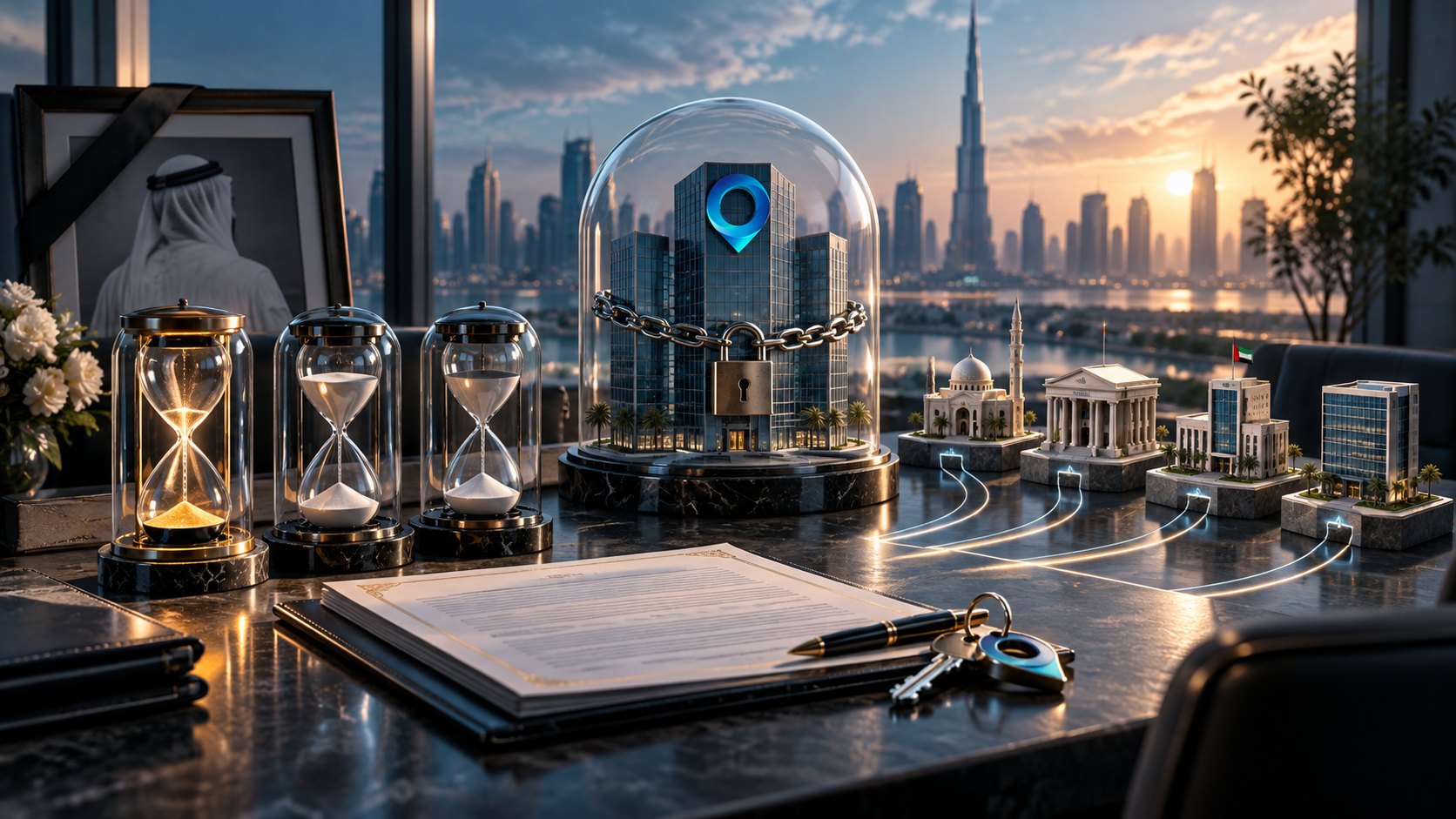
The entity survives, instantly and without help. Nobody has to do anything to keep it alive. It keeps accruing rent, salaries, corporate tax obligations and the annual filings it always owed.
The shares stop moving until a court has said who holds them. A share in a UAE company is property, and property that belonged to a deceased person is in an estate. No licensing authority will amend the shareholder line on the strength of a family's account of what the deceased wanted, a foreign grant of probate that nobody has legalised, or a copy of a will that has never been in front of a UAE court. Our company liquidation page states the same point from the other end: where a shareholder has died, the shares pass through an inheritance process before anyone can vote them at all.
The signature fails at the first document that needs it. Bank mandates name people, not roles. So do the manager entries on a licence, the authorised-signatory records at the bank, and most of the portal accounts described in the government accounts that are your company. A general manager who was also the sole authorised signatory takes all of that with him. The company still exists, still owes payroll, and cannot make a transfer.
The gap between the first clock and the second is where the damage happens. The company keeps incurring obligations at full speed while the only people who could authorise paying them are waiting on a court.
Which law decides the shares, and what changed in 2023
Two questions sit underneath this, and they are routinely collapsed into one. Both turn on the shareholder rather than on the company, which is why the 2020 ownership reform left them exactly where they were: the position a foreign national actually occupies sets out what that reform changed on the file and what it did not.
The first is which law governs the succession at all. Article 17 of the Civil Transactions Law, as replaced by Federal Decree-Law No. 30 of 2020, refers inheritance to the law applicable in the state of the deceased at the time of death. That is a conflict-of-laws rule, and it is not self-executing: somebody still has to satisfy a UAE court about what that foreign law says and how it applies to these particular shares.
The second is what happens where no foreign law is successfully invoked. For non-Muslims this is where the position changed. Federal Decree-Law No. 41 of 2022 on Civil Personal Status created a civil regime for non-Muslims in the UAE, applied by the family courts from early 2023, and it provides its own default distribution of an estate where the deceased left no will. Sharia principles are no longer the automatic fallback for a non-Muslim who dies intestate.
That is the headline, and it is where most coverage of this subject stops. Two things it leaves out matter more to a shareholder than the headline does.
A default is still a distribution you did not choose. The decree-law sets out who takes what among spouse, children, parents and siblings. Those fractions are in the instrument, and they are the thing to read rather than to take from a summary — including this one, which deliberately quotes none of them. Applied to shares rather than to cash, a statutory split has a specific consequence: it fragments a shareholding across several people who may not agree with each other, may not live here, and may each need to be produced to a licensing authority before a single amendment can be filed. A business that had one owner now has four, and the memorandum was drafted on the assumption that it had one.
Muslim shareholders are on a different track. Federal Decree-Law No. 41 of 2024 on Personal Status came into force on 15 April 2025 and governs personal status generally; the 2022 civil regime is the non-Muslim one. Any structure built on the assumption that everybody in a shareholder group is treated identically is built on a mistake, and mixed-faith shareholder groups are common in this market.
two questions, routinely collapsed into one
- A shareholder dies holding shares in a UAE companyThe entity survives. The shares are property, and property of a deceased person is in an estate
- Article 17 sends the succession to the law of the deceased's own stateThe Civil Transactions Law as replaced by Federal Decree-Law No. 30 of 2020: a conflict-of-laws rule, not a self-executing one
- Somebody satisfies a UAE court what that foreign law saysAnd how it applies to these particular shares. Nobody does this step for you
- What happens where no foreign law is successfully invoked
- A non-Muslim shareholderFederal Decree-Law No. 41 of 2022 on Civil Personal Status, applied by the family courts from early 2023, with its own default among spouse, children, parents and siblings
- A Muslim shareholderThe separate personal status regime: Federal Decree-Law No. 41 of 2024, in force on 15 April 2025
- A default is still a distribution you did not chooseIt fragments one shareholding across people who may not agree with each other and may not live here

The memorandum is where the answer belongs, and since October 2025 it has to be there
Most of the anxiety in this subject is misdirected at wills. The first place a UAE company's answer lives is its own constitutional documents.
Federal Decree-Law No. 20 of 2025 amended the Commercial Companies Law with effect from 15 October 2025 — the same amendment that made share classes lawful in a mainland limited liability company, covered in structuring a UAE company that investors can fund. Among its provisions is the treatment of a deceased shareholder's stake: the surviving shareholders hold a right of first refusal over it, the price is settled by agreement with the legal heirs, and where no agreement is reached the competent court determines the valuation. The memorandum and articles are required to carry provisions on that right.
Read what that actually gives you and what it does not.
It gives the surviving shareholders a mechanism. It does not give the deceased one. The heirs get value; they do not get the business, unless the survivors decline to take it. For a founder whose intention was that a spouse or child should inherit the company itself rather than a cheque for it, a boilerplate pre-emption clause is not neutral — it actively defeats the plan, and it does so quietly, because nobody reads the memorandum at the point of sale.
It also assumes there are surviving shareholders. In a single-shareholder company there is nobody to exercise the right, and the clause does nothing at all.
The practical instruction is unglamorous: read the shareholder-death provision in your own memorandum, decide whether it says what you want, and amend it while everybody is alive and the amendment costs an afternoon. This belongs on the same list as the other constitutional choices in the setup decisions you cannot undo later, and it is the one item on that subject that most memoranda in this market inherited from a template.
Four places a will can be lodged, and they do not cover the same assets
For a non-Muslim, a will is what displaces the statutory default. The UAE offers several channels, and they are not interchangeable.
The DIFC Wills Service Centre, a joint initiative of the Government of Dubai and the DIFC Courts, operates under Dubai Law No. 15 of 2017 and the DIFC's own wills and probate rules. Eligibility, per the DIFC Courts' own wills FAQ, requires that you are not Muslim and have never been a Muslim, that you meet a minimum age, and that you hold assets in the UAE or have minor children resident here. A will lodged there may cover assets across the UAE.
The detail worth the whole section is that DIFC does not sell one product. It offers several, and they are scoped differently:
A Digital Assets Will also appears on the current services list. Guardianship appointments are limited to children resident in Dubai or Ras Al Khaimah; the asset wills are not.
The line that matters is the bolded one. There is a will product built specifically for shareholdings in UAE companies, and almost nobody who owns a UAE company is told it exists. Founders who have done any planning at all have usually done the property will, because property is the asset everyone thinks of as an inheritance. The company — frequently the more valuable asset, and certainly the more fragile one, because it has employees and a licence renewal date — is left out of the estate plan entirely.
The Abu Dhabi Judicial Department operates a wills service through its civil wills office that has been available to non-Muslims since 2018 and, on the department's more recent position, to Muslim expatriates as well. Everything published about it says the process runs remotely and that a will lodged there can reach assets across the emirates. All of that is secondary-sourced and should be confirmed with the department before it is relied on.
The Dubai Courts Notary Public and the Ministry of Justice accept wills through the ordinary notarial route, and the ADGM Courts operate their own regime in Abu Dhabi Global Market. Whether each will accept a will drafted specifically over company shareholdings, and on what conditions, is a question for that body rather than for a comparison table.
| Where a will can be lodged | Who the channel is open to | What it is published as reaching |
|---|---|---|
| The DIFC Wills Service Centre | Not Muslim and never Muslim, a minimum age, and assets or minor children here | Assets across the UAE, through several products, one built for company shareholdings |
| The Abu Dhabi Judicial Department | Non-Muslims since 2018 and, on its more recent position, Muslim expatriates too | Assets across the emirates, remotely, on secondary-sourced material throughout |
| The Dubai Courts Notary Public and the Ministry of Justice | The ordinary notarial route | Nothing published here on a will over company shareholdings; ask the body itself |
| The ADGM Courts | Their own regime in Abu Dhabi Global Market | The same silence, on the same question, and on whatever conditions that body attaches |
Whichever channel is used, the mechanical point is the same one that governs every foreign document in a UAE file: a will made abroad, in a foreign language, that has never been legalised or legally translated, is not a document a UAE court can act on quickly. That chain is the same one described under document attestation, and it is the slow part.
A foundation removes the question instead of answering it
There is a structural alternative to answering "who inherits the shares", which is to arrange matters so that nobody does.
A foundation — available in ADGM, in DIFC and through RAK ICC — is an orphan structure. It holds assets in its own name and it has no shareholders. Transfer the company shares into it during your lifetime and there are no shares in your estate when you die, because you no longer own them. The foundation's own charter and by-laws, not an inheritance court, decide who benefits and who controls it. Continuity is the point: the entity that holds the shares does not have a mortality.
That is the correct tool for a genuine family holding structure, and it is also the most over-sold product in this part of the market. It costs materially more than a will to establish and to maintain, it needs a service provider, and it introduces its own governance that somebody has to administer for decades. The relevant comparison is not "foundation versus nothing" but "foundation versus a memorandum clause plus a will lodged in the right place" — and for a single operating company with one owner and a straightforward family, the second answer is usually correct.
The single-shareholder company is the version with no way out
Sole ownership is sold as the clean answer — full control, no partner, no dispute. It is also the shape with the least resilience to this particular event.
In a company with one shareholder who is also the sole manager and sole bank signatory, there is no second person anywhere in the structure with authority to do anything. No shareholder resolution can be passed, because the only shareholder cannot pass one. No new manager can be appointed, because appointing one is a shareholder act. No payment can be authorised. The company continues to owe rent, wages and its annual obligations throughout, and the heirs cannot lawfully act for it until the succession is resolved and the licensing authority has amended the file. Who is permitted to bind an onshore limited liability company at all, and where its liability boundary actually falls, is set out in the LLC is not a trend.
- A shareholder resolution can be passedThe only shareholder cannot pass oneNot met
- A new manager can be appointedAppointing one is itself a shareholder actNot met
- A payment can be authorisedThe mandate named the person, not the roleNot met
- The heirs can act for it meanwhileNot until the succession is resolved and the licensing authority has amended the fileNot met
This is not an argument for taking a partner you do not want. It is an argument for the three cheap mitigations that a sole shareholder can put in place in a week: a second authorised signatory on the bank mandate, a manager appointment that does not depend on one person's survival, and a will that names who takes the shares. The same reasoning applies to a solo founder in any of the shapes compared in working alone in the UAE — and note that a freelance permit or a sole establishment is worse here, not better, because there is no separate legal person at all and the licence dies with the holder.
Where any of this is the wrong purchase
Estate planning is sold with a fear premium, so the honest boundaries matter.
Where the company is a dormant shell or about to be closed. If the entity holds nothing, trades with nobody and is heading for liquidation anyway, planning its succession is spending money to protect an asset with no value. Close it.
Where a foundation is proposed for a single operating business. A foundation is an asset-holding and family-governance structure. Wrapping one operating company in it, with no other assets and no succession beyond a single obvious heir, buys annual cost and administrative complexity in exchange for something a will and a memorandum clause already deliver. Ask the person quoting it what specifically it does that those two do not.
Where an offshore vehicle is offered as the answer. Holding shares through a RAK ICC or Jafza Offshore company genuinely does move the succession question up a level — the estate then contains offshore shares rather than operating-company shares. It also imports every constraint set out on our offshore company page, including the banking difficulty, and it does not remove the need for a will over the offshore shares themselves. It solves one layer and creates another.
Where the real exposure is operational, not testamentary. A founder who is the only bank signatory and the only holder of the company's portal credentials has a continuity problem that no will fixes. That is solved by a second signatory and by properly held credentials, both of which are free, and both of which should be done before anybody drafts anything.
Where the shares are in a DIFC or ADGM company. Those entities sit under their own companies regulations and their own courts. The analysis on this page still frames the question, but the answers come from that jurisdiction's rulebook rather than from the federal Commercial Companies Law, and the will you lodge should be drafted with that in mind.
What to settle, and who to settle it with
Four things, in the order they bite, and none of them requires a decision about your mortality to be interesting.
- Read the shareholder-death clause in your own memorandum. It exists, it is now required to address pre-emption, and it may say the opposite of what you intend. This is a conversation with whoever holds your constitutional documents.
- Add a second authorised signatory to the bank mandate, and make sure the manager appointment does not rest on one person. This is a conversation with your bank and with your licensing authority, it is cheap, and it is the single change that most reduces the damage.
- Decide whether a will covering shareholdings is needed, and where it should be lodged. For a non-Muslim with shares in a UAE company, this is a specific product rather than a general one. The DIFC Courts wills service and the Abu Dhabi Judicial Department are the two channels to ask first.
- Only then ask whether a holding structure is warranted. Multiple companies, multiple jurisdictions, property, a blended family or beneficiaries who should not control what they inherit are the facts that make a foundation the right answer. One company and one obvious heir are not.
- Read the shareholder-death clause in your own memorandumIt exists already, it is now required to address pre-emption, and it may say the opposite of what you intend
- Add a second authorised signatory to the bank mandateAnd make sure the manager appointment does not rest on one person. Cheap, and the single change that most reduces the damage
- Decide whether a will covering shareholdings is neededAnd where it should be lodged. For a non-Muslim with shares in a UAE company this is a specific product rather than a general one
- Only then ask whether a holding structure is warrantedMultiple companies, multiple jurisdictions, property, a blended family or beneficiaries who should not control what they inherit. One company and one obvious heir are not
Every article number, fraction and eligibility condition touched on here is set by an instrument that is amended without notice, and this page quotes no fraction and no fee for exactly that reason. Confirm the succession provisions with a UAE-qualified lawyer and the will channel with the court or department that would hold it.
Tell us what the company holds and who is meant to end up with it, and our business support team will map which of the four steps above your structure is actually missing — including the frequent case where the answer is a second bank signatory and nothing else.
Frequently asked questions
Does the company close when a shareholder dies?
No. A UAE company is a separate legal person, so it survives its owner: the entity does not dissolve, the licence does not lapse and the contracts do not terminate. What stops is narrower — anything that needs a shareholder to act or a named person to sign. The company keeps accruing rent, salaries and its annual obligations at full speed while nobody has the authority to approve paying them.
Who takes the shares if there is no will?
For a non-Muslim, Federal Decree-Law No. 41 of 2022 on Civil Personal Status provides its own default distribution among spouse, children, parents and siblings, applied by the family courts from early 2023, so Sharia principles are no longer the automatic fallback. Before that default is reached, Article 17 of the Civil Transactions Law refers inheritance to the law of the deceased's own state — but somebody still has to satisfy a UAE court what that law says. Muslim shareholders sit under the separate personal status regime.
Can my family sign for the company while the estate is being settled?
No, and that gap is where the damage happens. The shares cannot be voted until a court has said who holds them, so no shareholder resolution can be passed and no replacement manager appointed. Bank mandates and manager entries name people rather than roles, so they fail with the signatory. And no licensing authority will amend the shareholder line on the strength of a family's account of what the deceased intended.
I already have a will covering my apartment. Does it cover the company?
Not necessarily, and this is the most common gap we see. The DIFC Wills Service Centre does not sell one product: a Property Will reaches up to five UAE real estate properties, while a separate Business Owners Will reaches up to five shareholdings in UAE companies, free zone and onshore. Founders who have planned anything have usually done the property one, because property is the asset people think of as an inheritance.
Do I need a foundation to protect the business?
Usually not. A foundation holds assets in its own name and has no shareholders, so shares moved into it during your lifetime are not in your estate at all — the right tool for a genuine family holding structure spanning several companies, jurisdictions or a blended family. For one operating company with one obvious heir, a memorandum clause that says what you actually intend, plus a will lodged in the right place, does the same work for far less.
Begin with a clear conversation
Tell us what you intend to build.
A consultant will map the structure, jurisdiction, approvals and likely cost against what you actually described — not against a package.
