
Answered plainly
Tourism Is a Sector in the Statistics and Six Different Licences in Practice
There is no tourism licence.
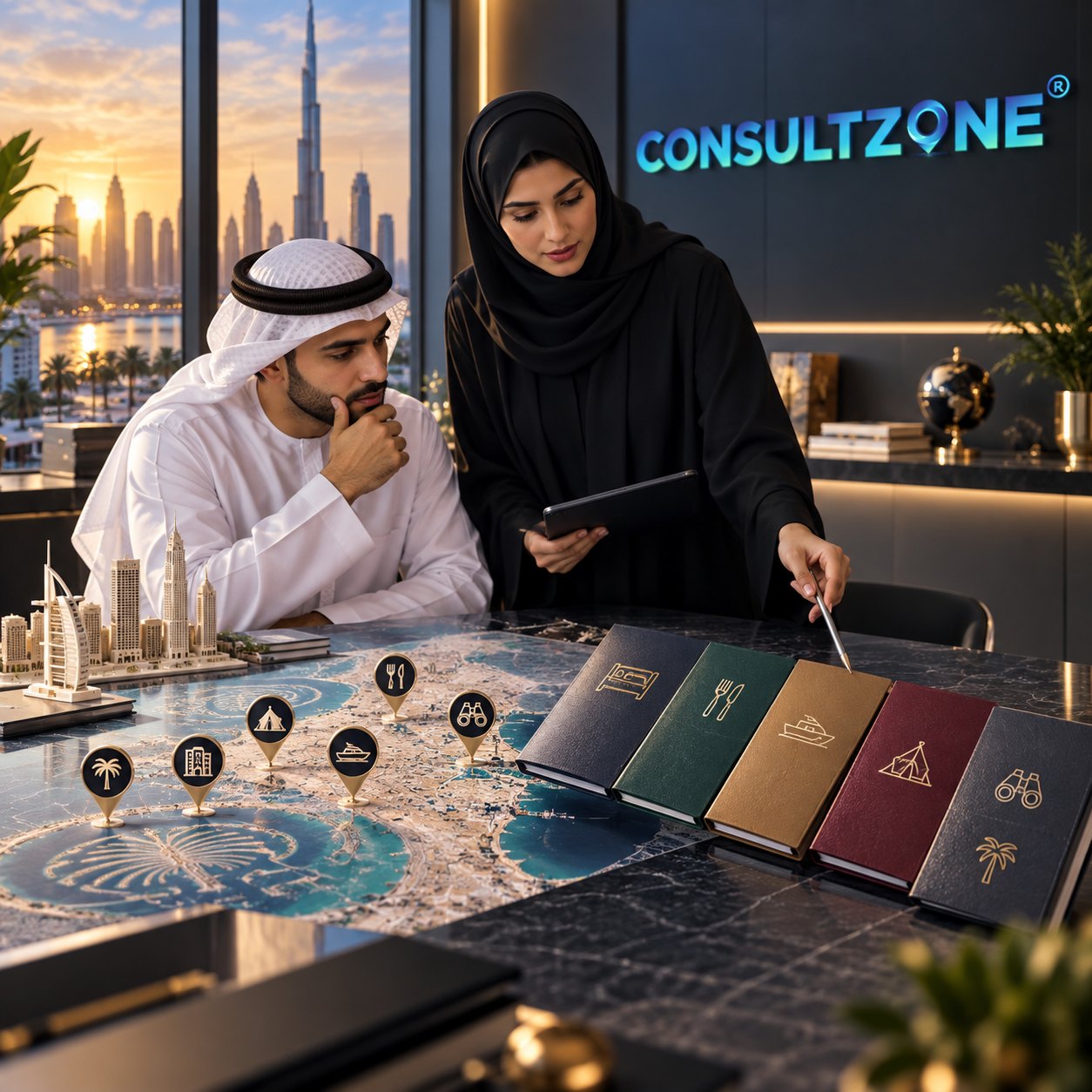
Tourism Is a Sector in the Statistics and Six Different Licences in Practice
Tourism is one of the numbers the UAE quotes about itself, and the number is real. It is also the least useful thing you can know if you are trying to open a business in it, because there is no tourism licence.
A founder who arrives having read that tourism is a major pillar of the non-oil economy has learned something about the country's revenue mix and nothing about which application to file. The sector, at the counter where permissions are actually issued, splits into at least six unrelated activities governed by different authorities with different evidence standards.
This article is about that split, because choosing the wrong one of the six is the most common way a tourism business loses a quarter.
The six things "tourism" turns out to mean
Each row is a different application, a different supervisor, and a different reason to be refused. Two of them — short-term letting and passenger transport — issue permissions against the asset rather than the company, which is a structural difference founders rarely price. You do not get one permit and operate a fleet; you get a permit per vehicle, and the same logic applies to holiday-home units.
The economic department
- The trade licenceFirst, and it only makes you eligible to apply for the rest
The municipality
- Kitchen layout, extraction and storage temperaturesBefore the fit-out is finished, not after
- Staff health clearancesConditions on the premises, not on the company
The emirate's tourism authority
- Tour operation and travelA separate application from the restaurant beside it
The authority that governs the activity
- The operator permission for letting by the nightPer unit, and before the apartment is bought
- Classification of the propertyAfter the lease is signed, when the property may not have it
- Safety sign-offNobody can pre-approve it

Why this catches people
The trade licence is issued by the economic department. Almost every tourism permission is issued by somebody else, afterwards, and it can be refused after the licence is paid for.
That produces the sequence failure this whole site keeps returning to. A founder licenses a "tourism" activity because the word appears on the activity list, signs a lease, and then discovers that the specific thing they intend to do needs a second authority's approval which the premises cannot support, or which requires classification the property does not have.
The licence was never the permission. It was the thing that made you eligible to apply for the permission. Which activities carry a second authority's clearance, and which body owns each one, is set out in the activities a second authority has to approve.
The three that are more restrictive than they look
Short-term letting. Letting by the night is a licensed activity, not a property decision, and what that permission involves is worth reading before an apartment is bought. It requires an operator permission, it is granted per unit, and it changes the property's position — a unit let nightly is not in the same tenancy or tax situation as one on an annual lease. Buying an apartment intending to let it nightly, without checking the permission first, is the most common version of this mistake because the property purchase feels like the decision.
Food. A restaurant is a municipality matter as much as an economic-department one. Kitchen layout, extraction, storage temperatures and staff health clearances are conditions on the premises, not on the company, and a fit-out completed before the food permit is assessed is a fit-out that may need redoing.
Guiding and transport. Moving paying passengers is a transport permission attached to vehicles and drivers. A tour company that owns no vehicles and subcontracts is in a different position from one that operates its own — and the second is a materially heavier licensing project.
| Activity | What the permission attaches to | What is actually assessed | The order that goes wrong |
|---|---|---|---|
| Short-term letting | The unit, not the company | An operator permission, and the unit's tenancy and tax position | Buying the apartment, then checking the permission |
| Food | The premises | Kitchen layout, extraction, storage temperatures, staff health clearances | Completing the fit-out before the food permit is assessed |
| Guiding and transport | Vehicles and drivers | Whether you operate your own fleet or subcontract it | Pricing an owned fleet as the same project as subcontracting |
What the sector statistic is actually good for
Not nothing. Two legitimate uses:
It tells you the market exists. Demand is not the risk in UAE tourism; permission and premises are. A founder can reasonably skip the market-validation step that would dominate a decision in a smaller economy.
It tells you the authorities are staffed and the rules are maintained. A sector that matters to the national accounts gets an authority that answers the phone, publishes its requirements and updates them. That is worth more than it sounds when the alternative is an activity nobody has written rules for.
What it does not tell you is whether your activity is available, at your premises, in your emirate, at the price you were quoted.
What it does tell youWhat it does not tell you
- DemandThe market exists, so the market-validation step can reasonably be skippedNothing about the unit economics of a single venue
- The authoritiesOne that answers the phone, publishes its requirements and updates themNothing about whether your activity is available at your premises
- The rulesThey are maintained, unlike an activity nobody has written rules forReading them is yours to do, and the economic department's are the easy half
Four questions that decide a tourism application
1. Which of the six am I actually doing? If the answer is "two of them", it is two applications and possibly two authorities. Combining them on one licence is where the refusals come from.
2. Is the permission attached to the company, the premises, or the asset? Company-level is simplest. Premises-level constrains your lease. Asset-level means the permission scales with your fleet or your unit count and never stops being an administrative cost.
3. Which authority decides, and have I read their requirements rather than the economic department's? The trade licence requirements are the easy half. The second authority is where the substance is.
4. Does my emirate do it the same way? Tourism permissions are among the most emirate-specific in the country. Advice written for Dubai does not transfer to Sharjah or Ras Al Khaimah, and the tourism authorities are genuinely different institutions with different standards.
Where the tourism sector is the wrong business to enter
- You are attracted by the statistic rather than by the operation. Hospitality and tour operation are low-margin, staff-heavy, permission-heavy businesses. The sector's size is not a signal about the unit economics of a single venue.
- You want a licence and not a premises. Four of the six require physical facilities that are inspected. If your plan depends on operating without premises, most of this sector is closed to you.
- You are buying property and adding letting as an afterthought. That is the order that produces an apartment you cannot legally let nightly. Check the permission before the purchase.
- You need certainty of approval to commit. Classification, safety sign-off and operator permissions are decisions of the authority. Nobody can pre-approve them, and a provider implying otherwise is selling you their optimism.
What to do before you file anything
Write down, in one sentence, the transaction: what the customer pays for and what they receive. Then find which of the six rows that sentence sits in. If it sits in two, you have two projects.
Then read the second authority's own published requirements before the economic department's, because the second authority is the one that can refuse you after you have spent the money.
the one question that decides whether the permission is paid once or permanently
- Write the transaction in one sentenceWhat the customer pays for and what they receive
- Find which of the six rows that sentence sits inIf it sits in two, you have two projects
- Read the deciding authority's requirements before the economic department'sThat authority is the one that can refuse you after the money is spent
- Is the permission attached to the company, the premises or the asset
- Company levelThe simplest of the three
- Premises levelIt constrains your lease, and the premises can fail to support the use
- Asset levelIt scales with your fleet or unit count and never stops being an administrative cost
- Which of the three levels your activity sits atAsk it before the lease is signed or the apartment is bought

The tax and filing side, which the sector statistic also hides
Two things change once a tourism business is actually operating, and neither is a licensing question.
Corporate tax applies to the activity, not to the sector. There is no tourism exemption. A hospitality or tour business sits inside the corporate tax framework on the same basis as any other, and if it is licensed in a free zone the qualifying-income conditions are the ones that decide the treatment — which for a business serving UAE-resident customers is frequently the harder test to meet, because the customers are here.
The cash is the compliance risk. Several of the six activities take payment from the public in volume, in mixed channels, sometimes in cash, often from customers who will never be seen again. That is the transaction profile banks scrutinise most closely and it interacts with the anti-money-laundering obligations that attach to the business. A tour desk or a restaurant with no documented takings reconciliation is not merely untidy at year end; it is a bank-relationship problem in the making.
Neither is a reason to avoid the sector. They are reasons to decide the bookkeeping and the banking at the point of formation rather than at the point of the first return, because the sector's own economics — high volume, thin margin, seasonal — leave very little room to absorb a penalty or a frozen account.
Frequently asked questions
Is there a tourism licence in the UAE?
No. Tourism is a statistical sector rather than a licensable activity. At the counter where permissions are actually issued it splits into at least six unrelated groups — accommodation, short-term letting, food and beverage, tour operation and travel, passenger transport, and events and attractions — each governed by a different authority, with its own evidence standard and its own reason to refuse you. Choosing the wrong one of the six is the most common way a tourism business loses a quarter.
Do I need a separate permission to let an apartment by the night?
Yes. Letting by the night is a licensed activity rather than a property decision. It needs an operator permission, it is granted per unit rather than per company, and it moves the property out of the tenancy and tax position an annual lease sits in. Buying the apartment first and checking the permission afterwards is the usual order, and it is the wrong one, because the permission decides whether the unit can be let at all.
Can one licence cover a restaurant and a tour desk?
Treat those as two projects. Each of the six groups is a separate application with a separate supervisor, and combining two of them under one licence is where the refusals come from. A restaurant is a municipality matter — kitchen layout, extraction, storage temperatures, staff health clearances — as much as an economic-department one, while tour operation answers to the emirate's tourism authority. If your one-sentence description of the transaction sits in two rows, you have two applications.
Is tourism income taxed differently in the UAE?
No. There is no tourism exemption, and corporate tax applies to the activity on the same basis as any other business. Where the company is licensed in a free zone, the qualifying-income conditions decide the treatment, and for a business serving UAE-resident customers that is frequently the harder test to meet, because the customers are here. The sharper operational risk is the cash: high-volume public takings with no documented reconciliation become a bank-relationship problem.
Does advice written for Dubai work in the other emirates?
Not reliably. Tourism permissions are among the most emirate-specific in the country, and the emirates' tourism authorities are genuinely different institutions applying different standards. Guidance drafted for Dubai does not transfer to Sharjah or Ras Al Khaimah. Read the deciding authority's own published requirements for your own emirate before the economic department's, because the second authority is the one that can refuse you after the money has been spent.
Begin with a clear conversation
Tell us what you intend to build.
A consultant will map the structure, jurisdiction, approvals and likely cost against what you actually described — not against a package.
