
Activity CZ 217
How to Start a Building Cleaning Business in Dubai
A cleaning contract is won on price and lost on the hours a cleaner is paid for and not deployed. What the building cleaning line carries, and the work it only carries with an approval behind it.
ConsultZone licensing desk
- Activity code
- CZ 217
- Category
- Cleaning & Facility Management
- Reviewed
- Read
- 7 min
Listen instead
44 seconds
An audio summary of this guide.
Topic summary
How to Start a Building Cleaning Business in Dubai
A contract cleaning company is a payroll with a mop in front of it. Nearly the whole cost base is people — wages, accommodation, transport, visas, consumables and the supervision that keeps a dozen sites honest at once — and the margin is the gap between the hour billed to a client and the fully loaded cost of the cleaner who worked it. That gap is narrow, every competitor in the tender knows roughly what it is, and only one lever moves it: how many of the hours you pay for are hours somebody is paying you for.
So Building Cleaning Services is a business measured on deployment, which is an uncomfortable thing to say about a trade the client judges on a smudged lift mirror. Both are true at the same time. The client notices what was missed. The accounts notice the four cleaners who sat in the accommodation block for a fortnight because one contract ended on a Monday and the next one starts after Eid.
The second structural fact is that there are two businesses inside the line and they fund each other. The recurring contract — daily attendance at an office tower, a mall, a compound, a clinic — is priced low, re-tendered annually and almost never exciting, and it is what pays the payroll between the fifteenth and the end of the month. The project clean is the opposite: a post-handover clean on a newly finished building, a deep clean before a tenant moves in, a one-off after a flood. It commands several times the hourly rate, it arrives without warning, and it cannot be planned around. A company built only on projects has a very good year and then a frightening one. A company built only on contracts survives but never earns anything above the tender price.
Who is this for?
Operators who already hold the labour
The honest best fit. If you already employ a workforce under another licence — a contracting company, a manpower business, a hospitality operator — the hardest and most expensive part of this trade is already built, and the cleaning licence turns a cost centre into something that invoices. Starting from nothing means building accommodation, transport and supervision before the first contract is signed.
Property and owners' association managers taking it in-house
Common, and sound where the portfolio is large enough to keep the crews deployed. The arithmetic to run first is not the saving against the incumbent's price; it is whether your own buildings alone can fill a working week. If they cannot, you have moved an outsourced cost onto your own payroll and kept the idle hours.
Specialist contractors
Façade and high-level cleaning, water tank cleaning, kitchen duct and grease extract cleaning, carpet and upholstery restoration. These are narrow, technical, better paid per hour and far less exposed to the annual price war, because a client who needs a rope access team cannot shop on price alone. They are also the parts of the line that carry a separate approval behind them, which is the subject below.
Where this is the wrong purchase
If what you intend to sell is responsibility for how a building performs — the plant, the lifts, the fire systems, the planned schedule, a single point of accountability across all of it — this is the wrong line and facility management is the right one. Cleaning sits inside that broader service as one of its components. Buying the component when the client wants the whole is the most expensive mistake available on this activity.

CZ 217 — Building Cleaning Services
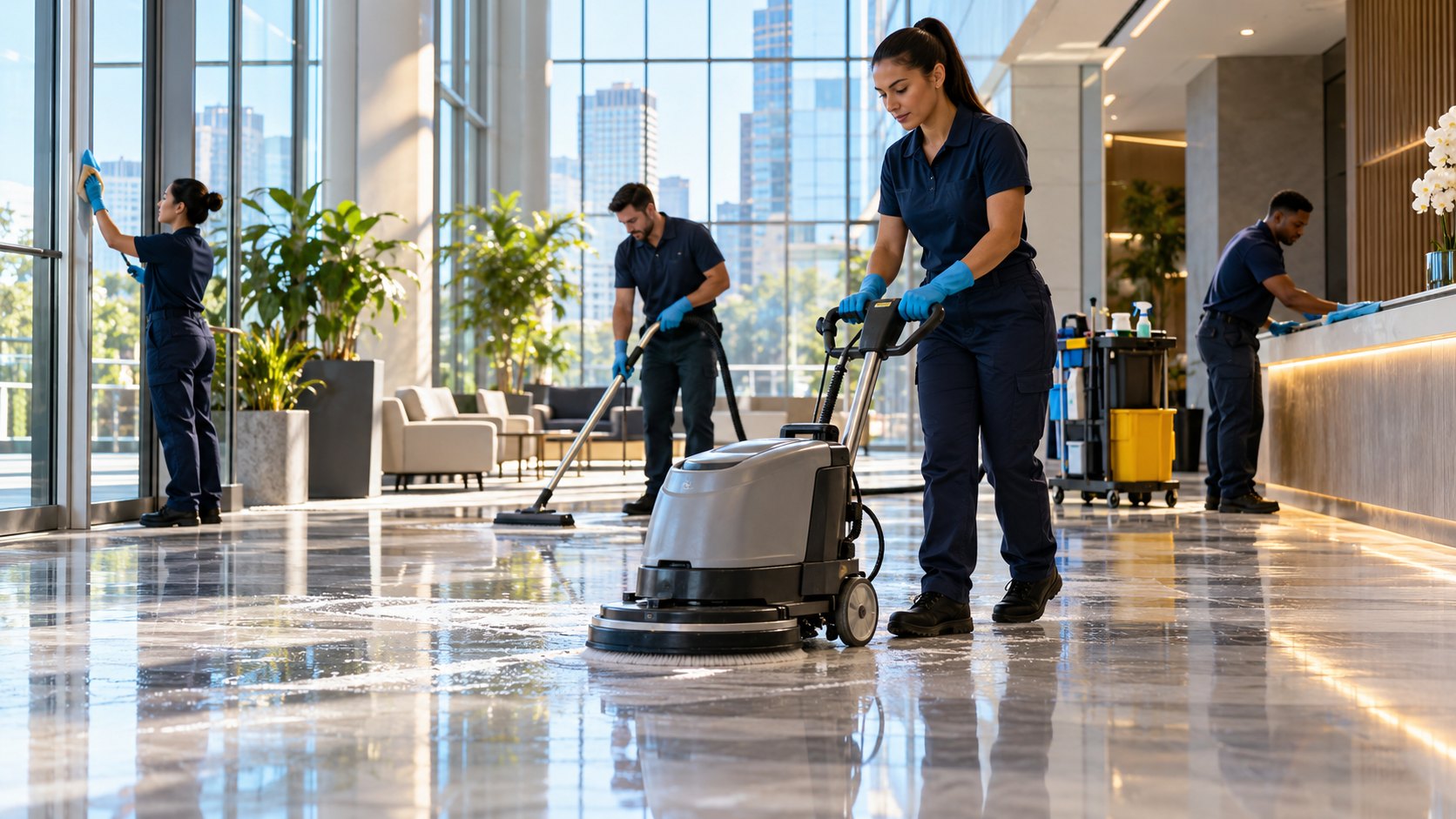
The line covers the cleaning of buildings and the surfaces, fittings and contents inside them: scheduled attendance at offices, retail, residential and common areas, deep and periodic cleaning, post-construction and post-handover cleaning, external surfaces and glazing, floors and carpets, upholstery and soft furnishings, washroom servicing, and disinfection work. In practice the company is a supplier of supervised labour, consumables and method to a site that is not its own.
Not all of that work sits on the licence in the same way, and this is the single most useful thing to understand before quoting. Some of it is the ordinary business the activity was written for. Some of it is still cleaning but is assessed on the method rather than on the cleaning, because of where the operative stands or what the surface touches. And some of it is not cleaning at all in licensing terms, however naturally it follows on site.
six kinds of work, three different answers
- Daily office, retail and residential attendanceThe ordinary contract the line was written for
- Deep, periodic and post-handover cleansProject work, same activity, different pricing
Inside this licence
- Façade and high-level external cleaningWork at height is judged on the access method, not the cleaning
This licence plus a safety approval
- Water tanks, kitchen hoods and grease extractsThe municipality cares what touches drinking water and food
This licence plus a public-health approval
- Pest controlLicensed on its own terms, with its own trained operatives
- Waste carried away from the siteMoving waste is a waste permission, not a cleaning one
A separate activity altogether
The two middle rows are where quotations go wrong. A rope access or cradle job is a working-at-height exercise that happens to end in clean glass, and it is assessed as one; a water tank or a kitchen extract is a public health matter because of what the surface is connected to, and the controls attach to the materials used and the competence of the operative as much as to the company. Those conditions differ by emirate and by authority, and they are confirmed for the specific site rather than assumed from a licence line.
The operational problem the licence cannot help with is supervision at distance. One supervisor covering a dozen buildings across a city cannot see most of what is being done, and the client's judgement is formed in the thirty seconds between the car park and the lift. The companies that keep contracts are the ones that replace presence with a written method per site, a signed attendance record, a fixed consumables list and a named escalation route — none of which the client pays extra for, and all of which decide whether the contract is renewed.
What the licence does not cover
The line ends at cleaning, and nearly every boundary dispute on it starts with a cleaner on site being asked for something reasonable. Changing a tap washer, replacing a lamp, pulling an air-conditioning filter and swapping a door closer are maintenance, and maintenance is a different activity with different competence behind it. Pest control is licensed separately and cannot be absorbed because the chemistry and the operative are the controlled part. Collecting, carrying or disposing of waste away from the premises is a waste activity with its own permission. Landscaping and gardening are their own line. Supplying cleaners to another company to direct and supervise is manpower supply, which is regulated on its own terms and is not what this licence permits.
Selling the chemicals, machines and consumables rather than using them is trading, and a cleaning company that starts invoicing its clients for cases of detergent has quietly begun an activity it does not hold. And holding this licence does not make the company the building's facility manager: that service is a different promise, carrying different liability, and it is the line a reader comparing the two should read next.
What the licence costs to hold, what the premises and staff accommodation conditions are, and which approvals attach to the specialist work all depend on the emirate, the authority issuing the licence and the sites you intend to serve. ConsultZone confirms them against the specific case before anything is committed.
References
- Dubai Municipality — public health conditions on premises, waste handling, and the controls that attach to cleaning water storage tanks and food-preparation extracts. Dubai Municipality
- Dubai Civil Defence — fire safety approvals and the conditions that attach to storing flammable cleaning chemicals on a site. Dubai Civil Defence
- Ministry of Human Resources and Emiratisation — work permits, labour contracts and wage protection, which govern the cost base of a labour-led service. Ministry of Human Resources and Emiratisation
Elsewhere in Cleaning & Facility Management
Activities that sit beside this one
Most licences carry more than one activity. Adding a neighbouring line at the application stage costs a fraction of amending the licence afterwards.
Begin with a clear conversation
Tell us what you intend to build.
A consultant will map the structure, jurisdiction, approvals and likely cost against what you actually described — not against a package.
